

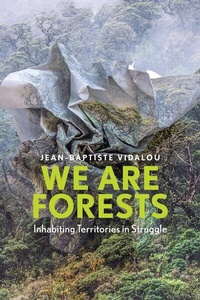
We are Forests
Description

Forests are made up of insurgents. Jean-Baptiste Vidalou went to see some of these forests and meet those who are defending them: he discovered a completely different way of understanding the world, sharply opposed to the mentality of planners who see forests as just one more territory to be managed. Here he recounts this encounter, relays what these forest peoples and struggles convey, not to offer any recipes or ready-made solutions to the crises of our times but to be the forest, like a force that grows, stem by stem, leaf by leaf, slowly becoming ungovernable.
More details
Other editions
Additional editions
Persons
Content
2 A Country Like No Other
3 A Little History of the Map
4 Friction on the Ground
5 Welcome to the Park!
6 A Genealogy of Territorial Planning
7 Devastating Accounting
8 The Physiocrats and the War on the Commons
9 All That Is Solid Must Be Liquidated
10 Total Calculation
11 From Encampment to Logistics
12 Forests Versus Wood-Energy
13 Bringing the Outside In
14 Returning to Forests, Becoming a Secessionist
15 The New Nomos of the Earth
References
Notes
1
WHERE WE LIVE, WE STRUGGLE
Inhabit, populate, start from the situation you are in. Always stand in the power of.
Alain Damasio, Le Dehors de toute chose
This era no longer seems to stand for anything much. It is an era escaping its own disaster in the confines of 'spaceship Earth'. Having invested so much in the religion of Progress, it now finds itself at the whim of a drifting globe, stripped of all meaning, utterly extra-terrestrial. An era that thought it was taking control of the world is now irreparably distanced from it. Until final lift-off. It still claims that technocratic management is its last chance for survival.
Because that is all we do in this era now: manage. We manage ecosystems, we manage populations, we manage bodies, just as we manage an electricity network, a control room, a cockpit. We wanted to build a paradise; now we live in a complete hell. The only road map we have available to us now opens onto a devastated landscape: on the one hand, gigantic construction sites where living things are being destroyed; on the other, biodiversity museumified.
There has never been so much talk about the 'planet', the 'climate', the 'global environment', as at the very moment when we find ourselves locked in the smallest of worlds, the world of engineers. Never has there been so much talk about 'climate diplomacy' as when everything is being judged by calculations and algorithms.
We might as well talk about 'carbon' just in order to plan markets for it. Natural environments such as the verges or hedges in our countryside are becoming infrastructures like anything else, AEIs - 'agro-ecological infrastructures' - with their 'ecosystem services' monitored by satellite.
This stratospheric vision stems from the idea that we live on this globe as if it were a 1:1 map, a surface on which we could flatten out living things and objects in real time. Just as you can scroll through this or that population variable on a screen, with this or that biomass indicator. Always points that are registered, flows that are controlled. Everything that is still heterogeneous, everything that lives on profusely but in shadows, is always too chaotic in the eyes of the 'planetary stewards', and is compelled to integrate into this generalized equivalence, made legible and manageable.
Not surprisingly, Google is working with NASA to compile and transform millions of satellite images accumulated by the Landsat Program over the past four decades. An algorithm constantly analyses the evolution of the new satellite images received and, once seasonal or weather-related variations have been eliminated, it can detect global fluctuations in forest cover in real time. Through Global Forest Watch, Google boasts that it is the first to offer professionals and the general public very high-resolution images of the state of the forest. Of course, an app for smartphones is available. The fact that a company whose aim is to map the entire planet, as well as the entire lives of its inhabitants, is now interested in forests says a lot about how intense this hegemonic control is becoming. The fact that these spaces, these forests, only have meaning once they are measured, measured by the yardstick of their very destruction, is in itself a disaster. Quantifying the unquantifiable! Google tells us that the Earth lost 2.3 million square kilometres of forest between 2000 and 2012, the equivalent of fifty football fields per minute!
It seems that you can judge an era by the way it treats its forests. This one will be judged by the way it measures, pixel by pixel, its own annihilation.
A Sumerian legend, dating from 2700 BCE - probably the first written history of humankind - tells of the journey of the first great 'hero': Gilgamesh. This legendary king of a Sumerian city, obsessed with death and driven by a desire for eternal fame, decides to undertake a journey to the cedar forest. To acquire the glory due to his rank, he has to kill Humbaba, the demon of this sacred forest. Once the sacrilegious murder has taken place, Gilgamesh cuts down the cedar forest and sends the logs back to the city, floating on rivers, like corpses in funeral rites. King Gilgamesh thus destroys another, more ancient law, the law of what is 'outside' the city walls. The law of the forest. Epic narratives aside, Sumerian civilization seems to have been the first to massively deforest, with its uprooting of the famous cedar forest of Lebanon. There was never enough: they had to go further and further north to find resources, until the mountains were all denuded. The story of Gilgamesh perhaps recounts the first ecological catastrophe, the catastrophe that is civilization itself.
Epics were the chronicles of their times; today we don't even have stories to understand ours. We are left gazing at screens to contemplate the disaster. And our eyes weep. The devastation of the world has become an object that we watch from 'above', from our satellites. In any case, we are strangers to it. Cut off from the sensuous world. Moreover, what do we see from so high up, via these satellite data-feeds? Not a forest full of life, that's for sure, nor the profusion of plants, nor the teeming life of the soil. If the epics had 'signs', translating the world into actions, now there are only 'signals' on a touch screen.
But if we come back to Earth, if we break through this screen placed over reality, the forest will give itself to us in a completely different way. If we go into the forest, if we collect or cut wood, if we gather, if we hunt, if we play, if we stroll, if we defend it, if we fight in it, we will grasp it in a different way than in terms of numbers, resources and data. Another relationship to the world can then be built, made up of spaces that are irreducible to each other. A way of standing up straight. No longer bowing one's head. Taking root but also springing forth. Spreading out. Something like a new verticality. This is perhaps first and foremost what a forest is and what we want to defend in it: it is a vertical event. Something that, against the strangeness of the administered world, is finally there. Fully there.
Western civilization has been built, stone by stone, on the ashes of the forests, and there is no absurdity in thinking that the forests are now fighting back, as they have in other moments of intense historical conjunctures. Every day, new shoots are breaking through the concrete slab of our era.
This is not so much about the Forest as it is about the uses and links we have with forests. Better still, it is a question of seeing how we are forests. Forests that are not so much a piece of 'wilderness' as a certain alliance, a special composition of links, of living beings, of magic. Not something spread out, but a growing strength, both in its heart and at its edges. Forests are a sensitive reality, not so much a 'tree-covered space', as its common definition suggests, as a singular way of arranging the world, of imagining it, of becoming attached to it. Perhaps those who live in their neighbourhoods, their fields, their workshops or their woodlands could come to the same conclusions. In any case, it is a question of the forms we give ourselves and the materials we follow, like following wood-grains under the smoothness of the hand. Like this beautiful timber framework which comes from the nearby forest and which our companions went to find with this precise aim in mind, scanning the trees and already seeing there the structures that the new dwelling will enclose. It is also a way to look after themselves, a healing during devastation. And to defend themselves together.
For the past ten years, whether it's in the ZAD [zone to defend] of Tronçay woods in the Morvan, in the woods of Sivens, in Notre-Dame-des-Landes, in the Chambarans forest in Roybon, in Bure or in the Cévennes, it's obvious that something is happening in the forest and other 'low-density spaces', as they say in some sordid office of some sordid boss. Some people have begun to inhabit these spaces, and really intensely.
In fact, they have begun to inhabit them in opposition to the planning that has come down from on high. Against this planned future that would like to see them converted into 'enterprise systems', 'pre-urban zones', 'productive spaces' or pure 'relegation zones'. There is a determination to exit the empty world of the economy, to block the infrastructures of death. A completely different relationship to the territory then takes shape. Another sensibility begins to form. A common sensibility that is built against the militaristic science of territorial management, here opposing a dam, there against a leisure centre, an airport, biomass extraction. But this is not just a local matter: the peasants of Guerrero in Mexico have been fighting for more than fifteen years to free their forests from loggers; the Cree trappers of Canada are defending the boreal forest of the Broadback Valley against deforestation; the Penan of Borneo are building dams and arming themselves with blowpipes against oil palm plantation companies; in the Hambach forest in the Rhineland, resistance is being organized to block open-cut brown coal mining and the destruction of Europe's last old-growth forest; in Greece, near Irisos, people are fighting to...
