

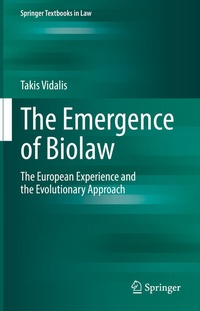
The Emergence of Biolaw
Description

More details
Other editions
Additional editions
Person
Takis Vidalis (1963) received his PhD from the Law School at the University of Athens. In 2001, he was elected a senior researcher and legal advisor to the Hellenic National Bioethics Commission.
Author of 5 books and numerous papers on biolaw, bioethics, medical ethics and law, human rights, philosophy of law, AI ethics and law, and environmental law, he presented original research in more than 100 international and national conferences and workshops.
Takis is the founder of the BioMedLex service (www.biomedlex.gr), specializing in the law of biomedical research and red biotechnology.
Currently, he teaches law and ethics in advanced technologies at the International Hellenic University, the Law School at the University of Athens, the Medical School at the University of Thrace, and the Open University of Cyprus.
President of the Research Ethics Committee of the leading research Institute in Greece "Democritus," Takis is now a member of the European Groupon Ethics in Science and New Technologies (EGE).Content
A General Introduction.- Part I: Persons.- Introduction - The Concept of Biological Autonomy.- Pathology.- Research.- Death.- Data.- Reproduction.- Enhancement.- Self-ownership.- Part II: From Biodiversity To Intelligent Machines.- Introduction: Biodiversity as a Legal Value.- The Conservation of Species.- The Creation of Species.- Life as commodity.- Concluding Remarks.- Future Challenges for Biolaw.- "Animal rights".- Biolaw beyond Biology: Artificial Intelligence and Smart Robots.
