

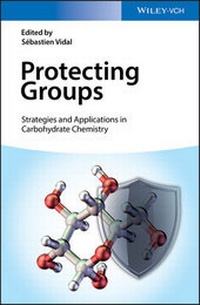
Protecting Groups
Strategies and Applications in Carbohydrate Chemistry
1st Edition
Published on 12. November 2018
XX, 502 pages
978-3-527-69700-7 (ISBN)
Description

A unique overview of the most important protecting group strategies in carbohydrate chemistry
Protecting Groups: Strategies and Applications in Carbohydrate Chemistry provides a detailed account of key strategies and methodologies for the protection of carbohydrates. Divided into two parts, the first focuses on groups that are used best to protect a specific position on a carbohydrate. In the second part, specific carbohydrate residues or compounds are discussed in the context of a specific protecting group strategy used to reach the desired regioisomer. This important book:
-Features chapters on protecting groups at the primary and secondary positions of carbohydrates
-Describes protecting group strategies towards sialic acid derivatives, glycofuranoses, sulfated glycosaminoglycans, and cyclodextrins
-Provides information on automated glycan assembly
-Includes a chapter on the industrial scale synthesis of heparin analogs
Written by a team of leaders in the field, Protecting Groups: Strategies and Applications in Carbohydrate Chemistry is an indispensable guide for academics and industrial researchers interested in carbohydrate and natural product synthesis, pharmaceutical chemistry, and biochemistry.
Protecting Groups: Strategies and Applications in Carbohydrate Chemistry provides a detailed account of key strategies and methodologies for the protection of carbohydrates. Divided into two parts, the first focuses on groups that are used best to protect a specific position on a carbohydrate. In the second part, specific carbohydrate residues or compounds are discussed in the context of a specific protecting group strategy used to reach the desired regioisomer. This important book:
-Features chapters on protecting groups at the primary and secondary positions of carbohydrates
-Describes protecting group strategies towards sialic acid derivatives, glycofuranoses, sulfated glycosaminoglycans, and cyclodextrins
-Provides information on automated glycan assembly
-Includes a chapter on the industrial scale synthesis of heparin analogs
Written by a team of leaders in the field, Protecting Groups: Strategies and Applications in Carbohydrate Chemistry is an indispensable guide for academics and industrial researchers interested in carbohydrate and natural product synthesis, pharmaceutical chemistry, and biochemistry.
Reviews / Votes
?Protecting Groups: Strategies and Applications in Carbohydrate Chemistry draws together several decades of advances in selectively protecting specific positions of carbohydrates and then takes a fresh look at this area from the perspective of synthetic strategies. (?) Throughout the book, the authors present useful examples of reliable experimental methods for introduction and removal of the most important protecting groups. (?) It is therefore highly suitable for newcomers to the field and for experienced glycochemists or glycobiologists who would like to expand their knowledge of this challenging field. In short, this is a book that should occupy the shelves of every practicing and aspiring carbohydrate chemist.?Carolyn R. Bertozzi in Angew. Chem. Int. Ed. 2019, 58, 2
More details
Other editions
Additional editions
Book
01/2019
1st Edition
Wiley-VCH
€165.00
Shipment within 5-7 days
Software
11/2018
Wiley-VCH
€218.00
No shipping information available
Person
Sébastien Vidal, PhD, holds a CNRS position at the University of Lyon, France. His main area of research is the design of glycoclusters for anti-adhesive strategy against bacterial infections and enzyme inhibitors targeting glycogen phosphorylase with applications in type-2 diabetes. In 2014, he was given the young investigator award "Prix du Groupe Français des Glycosciences".
Content
1. Protecting Group Strategies in Carbohydrate Chemistry (A. G. Volbeda, G. A. van der Marel, J. D. C. Codée)
2. Protecting Groups at the Primary Position of Carbohydrates (M. Donnier-Maréchal, S. Vidal, M. Fiore)
3. Protecting Groups at the Secondary Position of Carbohydrates (S. Vidal, P. G. Goekjian)
4. Regioselective Protection at the Secondary Position of Carbohydrates with Acyclic Protecting Groups (P. G. Goekjian, S. Vidal)
5. Protecting Groups at the Anomeric Position of Carbohydrates (C. Sakonsinsiri, W. Bruce Turnbull)
6. N-Protecting Groups for 2-Amino-2-Deoxy-Glycosides (S. Vidal)
7. One-Pot Multi-Step Regioselective Protection of Carbohydrates Catalyzed by Acids (J.-M. Beau, Y. Bourdreux, G. Despras, A. Gouasmat, G. San Jose, D. Urban, B. Vauzeilles)
8. Acyl Migrations in Carbohydrate Chemistry (F. S. Ekholm, R. Leino)
9. De Novo Asymmetric Synthesis of Oligosaccharides Using Atom-Less Protecting Groups (D. Ray, G. A. O'Doherty)
10. Protecting Group Strategies for Sialic Acid Derivatives (H. Amarasekara, S. Buda, A. Reddy Mandhapati, D. Crich)
11. Strategies Towards Protection of 1,2- and 1,3-Diols in Carbohydrate Chemistry (M. Schuler, A. Tatibouët)
12. Protecting Group Strategies Towards Glycofuranoses (V. Ferrières, L. Legentil, L. Lemiègre)
13. Cyclodextrin Chemistry via Selective Protecting Group Manipulations (J. M. Benito, J. M. García Fernández)
14. Protecting Group Strategies Towards Sulfated Glycosaminoglycans (H. Ledru, P. Matton, J.-M. Mallet, C. Lopin-Bon)
15. Applications of Fluorous and Ionic Liquid Tags in Oligosaccharide Synthesis (I. Sittel, M. Carmen Galan)
16. Orthogonally Protected Building Blocks for Automated Glycan Assembly (F. Pfrengle, P. H. Seeberger)
17. Kilogram-Scale Production of Synthetic Heparin Analogs (P. Trouilleux, P. Potier, P.-A. Driguez)
2. Protecting Groups at the Primary Position of Carbohydrates (M. Donnier-Maréchal, S. Vidal, M. Fiore)
3. Protecting Groups at the Secondary Position of Carbohydrates (S. Vidal, P. G. Goekjian)
4. Regioselective Protection at the Secondary Position of Carbohydrates with Acyclic Protecting Groups (P. G. Goekjian, S. Vidal)
5. Protecting Groups at the Anomeric Position of Carbohydrates (C. Sakonsinsiri, W. Bruce Turnbull)
6. N-Protecting Groups for 2-Amino-2-Deoxy-Glycosides (S. Vidal)
7. One-Pot Multi-Step Regioselective Protection of Carbohydrates Catalyzed by Acids (J.-M. Beau, Y. Bourdreux, G. Despras, A. Gouasmat, G. San Jose, D. Urban, B. Vauzeilles)
8. Acyl Migrations in Carbohydrate Chemistry (F. S. Ekholm, R. Leino)
9. De Novo Asymmetric Synthesis of Oligosaccharides Using Atom-Less Protecting Groups (D. Ray, G. A. O'Doherty)
10. Protecting Group Strategies for Sialic Acid Derivatives (H. Amarasekara, S. Buda, A. Reddy Mandhapati, D. Crich)
11. Strategies Towards Protection of 1,2- and 1,3-Diols in Carbohydrate Chemistry (M. Schuler, A. Tatibouët)
12. Protecting Group Strategies Towards Glycofuranoses (V. Ferrières, L. Legentil, L. Lemiègre)
13. Cyclodextrin Chemistry via Selective Protecting Group Manipulations (J. M. Benito, J. M. García Fernández)
14. Protecting Group Strategies Towards Sulfated Glycosaminoglycans (H. Ledru, P. Matton, J.-M. Mallet, C. Lopin-Bon)
15. Applications of Fluorous and Ionic Liquid Tags in Oligosaccharide Synthesis (I. Sittel, M. Carmen Galan)
16. Orthogonally Protected Building Blocks for Automated Glycan Assembly (F. Pfrengle, P. H. Seeberger)
17. Kilogram-Scale Production of Synthetic Heparin Analogs (P. Trouilleux, P. Potier, P.-A. Driguez)
