

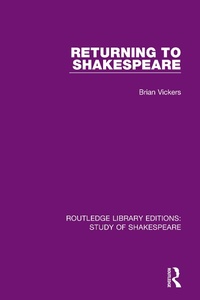
Returning to Shakespeare
1st Edition
Published on 30. March 2021
268 pages
978-1-000-35018-0 (ISBN)
Description

Returning to Shakespeare addresses two broad areas of Shakespeare criticism: the unity of form and meaning, and the history of the plays' reception. Originally published in 1989, the collection represents the best of Brian Vickers' work from the previous fifteen years, in a revised and expanded form.
The first part of the book focuses on the connection between a work's structural or formal properties and our experience of it. A new study of the Sonnets shows how personal relationships are literally embodied in personal pronouns. An essay on Shakespeare's hypocrites (Richard III, Iago, Macbeth) analyses the uncomfortable intimacy established between them and the audience by means of soliloquies and asides. Another traces the interplay between politics and the family in Coriolanus, two forms of pressure which combine to push the hero outside society.
In the second part Professor Vickers examines some key episodes in the history of Shakespeare criticism. One essay reviews the persistence of drastically altered adaptations of Shakespeare on the London stage from the 1690s to the 1830s, due to the conservatism of both theatre managers and audience. Another reconstructs the debate over Hamlet's character in the last quarter of the eighteenth century, in which the Romantic image of a hero lacking control of his faculties emerged for the first time.
This is an important collection by an outstanding Shakespeare critic which will interest specialists and general readers alike.
The first part of the book focuses on the connection between a work's structural or formal properties and our experience of it. A new study of the Sonnets shows how personal relationships are literally embodied in personal pronouns. An essay on Shakespeare's hypocrites (Richard III, Iago, Macbeth) analyses the uncomfortable intimacy established between them and the audience by means of soliloquies and asides. Another traces the interplay between politics and the family in Coriolanus, two forms of pressure which combine to push the hero outside society.
In the second part Professor Vickers examines some key episodes in the history of Shakespeare criticism. One essay reviews the persistence of drastically altered adaptations of Shakespeare on the London stage from the 1690s to the 1830s, due to the conservatism of both theatre managers and audience. Another reconstructs the debate over Hamlet's character in the last quarter of the eighteenth century, in which the Romantic image of a hero lacking control of his faculties emerged for the first time.
This is an important collection by an outstanding Shakespeare critic which will interest specialists and general readers alike.
More details
Series
Edition
1. Auflage
Language
English
Place of publication
London
United Kingdom
Publishing group
Taylor & Francis Ltd
Target group
College/higher education
Professional and scholarly
ISBN-13
978-1-000-35018-0 (9781000350180)
Copyright in bibliographic data and cover images is held by Nielsen Book Services Limited or by the publishers or by their respective licensors: all rights reserved.
Schweitzer Classification
Other editions
Additional editions
Brian Vickers
Returning to Shakespeare
Book
02/2023
1st Edition
Routledge
€53.20
Shipment within 15-20 days
Brian Vickers
Returning to Shakespeare
Book
03/2021
1st Edition
Routledge
€136.18
Shipment within 15-20 days
Person
Brian Vickers
Content
Acknowledgements. Returning to Shakespeare: An Autobiographical Preface. Part 1: Forms and Meanings 1. Rites of Passage in Shakespeare's Prose 2. 'Mutual Render': I and Thou in the Sonnets 3. Shakespeare's Hypocrites 4. Coriolanus and the Demons of Politics Part 2: Shakespeare and His Critics 5. The Emergence of Character Criticism, 1774-1800 6. Shakespearean Adaptations: The Tyranny of the Audience 7. Shakespeare. 'A National Asset' 8. Tribute to a Scholar-Critic. Index.
