

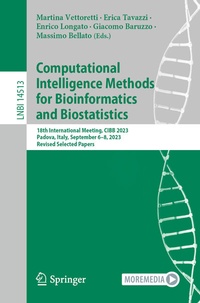
Computational Intelligence Methods for Bioinformatics and Biostatistics
Description

The book constitutes the refereed post-conference proceedings of the 18th International Meeting on Computational Intelligence Methods for Bioinformatics and Biostatistics, CIBB 2023, held in Padova, Italy, during September 6-8, 2023.
The 23 full papers presented in these proceedings were carefully reviewed and selected from 24 submissions. They focuses on topics such as machine learning in healthcare informatics and medical biology; machine learning explainability in medical imaging; prediction uncertainty in machine learning; advanced statistical and computational methodologies for single-cell omics data; present and future research in bioinformatics; distributed computing in bioinformatics and computational biology; and modelling and simulation methods for computational biology and systems medicine.
More details
Other editions
Additional editions
Content
.- A Network Approach to Aquatic Food Web Dynamics.
.- Leveraging Diffuser Data Augmentation to enhance ViT-based performance on Dermatoscopic Melanoma Images Classification.
.- Thyroid Nodule Diagnosis Using a New Supervised Autoencoder Neural net work with multi-categorical medical data.
.- Can smoothing methods recognize the patterns of the hazard function in complex clinical scenarios? A simulation study using discrete-time survival models.
.- Nested Named Entity Recognition in Chinese Electronic Medical Records.
.- Transformers for Interpretable Classification of Histopathological Images.
.- Breast Cancer Malignancy Prediction Through Explainable Models based on a Multimodal Signature of Features.
.- Exploring the Conformational Odorant Space in the Olfactory Re-ceptor Binding Region.
.- Synergy between mechanistic modelling and Ensemble Feature Selection ap proaches to explore multiscale biological Heterogeneity.
.- Homophily of large weighted networks in a data streaming setting.
.- Living along COVID-19: assessing contention policies through Agent-Based Models.
.- Stochastic modeling and dosage optimization of a cancer vaccine exploiting the EpiMod Framework.
.- Extension of the GreatMod modeling framework to simulate non-Markovian processes with general-distributed events.
.- Identifying Damage-Related Features in scRNA-seq Data.
.- A benchmark study of gene fusion prioritization tools.
.- Improving the reliability of tree-based feature importance via consensus signals.
.- Interpretable Machine Learning for Automated Cellular Population Analysis in Flow Cytometry.
.- Pre-trained Models Based on Primary Sequence to Classify Antibody Bind ing to Protein and Non-Protein Targets with 80% Accuracy.
.- Inferring breast cancer subtype associations using an original omics integra tion based on Non-negative Matrix Tri-Factorization.
.- Screening the bioactivity of the P450 enzyme by spiking neural networks.
.- Enhancing functional interpretability in gene expression analysis through biologically-guided feature selection.
.- Extraction of Attributes from Electrodermal Activity Signals Applying Time Series Fuzzy Granulation for Classification of Academic Stress Perception in Different Scenarios.
.- Transfer Learning and AutoML as a Support for the Pneumonia Diagnosis using Chest X-ray scan.
