

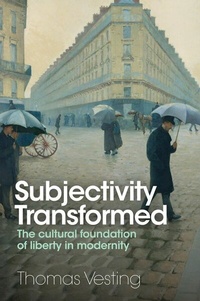
Subjectivity Transformed
Description

This book provides a historically informed reconstruction of the social practices that have shaped the formation of the modern subject from the early modern period to the present. The formal legal protections accorded to subjects are, and always have been, latent in social practices, norms, and language before they are articulated in formal legal orders.
Vesting argues that in Western societies legal personhood is closely tied to three ideal types of social personhood - what he calls the gentleman, the manager, and Homo digitalis. By examining these three ideal types and their emergence in society, we can see that Western formal law does not bring these ideal types into being but, on the contrary, they arise from the social and cultural conditions that they generate and reflect. Correspondingly, Western legal personhood, or "legal subjectivity," arises from the history and culture of Western nations, not the other way around. Therefore, signature features of Western formal law, particularly its valorization of the rights of persons (whether natural or nonnatural), come from the particular sociohistorical cultural developments that had already generated the strong ideas of social personhood inherent in the ideal types of the gentleman, the manager, and Homo digitalis.
Subjectivity Transformed is a major contribution to legal and social theory and, with its original analysis of the formation of modern subjectivity, it will be of interest to students and scholars throughout the social sciences and humanities.
More details
Other editions
Additional editions
Persons
Content
Preface
§ 1 Introduction
§ 2 Instituting Power
§ 3 Culture as an Orientation-Forming Symbol System
I. The Universalist Heritage of Cultural Theory
II. The Dual Character of Modern Culture
III. The Challenge of Information Technology
§ 4 Creative Freedom as a Source of Cultural Dynamics
I. Transsubjective Conditions of Subjectivity
II. Imagination as Poetic Mimesis
III. On the Event Character of the New
§ 5 Bourgeois Culture
I. The Gentleman as a Personality Ideal
II. The Technical Attitude to the World
1. The Early Modern Era as a Foundational Phase of Disruption
2. Fulfillment through Tireless Effort?
III. The Social Body and the Body Politic
IV. Formation of the Subject - In the Mirror of Society
V. Legal Subjectivity and the Practices of Liberty Instituted in Society
VI. The Alien Claim and Disciplining Subjectification
§ 6 The Anglo-American Variant: The Gentleman
I. Experimental Thinking and Useful Knowledge
II. Sociability and Other Virtues
III. The Mirror of Society Becomes Better Endowed
IV. Inclusive Institutions and Instituting Power
§ 7 The Continental Variant: Honnête homme and Bildungsbürger
I. The Sophisticated World of the Paris Salons
II. The German Bildungsroman
III. Subjectification as Subjugation and Empowerment
1. Invocation and Subjugation
2. Empowerment by Means of the State
§ 8 Managerial Culture
I. The Rise of Large-Scale Enterprises
II. The Research and Development Laboratory
III. Trust between Strangers
1. The Legacy of Spontaneous Sociability
2. From the Inner-Directed to the Other-Directed Individual?
IV. Managers in America and Germany
1. The American Manager
2. Senior Executives in Germany
V. Annex: Images of Corporate Bodies
§ 9 The Culture of Information Technology
I. Homo Digitalis and the Theory of the Network Society
II. The Regional High-Tech Cluster
III. The Organization of Economic Production
1. Dissolution of Conventional Corporate Boundaries
2. Collective Learning through Informal Institutions
3. Continuous Experimentation: New Contract Models
IV. On the Environmentalization of Legal Subjectivity
1. Paradigms of the Development of Technology
2. On the Intelligibility of IT Milieus
3. The Ecotechnological Dimension
V. The Relevance of Instituting Power
§ 10 Epilogue
References
Notes
Index
