

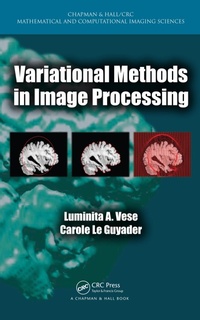
Variational Methods in Image Processing
1st Edition
Published on 18. November 2015
410 pages
978-1-040-06142-8 (ISBN)
Description

Variational Methods in Image Processing presents the principles, techniques, and applications of variational image processing. The text focuses on variational models, their corresponding Euler-Lagrange equations, and numerical implementations for image processing. It balances traditional computational models with more modern techniques that solve the latest challenges introduced by new image acquisition devices.
The book addresses the most important problems in image processing along with other related problems and applications. Each chapter presents the problem, discusses its mathematical formulation as a minimization problem, analyzes its mathematical well-posedness, derives the associated Euler-Lagrange equations, describes the numerical approximations and algorithms, explains several numerical results, and includes a list of exercises. MATLAB (R) codes are available online.
Filled with tables, illustrations, and algorithms, this self-contained textbook is primarily for advanced undergraduate and graduate students in applied mathematics, scientific computing, medical imaging, computer vision, computer science, and engineering. It also offers a detailed overview of the relevant variational models for engineers, professionals from academia, and those in the image processing industry.
The book addresses the most important problems in image processing along with other related problems and applications. Each chapter presents the problem, discusses its mathematical formulation as a minimization problem, analyzes its mathematical well-posedness, derives the associated Euler-Lagrange equations, describes the numerical approximations and algorithms, explains several numerical results, and includes a list of exercises. MATLAB (R) codes are available online.
Filled with tables, illustrations, and algorithms, this self-contained textbook is primarily for advanced undergraduate and graduate students in applied mathematics, scientific computing, medical imaging, computer vision, computer science, and engineering. It also offers a detailed overview of the relevant variational models for engineers, professionals from academia, and those in the image processing industry.
Reviews / Votes
"The book's contents are very well prepared for graduate-level students or advanced undergraduates who work in the field of mathematical image processing and computer vision. The book is also an indispensable resource for engineers and professionals in the image processing industry looking to adopt innovative concepts. Compared to existing textbooks, this one offers a useful view as it covers the fundamentals and many specific applications together in one place, balancing the traditional computational models with the more modern techniques developed to answer new challenges introduced by the new image acquisition devices."-Dr. Jalal Fadili, Ecole Nationale Superieure d'Ingenieurs de Caen
"... very educational ... a useful source of reference and inspiration for advanced undergraduate and graduate students in applied mathematics and/or computer vision as well for academic researchers or engineers from the image processing industry."
-Gilles Aubert, Professor of Mathematics, University of Nice-Sophia Antipolis
"This book will be immensely useful both as a reference and textbook, as it presents the fundamentals of variational methods in image processing. It covers all aspects of variational methods in image processing, with essential applications. Homework problems are also given at the end of each chapter. This book could be used as a textbook for a graduate course on variational methods in image processing. It will also be a reference book to researchers in the field."
-Jean-Francois Aujol, Professor of Mathematics, University of Bordeaux
"This book is a must-have for students and researchers working in mathematical image analysis, in particular on segmentation problems. It covers in a pedagogical way the mathematical foundations, classical convex and non-convex segmentation methods, as well as more advanced subjects such as non-local regularizations. This book also features a lot of graphical illustrations and pseudo-codes of algorithms. It showcases several concrete applications to medical imaging, and the availability of the corresponding MATLAB code is a great feature."
-Gabriel Peyre, CNRS Senior Researcher, Universite Paris-Dauphine
"Written by two world specialists of image segmentation, this book is the most complete account to date of the amazing applications of partial differential equations to image processing. Being provided with code and exercises, I found that it provides an excellent pedagogic introduction to the subject."
-Jean-Michel Morel, Professor, Ecole Normale Superieure de Cachan
More details
Series
Edition
1. Auflage
Language
English
Place of publication
London
United Kingdom
Publishing group
Taylor & Francis Ltd
ISBN-13
978-1-040-06142-8 (9781040061428)
Copyright in bibliographic data and cover images is held by Nielsen Book Services Limited or by the publishers or by their respective licensors: all rights reserved.
Schweitzer Classification
Other editions
Additional editions
Luminita A. Vese | Carole Le Guyader
Variational Methods in Image Processing
Book
12/2015
1st Edition
Chapman & Hall/CRC
€117.50
Article not available at the moment
Persons
Luminita A. Vese is a professor in the Department of Mathematics at UCLA. She is the author or co-author of numerous papers and book chapters on the calculus of variations, PDEs, numerical analysis, image analysis, curve evolution, computer vision, and free boundary problems.
Carole Le Guyader is an associate professor in the mathematical and software engineering department at the National Institute of Applied Sciences of Rouen. She has authored or co-authored many papers on analysis and simulation, digital imaging mathematics and applications, and parallel computing.
Carole Le Guyader is an associate professor in the mathematical and software engineering department at the National Institute of Applied Sciences of Rouen. She has authored or co-authored many papers on analysis and simulation, digital imaging mathematics and applications, and parallel computing.
Content
Introduction and Book Overview. Mathematical Background. IMAGE RESTORATION: Variational Image Restoration Models. Nonlocal Variational Methods in Image Restoration. Image Decomposition into Cartoon and Texture. IMAGE SEGMENTATION AND BOUNDARY DETECTION: The Mumford and Shah Functional for Image Segmentation. Phase-Field Approximations to the Mumford and Shah Problem. Region-Based Variational Active Contours. Edge-Based Variational Snakes and Active Contours. APPLICATIONS: Nonlocal Mumford-Shah and Ambrosio-Tortorelli Variational Models. A Combined Segmentation and Registration Variational Model. Variational Image Registration Models. A Piecewise-Constant Binary Model for Electrical Impedance Tomography. Additive and Multiplicative Piecewise-Smooth Segmentation Models. Numerical Methods for p - harmonic Flows.
