

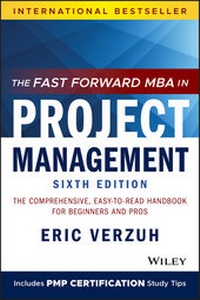
The Fast Forward MBA in Project Management
Description

The Fast Forward MBA in Project Management: The Comprehensive, Easy to Read Handbook for Beginners and Pros, 6th Edition is a comprehensive guide to real-world project management methods, tools, and techniques. Practical, easy-to-use, and deeply thorough, this book gives you the answers you need now. You'll find cutting-edge ideas and hard-won wisdom of one of the field's leading experts, delivered in short, lively segments that address common management issues. Brief descriptions of important concepts, tips on real-world applications, and compact case studies illustrate the most sought-after skills and pitfalls you should watch out for. This sixth edition now includes:
* A brand-new chapter on project quality
* A new chapter on managing media, entertainment, and creative projects
* A new chapter on the project manager's #1 priority: leadership
* A new chapter with the most current practices in Change Management
* Current PMP certification study tips
Readers of The Fast Forward MBA in Project Management also receive access to new video resources available at the author's website.
The book teaches readers how to manage and deliver projects on-time and on-budget by applying the practical strategies and concrete solutions found within. Whether the challenge is finding the right project sponsor, clarifying project objectives, or setting realistic schedules and budget projections, The Fast Forward MBA in Project Management shows you what you need to know, the best way to do it, and what to watch out for along the way.
More details
Other editions
Additional editions
Person
EVerzuh@VersatileCompany.com
Content
About the Author
Preface
Part 1: Introduction
Chapter 1: Project Management: A Platform for Innovation
Chapter 2: Project Leadership: People Before Process
Chapter 3: Foundation Principles of Project Management
Chapter 4: Agile and Waterfall: Choose a Development Process
Part 2: Defining the Project
Chapter 5: Project Initiation: Turn a Problem or Opportunity into a Business Case
Chapter 6: Engage Your Stakeholders and Win Their Cooperation
Chapter 7: Write the Rules: Manage Expectations and Define Success
Part 3: The Planning Process
Chapter 8: Risk Management: Minimize the Threats to Your Project
Chapter 9: A Work Breakdown Structure Makes a Project Manageable
Chapter 10: Realistic Scheduling
Chapter 11: Manage Agile Development with Scrum
Chapter 12: The Art and Science of Accurate Estimating
Chapter 13: Balance the Trade-Off Between Cost, Schedule, and Scope
Chapter 14: Manage Media and Entertainment Projects: Insights from Creative Projects
Part 4: Controlling the Project
Chapter 15: Build a High-Performance Project Team
Chapter 16: Communicate with Project Stakeholders
Chapter 17: Change Management: Engage Your Stakeholders to Maximize Value
Chapter 18: Control Scope to Deliver Value
Chapter 19: Measure Progress
Chapter 20: Solve Common Project Problems
Part 5: Advancing Your Practice of Project Management
Chapter 21: Enterprise Project Management: Align Projects with Strategy
Chapter 22: Requirements: Describe the Solution Target
Chapter 23: Use the Quality Discipline to Hit the Target
Chapter 24: Pass the PMP Exam
Appendix A: The Detailed Planning Model
Appendix B: Forms Available Online
Notes
Index
CHAPTER 1
Project Management: A Platform for Innovation
INTRODUCTION
Projects dominate our headlines.
A pandemic, economic upheaval, and an environmental crisis demand innovative thinking, courageous leadership, and globally orchestrated action. Technological innovation is a relentless engine of growth and destruction.
The need to respond to a global pandemic has forced organizations large and small to react quickly, learn rapidly, and make critical decisions based on shifting circumstances. Every response is a project.
Innovation in energy production has changed assumptions about how cars, buildings, and factories are powered. Installing solar panels and windmills, scientific research, closing out-of-date power plants, and launching electric car companies are all projects.
Projects dominate our workplace.
Our project-driven workforce repairs freeways, releases social media apps, makes films, remodels our houses, and searches for medicines and therapies to protect and heal us. Businesses shift supply chains. Nonprofits open below-market rental housing to ease economic pressures on working families. We are constantly transforming our global civilization in tiny increments. One project at a time.
Innovation, more than ever before, is a must-have capability for every organization. We do not all need to be inventors, scientists, and software developers to innovate. Throughout this book, innovation means bringing a fresh solution to a problem that matters to people. Innovation is always built on projects.
Project management provides critical thinking and communication tools to navigate the ever-increasing avalanche of change that surrounds us.
A TIMELESS LEADERSHIP TOOLSET
Project management is not new. The pyramids and aqueducts of antiquity certainly required the coordination and planning skills of a project manager. While supervising the building of St. Peter's Basilica in Rome, Michelangelo experienced all the torments of a modern-day project manager: incomplete specifications, insufficient labor, unsure funding, and a powerful customer. Michelangelo was the exception in his day. Now, 500 years later, the challenge of leading projects affects every level of every organization.
To understand how deeply our workplace benefits from project management, we must first understand projects. Projects are all the work we do one time. Whether it's designing an aircraft, building a bakery display case, or creating a business logo, every project produces an outcome and every project has a beginning and an end. Fundamental to understanding the importance of projects is realizing that each one produces something unique. Designing and tooling up to build a new electric car is a project (actually a lot of projects), but manufacturing thousands of electric cars is not. Manufacturing and other repetitive processes are defined as ongoing operations.
The challenge of managing operations is to become highly proficient at known tasks. The challenge of managing projects is to lead a disparate group of people to make good decisions, over and over, as they make something new. That's why project management is really a set of critical thinking and communication tools. These tools help us with a range of leadership duties:
- Communicating with team members and stakeholders from project conception through completion.
- Estimating the effort, cost, and time it will take to deliver a project, and evaluating whether the benefits of the project will justify the forecasted costs.
- Rapidly building cohesive project teams that are highly productive even though team members have not worked together before.
- Coordinating the actions of a diverse workforce, assembled specifically for a project, to achieve the goal for the least possible expense and in a reasonable time frame.
- Accounting for progress and productivity to provide accurate forecasts of project completion dates and budget amounts.
- Managing the varying staffing needs that result from continually running multiple projects concurrently, all of which share a common pool of personnel.
Project management, when done well, is a triumph of human cooperation and critical thinking. The tools of project management help people make rational decisions based on objective information. Of course, it is commonplace for experts with good intentions to disagree. That only makes project management all the more valuable and increases the importance of sound decision-making techniques.
In a world filled with challenges and opportunities, the project management toolset helps us navigate uncertainty and turn dreams into realities.
PROJECT MANAGEMENT IS KEEPING PACE WITH GLOBAL CHANGE
Project management is a discipline-a set of methods, theories, and techniques that have evolved to manage the complexities of work that is unique and temporary. Even as the discipline continues to evolve, it can claim a proven track record. Millions of projects around the globe routinely rely on the concepts found in this and other project management books. The Project Management Institute (PMI), headquartered in the United States; the International Project Management Association (IPMA), serving Europe, Asia, and Africa; and other standards organizations have formalized this discipline over the past 60 years.
The proliferation of projects has led to substantial growth in the number of people who call themselves project managers, and project manager is now a common role in nearly every kind of organization. The related phenomenon is the rise of the certified project manager. PMI and IPMA both offer professional certification programs to formally recognize skills, knowledge, or both.
Examples of how project management is spreading to new parts of our global workplace can be found in the profiles at the end of this chapter on two organizations, OrthoSpot and PM4NGOs. The first is a business startup, and the second is a nonprofit that is promoting the use of project management in developing countries by aid agencies. In both cases, these organizations have used the proven project management framework as a starting point, and then adjusted it to meet the needs of their unique audience.
PROJECT MANAGEMENT IS AN ESSENTIAL LEADERSHIP SKILL SET
Given the importance of thriving in a project-driven world, the people who lead projects-who turn visions of what might be into tangible products and services-stand out. But it has been proven that project managers alone can't carry the burden of creating mature organizations whose project management capability produces a strategic advantage. In fact, as the pace of change continues to increase, leaders at every level must be able to speak the language of project management.
- Executives select projects. They also stand behind projects as champions or sponsors, overseeing project progress and providing advice to the project manager and team. Every major project or program has an executive who is ultimately accountable for its success. Executives are also accountable for the project portfolio, the collection of all active projects that have been selected as the best way to achieve the organization's goals.
- Functional managers sponsor, lead, or oversee projects within their departments. They make decisions about project priorities as they assign their staff to project teams.
- Team members who understand project management make the entire project run more smoothly. They make the project manager more effective because they make better estimates, identify risks, and participate in planning and problem-solving.
A related trend is the growth of part-time project leaders. These tend to be senior staff and functional managers tasked with leading smaller or part-time projects. They don't want the project manager title or career path. But they still need to clarify goals, make practical plans, and communicate regularly. These people view project management as one more set of tools that make them effective leaders.
How does project management fit into your personal career goals? In an economy that is pushing each of us to learn and adapt, how much change do you expect in your job over the next decade? If the new normal is continuous transformation, isn't the ability to navigate new territory the most enduring skill?
SUCCESSFUL PROJECTS DELIVER VALUE
Twenty-five years ago, the project management community could agree that a successful project was on time, on budget, and delivered to specification. But times change. Too many projects have "delivered to specification" without actually being valuable to the organization that paid for them. The most common offenders have been expensive information technology (IT) projects that produced reports or systems that didn't make a positive difference to the business, either because the system was rejected by the users or it didn't solve the real problem driving the project. But IT isn't alone. Any project team that focuses only on delivering the specified product or service but loses sight of the context of the project can be guilty of failing to deliver value.
A more current definition of a successful project is one that delivers business value. The implication is that the project manager should understand the business case-why was this project approved? It has also broadened the perception of who is a project stakeholder....
