

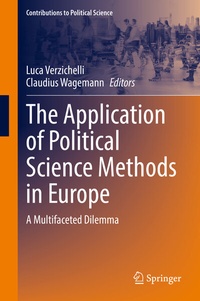
The Application of Political Science Methods in Europe
Description

This book attempts to provide the first comprehensive description of the complexity and comparative homogeneity of political science methods in Europe today. It deals with the present (and future) of political science methods in Europe in order to explore a multifaceted dilemma concerning not only the prospects for the profession, but also political scientists' ability to do their part in empowering supranational integration and democracy. Thus, the book offers a broad analytical reflection on the changing ways that political scientists use "methods" and "methodological tools" in their daily work. It examines the evolution of processes regarding the standardization and dissemination of a reliable methodological inventory and invites readers to foster a methodological pluralism and improve the quality of methods available to the community of political science scholars.
In order to do so, it analyzes the development of European Political Science since the turn of the 21st century from the particular angle of the sensibility for questions of methods. In a nutshell, the common denominator of all chapters is the evolution of the "toolkit" available to political scientists, since they show that the methodological sensibility and specific methodological instruments have since spread across countries, disciplines, and generations of scholars.
More details
Other editions
Additional editions
Persons
Luca Verzichelli is a Professor of Political Science at the University of Siena (Italy).
Claudius Wagemann is a Professor of Political Science Methods at Goethe University in Frankfurt (Germany).
Content
Political Science Methods. Recent Trends in 'Western' Europe.- Political Science Methods. Recent Trends in Central-Eastern Europe.- Nothing Compares To You? Methodological 'Exceptionalism' in French Political Science.- Patterns of Diffusion of Political Science Methods: the Southern European 'Latecomer Countries'.- Methods of Public Policy Research in Europe.- Research Methods in European International Relations Scholarship.- Politics through the Microscope: The Use of Experiments in European Political Science.- Qualitative Comparative Analysis (QCA). Chances and Challenges When Establishing an Innovation.- What is Big Data?.- Gender-Biased Gaps and Differences in Methodological Approaches of Western European Political Scientists.- Expanding Methodological Quality to Qualitative Research.- Conclusion: An Agenda for Political Science Methods in Europe.
