

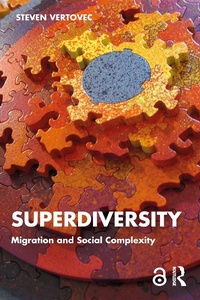
Superdiversity
Migration and Social Complexity
Published on 15. November 2022
250 pages
978-1-135-04943-0 (ISBN)
Description

Superdiversity explores processes of diversification and the complex, emergent social configurations that now supersede prior forms of diversity in societies around the world. Migration plays a key role in these processes, bringing changes not just in social, cultural, religious, and linguistic phenomena, but also in the ways that these phenomena combine with others like gender, age, and legal status.
The concept of superdiversity has been adopted by scholars across the social sciences in order to address a variety of forms, modes, and outcomes of diversification. Central to this field is the relationship between social categorization and social organization, including stratification and inequality. Increasingly complex categories of social "difference" have significant impacts across scales, from entire societies to individual identities. While diversification is often met with simplifying stereotypes, threat narratives, and expressions of antagonism, superdiversity encourages a perspective on difference as comprising multiple social processes, flexible collective meanings, and overlapping personal and group identities. A superdiversity approach encourages the re-evaluation and recognition of social categories as multidimensional, unfixed, and porous as opposed to views based on hardened, one-dimensional thinking about groups. Diversification and increasing social complexity are bound to continue, if not intensify, in light of climate change. This will have profound impacts on the nature of global migration, social relations, and inequalities.
Superdiversity presents a convincing case for recognizing new social formations created by changing migration patterns and calls for a re-thinking of public policy and social scientific approaches to social difference. This introduction to the multidisciplinary concept of superdiversity will be of considerable interest to students and researchers in a range of fields in the humanities and social sciences.
The Open Access version of this book, available at www.taylorfrancis.com, has been made available under a Creative Commons Attribution-Non Commercial-No Derivatives 4.0 license.
The concept of superdiversity has been adopted by scholars across the social sciences in order to address a variety of forms, modes, and outcomes of diversification. Central to this field is the relationship between social categorization and social organization, including stratification and inequality. Increasingly complex categories of social "difference" have significant impacts across scales, from entire societies to individual identities. While diversification is often met with simplifying stereotypes, threat narratives, and expressions of antagonism, superdiversity encourages a perspective on difference as comprising multiple social processes, flexible collective meanings, and overlapping personal and group identities. A superdiversity approach encourages the re-evaluation and recognition of social categories as multidimensional, unfixed, and porous as opposed to views based on hardened, one-dimensional thinking about groups. Diversification and increasing social complexity are bound to continue, if not intensify, in light of climate change. This will have profound impacts on the nature of global migration, social relations, and inequalities.
Superdiversity presents a convincing case for recognizing new social formations created by changing migration patterns and calls for a re-thinking of public policy and social scientific approaches to social difference. This introduction to the multidisciplinary concept of superdiversity will be of considerable interest to students and researchers in a range of fields in the humanities and social sciences.
The Open Access version of this book, available at www.taylorfrancis.com, has been made available under a Creative Commons Attribution-Non Commercial-No Derivatives 4.0 license.
Reviews / Votes
'In Superdiversity, Steven Vertovec provides a tour de force elucidation of the concept he introduced in 2007, explaining that superdiversity entails much more than rising ethnic heterogeneity tied to immigration, but is instead rooted in a deeper complexification of human society wherein social categories are reconfigured to be multiple, flexible, and porous rather than static and fixed, yielding increasingly complex identities that social scientists and policy makers must recognize and accept.'Douglas S. Massey, Henry G. Bryant Professor of Sociology and Public Affairs, Princeton University, USA
'Steven Vertovec's concept of "superdiversity" is widely used across the social sciences for understanding social change. In this ambitious and most informative new book, the author specifies and updates his theory; responds to his critics; creates bridges with the interdisciplinary literatures on categorization, identity, and boundaries; and analyzes all we know about the responses and backlash to diversification. For all these reasons, this book is sure to be a "must read" for anyone interested in immigration, diversity, cosmopolitanism, racism, inequality, and related topics. I recommend it with much enthusiasm.'
Michele Lamont, Robert I. Goldman Professor of European Studies and Professor of Sociology and African American Studies, Harvard University, USA
'A masterly account that takes us from the development of the superdiversity concept and its use in the social sciences to public responses to diversification. Vertovec's well-written and insightful book is a must read for students and scholars who hope to understand changes in the nature of diversity in today's world.'
Nancy Foner, Distinguished Professor of Sociology, Hunter College and Graduate Center, City University of New York, USA
'Superdiversity is now a key concept in research on cultural complexity. In this excellent, eagerly anticipated book, its originator explains and explores the implications of the current 'diversification of diversity', showing why diversity cannot be reduced to simple categories. It deserves to be read by everyone trying to make sense of the complex social realities of the contemporary world.'
Thomas Hylland Eriksen, Professor of Social Anthropology, University of Oslo, Norway
More details
Series
Language
English
Place of publication
London
United Kingdom
Publishing group
Taylor & Francis Ltd
Target group
College/higher education
Illustrations
4 Tables, black and white; 4 Line drawings, black and white; 4 Illustrations, black and white
File size
14,34 MB
ISBN-13
978-1-135-04943-0 (9781135049430)
Copyright in bibliographic data and cover images is held by Nielsen Book Services Limited or by the publishers or by their respective licensors: all rights reserved.
Schweitzer Classification
Other editions
Additional editions
Book
11/2022
1st Edition
Routledge
€186.20
Shipment within 15-20 days
Book
11/2022
1st Edition
Routledge
€60.30
Shipment within 15-20 days
Person
Steven Vertovec is Founding Director at the Max Planck Institute for the Study of Religious and Ethnic Diversity, Goettingen, Germany. Previously, he was Professor of Transnational Anthropology at the University of Oxford, and Director of the British Economic and Social Research Council's Centre on Migration, Policy and Society (COMPAS). He is the author of Transnationalism (Routledge, 2009), The Hindu Diaspora: Comparative Patterns (Routledge, 2000), and Hindu Trinidad: Religion, Ethnicity and Socio-economic Change (Palgrave, 1992) and co-author of Diversity and Contact: Immigration and Social Interaction in German Cities (Palgrave, 2016). He is also editor/co-editor of numerous volumes, including Conceiving Cosmopolitanism (Oxford University Press, 2003), The Multiculturalism Backlash (Routledge, 2010), Routledge International Handbook of Diversity Studies (Routledge, 2015), Diversities Old and New (Palgrave, 2015), and The Oxford Handbook of Superdiversity (Oxford University Press, 2022).
Content
1 Introduction 2 Super-Diversity and its Implications (2007) 3 The Many Meanings of Superdiversity 4 Diversifications 5 Responses to Diversification 6 Social Complexity 7 Conclusion
