

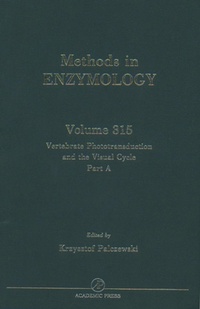
Vertebrate Phototransduction and the Visual Cycle, Part A
Vertebrae Phototransduction and the Visual Cycle : Part A
Academic Press
Published on 1. March 2000
959 pages
978-0-08-049672-6 (ISBN)
Description

This volume, and its companion Volume 316, include newly developed methods to study vertebrate phototransduction and the visual cycle. Major topics covered include expression, isolation, and characterization of opsins; proteins that interact with rhodopsin; transducin and regulators of G-protein signaling; photoreceptor protein phosphatases, phosphodiesterase, and guanylylcyclase; cyclis nucleolide gated channels; Na+/Ca2+-K+ exchanges and ABCR transporter.The critically acclaimed laboratory standard for more than forty years, Methods in Enzymology is one of the most highly respected publications in the field of biochemistry. Since 1955, each volume has been eagerly awaited, frequently consulted, and praised by researchers and reviewers alike. Now with more than 300 volumes (all of them still in print), the series contains much material still relevant today--truly an essential publication for researchers in all fields of life sciences.
More details
Other editions
Additional editions
Krzysztof Palczewski
Vertebrate Phototransduction and the Visual Cycle, Part A: Volume 315
Book
03/2000
Academic Press
€167.13
Withdrawn from sale
Persons
Content
- Front Cover
- Vertebrate Phototransduction and the Visual Cycle
- Copyright Page
- Table of Contents
- Contributors to Volume 315
- Preface
- Volumes in Series
- Section I: Expression and Isolation of Opsins
- Chapter 1. Heterologous Expression of Bovine Opsin in Pichia pastoris
- Chapter 2. Baculovirus Expression System for Expression and Characterization of Functional Recombinant Visual Pigments
- Chapter 3. Development of Stable Cell Lines Expressing High Levels of Point Mutants of Human Opsin for Biochemical and Biophysical Studies
- Chapter 4. Folding and Assembly of Rhodopsin from Expressed Fragments
- Chapter 5. Isolation of Isoelectric Species of Phosphorylated Rhodopsin
- Chapter 6. Rhodopsin Trafficking in Photoreceptors Using Retinal Cell-Free System
- Section II: Characterization of Opsins
- Chapter 7. Preparation and Analysis of Two-Dimensional Crystals of Rhodopsin
- Chapter 8. Domain Approach to Three-Dimensional Structure of Rhodopsin Using High Resolution Nuclear Magnetic Resonance
- Chapter 9. Analysis of Functional Microdomains in Rhodopsin
- Chapter 10. Mapping Tertiary Contacts between Amino Acid Residues within Rhodopsin
- Chapter 11. Energetics of Rhodopsin Photobleaching: Photocalorimetric Studies of Energy Storage in Early and Late Intermediates
- Chapter 12. Absorption Spectroscopy in Studies of Visual Pigments. Spectral and Kinetic Characterization of Intermediates
- Chapter 13. Structural Determinants of Active State Conformation of Rhodopsin. Molecular Biophysics Approaches
- Chapter 14. pKa of Protonated Schiff Base of Visual Pigments
- Chapter 15. Assays for Detection of Constitutively Active Opsins
- Chapter 16. Synthetic Retinals: Convenient Probes of Rhodopsin and Visual Transduction Process
- Chapter 17. Assays for Activation of Opsin by all-trans-Retinal
- Chapter 18. Assays for Activation of Recombinant Expressed Opsin by all-trans-Retinal
- Chapter 19. Electrical Approach to Study Rhodopsin Activation in Single Cells with Early Receptor Current Assay
- Chapter 20. Analysis of Amino Acid Residues in Rhodopsin and Cone Visual Pigments That Determine Their Molecular Properties
- Chapter 21. Phylogenetic Analysis and Experimental Approaches to Study Color Vision in Vertebrates
- Section III: Proteins That Interact with Rhodopsin
- Chapter 22. Light Scattering Methods to Monitor Interaction between Rhodopsin-Containing Membranes and Soluble Proteins
- Chapter 23. Heterogeneity of Rhodopsin Intermediate State Interacting with Transducin
- Chapter 24. Limited Proteolytic Digestion Studies of G Protein Receptor Interaction
- Chapter 25. Monitoring Proton Uptake from Aqueous Phase during Rhodopsin Activation
- Chapter 26. Use of Peptides-on-Plasmids Combinatorial Library to Identify High Affinity Peptides That Bind Rhodopsin
- Chapter 27. Purifiation of Rhodopsin Kinase by Recoverin Affinity Chromatography
- Chapter 28. Heterologous Expression and Reconstitution of Rhodopsin with Rhodopsin Kinase and Arrestin
- Chapter 29. Arrestin: Mutagenesis, Expression, Purification, and Functional Characterization
- Chapter 30. Mapping Interaction Sites between Rhodopsin and Arrestin by Phage Display and Synthetic Peptides
- Chapter 31. Characterization of RanBP2-Associated Molecular Components in Neuroretina
- Section IV: Transducin and Regulators of G-Protein Signaling
- Chapter 32. Intrinsic Biophysical Monitors of Transducin Activation. Fluorescence, UV/Visible Spectroscopy, Light Scattering, and Evanescent Field Techniques
- Chapter 33. Fluorescent Probes as Indicators of Conformation Changes in Transducin on Activation
- Chapter 34. Gat/Gai1 Chimeras Used to Define Structural Basis of Specific Functions of Gat
- Chapter 35. Enzymology of GTPase Acceleration in Phototransduction
- Chapter 36. Mutational Analysis of Effectors and Regulators of G-Protein Signaling Interfaces of Transducin
- Section V: Photoreceptor Protein Phosphatases
- Chapter 37. Isolation and Properties of Protein Phosphatase 2A in Photoreceptors
- Chapter 38. Purifiation and Characterization of Protein Phos- phate Type 2C in Photoreceptors
- Chapter 39. Photoreceptor Serine/Threonine Protein Phosphatase Type 7: Cloning, Expression, and Functional Analysis
- Section VI: Photoreceptor Phosphodiesterase and Guanylyl Cyclase
- Chapter 40. Purification and Assay of Bovine Type 6 Photoreceptor Phosphodiesterase and Its Subunits
- Chapter 41. Transcriptional Regulation of cGMP Phosphodiesterase B-Subunit Gene
- Chapter 42. Inhibition of Photoreceptor cGMP Phosphodiesterase by Its y Subunit
- Chapter 43. Kinetics and Regulation of cGMP Binding to Non- catalytic Binding Sites on Photoreceptor Phosphodiesterase
- Chapter 44. Purifiation and Autophosphorylation of Retinal Guanylate Cyclase
- Chapter 45. Use of Nucleotide a-Phosphorothioates in Studies of Photoreceptor Guanylyl Cyclase: Purification of Guanylyl Cyclase Activating Proteins
- Chapter 46. Heterologous Expression and Assays for Photoreceptor Guanylyl Cyclases and Guanylyl Cyclase Activating Proteins
- Chapter 47. Spectrophotometric Determination of Retinal Rod Guanylyl Cyclase
- Chapter 48. Calcium-Dependent Activation of Membrane Guanylate Cyclase by S100 Proteins
- Chapter 49. Characterization of Guanylyl Cyclase and Phosphodiesterase Activities in Single Rod Outer Segments
- Section VII: Cyclic Nucleotide-Gated Channels
- Chapter 50. Covalent Tethering of Ligands to Retinal Rod Cyclic Nucleotide-Gated Channels: Binding Site Structure and Allosteric Mechanism
- Chapter 51. Using State-Specific Modifiers to Study Rod cGMP- Activated Ion Channels Expressed in Xenopus Oocytes
- Chapter 52. Identification and Characterization of Calmodulin Binding Sites in cGMP-Gated Channel Using Surface Plasmon Resonance Spectroscopy
- Chapter 53. Determination of Fractional Calcium Ion Current in Cyclic Nucleotide-Gated Channels
- Chapter 54. Modulation of Rod cGMP-Gated Cation Channel by Calmodulin
- Section VIII: Na+ /Ca2+ -K+ Exchanger and ABCR Transporter
- Chapter 55. Purification and Biochemical Analysis of cGMP- Gated Channel and Na+ /Ca2+ -K+ Exchanger of Rod Photoreceptors
- Chapter 56. Spectrofiuorometric Detection of Na+ /Ca2+ -K+ Exchange
- Chapter 57. Purification and Characterization of ABCR from Bovine Rod Outer Segments
- Chapter 58. ABCR: Rod Photoreceptor-Specific ABC Transporter Responsible for Stargardt Disease
- Author Index
- Subject Index
