

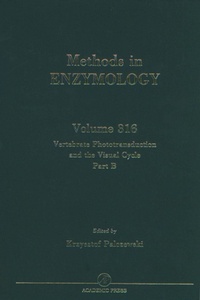
Vertebrae Phototransduction and the Visual Cycle, Part B
Vertebrae Phototransduction and the Visual Cycle : Part B
Academic Press
Published on 19. April 2000
849 pages
978-0-08-049673-3 (ISBN)
Description

Major topics covered include photoreceptor proteins, phototransduction calcium-binding proteins and calcium measurement in photoreceptor cells, enzymes of the visual cycle, posttranslational and chemical modifications, analysis of animal models of retinal diseases. Inherited retinal disease; from the defective gene to its function and repair. This volume and its companion Volume 315 include newly developed methods to study vertebrate phototransduction and the visual cycle.The critically acclaimed laboratory standard for more than forty years, Methods in Enzymology is one of the most highly respected publications in the field of biochemistry. Since 1955, each volume has been eagerly awaited, frequently consulted, and praised by researchers and reviewers alike. Now with more than 300 volumes (all of them still in print), the series contains much material still relevant today--truly an essential publication for researchers in all fields of life sciences.
More details
Other editions
Additional editions
Krzysztof Palczewski
Vertebrae Phototransduction and the Visual Cycle, Part B: Volume 316
Book
04/2000
Academic Press
€167.13
Withdrawn from sale
Persons
Content
- Front Cover
- Vertebrate Phototransduction and the Visual Cycle
- Copyright Page
- Table of Contents
- Contributors to Volume 316
- Preface
- Volumes in Series
- Section I: Photoreceptor Proteins
- Chapter 1. Inhibition of Rhodopsin Phosphorylation by S- Modulins: Purification, Reconstitution, and Assays
- Chapter 2. Analysis of Protein-Protein Interactions in Phototransduction Cascade Using Surface Plasmon Resonance
- Chapter 3. Expression of Phototransduction Proteins in Xenopus Oocytes
- Chapter 4. Xenopus Rod Photoreceptor: Model for Expression of Retinal Genes
- Chapter 5. Fusion between Retinal Rod Outer Segment Membranes and Model Membranes: Functional Assays and Role for Peripherin/rds
- Chapter 6. Bovine Retinal Nucleoside Diphosphate Kinase: Biochemistry and Molecular Cloning
- Section II: Calcium-Binding Proteins and Calcium Measurements in Photoreceptor Cells
- Chapter 7. Calcium-Binding Proteins and Their Assessment in Ocular Diseases
- Chapter 8. Molecular Structure of Membrane-Targeting Calcium Sensors in Vision: Recoverin and Guanylate Cyclase-Activating Protein 2
- Chapter 9. Measurement of Light-Evoked Changes in Cytoplasmic Calcium in Functionally Intact Isolated Rod Outer Segments
- Chapter 10. Laser Spot Confocal Technique to Measure Cytoplasmic Calcium Concentration in Photoreceptors
- Section III: Phototransduction
- Chapter 11. Functional Study of Rhodopsin Phosphorylation in Vivo
- Chapter 12. Mechanisms of Single-Photon Detection in Rod Photoreceptors
- Chapter 13. Electroretinographic Determination of Human Rod Flash Response in Vivo
- Chapter 14. Electrophysiological Methods for Measurement of Activation of Phototransduction by Bleached Visual Pigment in Salamander Photoreceptors
- Chapter 15. Exploring Kinetics of Visual Transduction with Time-Resolved Microcalorimetry
- Chapter 16. Use of a-Toxin-Permeabilized Photoreceptors in in Vitro Phototransduction Studies
- Chapter 17. Photoreceptors in Pineal Gland and Brain: Cloning, Localization, and Overexpression
- Chapter 18. Cultured Amphibian Melanophores: A Model System to Study Melanopsin Photobiology
- Section IV: Enzymes of the Visual Cycle
- Chapter 19. High-Performance Liquid Chromatography Analysis of Visual Cycle Retinoids
- Chapter 20. Quantitative Measurements of Isomerohydrolase Activity
- Chapter 21. Multienzyme Analysis of Visual Cycle
- Chapter 22. Analyzing Membrane Topology of 11-cis-Retinol Dehydrogenase
- Chapter 23. Phase Partition and High-Performance Liquid Chromatography Assays of Retinoid Dehydrogenases
- Chapter 24. Short-Chain Dehydrogenases/Reductases in Retina
- Chapter 25. Substrate Specificities of Retinyl Ester Hydrolases in Retinal Pigment Epithelium
- Chapter 26. Molecular Characterization of Lecithin-Retinol Acyltransferase
- Chapter 27. Analysis of Chromophore of RGR: Retinal G-Protein-Coupled Receptor from Pigment Epithelium
- Section V: Posttranslational and Chemical Modifications
- Chapter 28. Low Temperature Photoaffinity Labeling of Rhodopsin and Intermediates along Transduction Path
- Chapter 29. Structural Analysis of Protein Prenyl Groups and Associated C-Terminal Modifications
- Chapter 30. Isoprenylation/Methylation and Transducin Function
- Chapter 31. Functional Analysis of Farnesylation and Methylation of Transducin
- Chapter 32. Identification of Phosphorylation Sites within Vertebrate and Invertebrate Rhodopsin
- Chapter 33. Ocular Proteomics: Cataloging Photoreceptor Proteins by Two-Dimensional Gel Electrophoresis and Mass Spectrometry
- Section VI: Analysis of Animal Models of Retinal Diseases
- Chapter 34. Animal Models for Inherited Retinal Diseases
- Chapter 35. Avian Models of Inherited Retinal Disease
- Chapter 36. Biochemical Analysis of Phototransduction and Visual Cycle in Zebrafish Larvae
- Chapter 37. Genetic Models to Study Guanylyl Cyclase Function
- Chapter 38. Analysis of Visual Cycle in Normal and Transgenic Mice
- Section VII: Inherited Retinal Disease: From the Defective Gene to Its Function and Repair
- Chapter 39. In Situ Hybridization Studies of Retinal Neurons
- Chapter 40. Cloning and Characterization of Retinal Transcription Factors, Using Target Site-Based Methodology
- Chapter 41. In Vivo Assessment of Photoreceptor Function in Human Diseases Caused by Photoreceptor-Specific Gene Mutations
- Chapter 42. Spectral Sensitivities of Human Cone Visual Pigments Determined in Vivo and in Vitro
- Chapter 43. Molecular Analysis of Human Red/Green Visual Pigment Gene Locus: Relationship to Color Vision
- Chapter 44. Expression and Characterization of Peripherin/rds rom-1 Complexes and Mutants Implicated in Retinal Degenerative Diseases
- Chapter 45. Isolation of Retinal Proteins That Interact with Retinitis Pigmentosa GTPase Regulator by Interaction Trap Screen in Yeast
- Chapter 46. Genetic Analysis of RPE65: From Human Disease to Mouse Model
- Chapter 47. Construction of Encapsidated Gutted Adenovirus Minichromosomes and Their Application to Rescue of Photoreceptor Degeneration
- Chapter 48. Production and Purification of Recombinant Adeno-Associated Virus
- Chapter 49. Ribozymes in Treatment of Inherited Retinal Disease
- Chapter 50. Cross-Species Comparison of in Vivo Reporter Gene Expression after Recombinant Adeno-Associated Virus-Mediated Retinal Transduction
- Author Index
- Subject Index
