
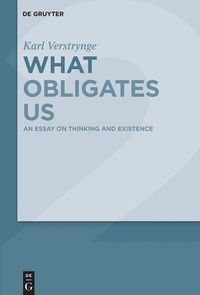
An Essay on Thinking and Existence
Description
Alles über E-Books | Antworten auf Fragen rund um E-Books, Kopierschutz und Dateiformate finden Sie in unserem Info- & Hilfebereich.
What do we humans claim when we define ourselves as thinking beings? What do we mean when we claim to know something? What can we know at all? How autonomous is our thinking? When can we claim something to be true? How certain and truthful are the insights provided by the natural sciences? To what are we committed for all our knowing? Such and other questions are being addressed from the perspective and the tradition of existential thought.
The trilogy What Obligates Us raises the question about the ethical foundation of the human condition. This second part has human thinking as its specific scope. Like no others, existential philosophers have questioned the power and impotence of science, as they have addressed the many beliefs and certainties that humans appropriated for themselves. Central insights from the works of Kierkegaard, Heidegger, Wittgenstein and Gadamer inspire the book's quest for the particular nature of being human and our claims to be able to know anything at all. Beyond its specific questions, the work also lends itself to being read as an introduction into existential philosophy or into philosophy as such.
More details
Other editions
Additional editions

Person
Karl Verstrynge , Vrije Universiteit Brussel, Belgium.
System requirements
File format: PDF
Copy protection: Watermark-DRM (Digital Rights Management)
System requirements:
- Computer (Windows; MacOS X; Linux): Use the free software Adobe Reader, Adobe Digital Editions, or any other PDF viewer of your choice (see eBook Help).
- Tablet/Smartphone (Android; iOS): Install the free app Adobe Digital Editions or another reading app for eBooks, e.g., PocketBook (see eBook Help).
- E-reader: Bookeen, Kobo, Pocketbook, Sony, Tolino and many more (only limited: Kindle).
The file format PDF always displays a book page identically on any hardware. This makes PDF suitable for complex layouts such as those used in textbooks and reference books (images, tables, columns, footnotes). Unfortunately, on the small screens of e-readers or smartphones, PDFs are rather annoying, requiring too much scrolling.
This eBook uses Watermark-DRM, a „soft” copy protection. This means that there are no technical restrictions to prevent illegal distribution. However, there is a personalised watermark embedded in the eBook that can be used to identify the purchaser of the eBook in the event of misuse and to provide evidence for legal purposes.
For more information, see our eBook Help page.