

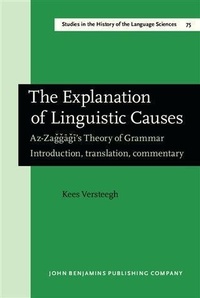
The Explanation of Linguistic Causes
Az-Zaggagi's Theory of Grammar. Introduction, translation, commentary
1st Edition
Published on 11. May 1995
XVI, 310 pages
978-90-272-7638-4 (ISBN)
Description

The ultimate aim of every linguistic tradition is to go beyond the purely descriptive level and seek an explanation for linguistic phenomena. Traditions differ, however, with regard to the class of linguistic phenomena they wish to explain and the framework in which they define their explanation. In this volume the English translation is presented of the treatise on linguistic explanation by the 10th-century Arab grammarian az-Zaggagi, one of the most original thinkers of the Arabic tradition. He worked in a period in which the influence of Greek logic and philosophy made itself felt in almost all Arabo-Islamic disciplines. Some of the problems he deals with are familiar to modern linguists (e.g., morphological segmentation, categorization of parts of speech), others are comprehensible only within the frame of reference of Arabic linguistics (e.g., the declension of the verb). An extensive commentary on the text analyzes the problems discussed, both within the Arabic tradition and from the point of view of modern linguistics. Apart from the index of names and terms, there is an index of subjects which enables the general reader to consult text and comments on specific key notions.
More details
Other editions
Additional editions
Kees Versteegh
The Explanation of Linguistic Causes
Az-Zaggagi's Theory of Grammar. Introduction, translation, commentary
Book
05/1995
John Benjamins Publishing Co
€127.20
Shipment within 10-15 days
Person
Content
- THE EXPLANATION OF LINGUISTIC CAUSES
- Editorial page
- Title page
- Copyright page
- Dedication
- Table of contents
- Preface
- Introduction Az-Zaggagi and his book on the explanation of linguistic causes
- NOTES
- The book of explanation of linguistic causes
- Introduction
- NOTES
- Chapter I. The parts of speech
- NOTES
- Chapter II. The disagreement of the grammarians about the definitions of noun, verb, and particle
- NOTES
- Chapter III. The knowledge of the definitions of noun, verb, and particle
- Definition of the noun
- Definition of the verb
- Definition of the particle
- NOTES
- Chapter IV. The theories about the verb and the infinitive: which one of them is derived from the other?
- NOTES
- Chapter V. The theory of linguistic causes
- NOTES
- Chapter VI. The theory about declension and speech: which one of them is prior to the other?
- NOTES
- Chapter VII. The theory about the declension: why was it introduced into speech?
- NOTES
- Chapter VIII. The theory about the declension: is it a vowel or a consonant?
- NOTES
- Chapter IX. The theory about the declension: why does it occur at the end of the word rather than at the beginning or in the middle?
- NOTES
- Chapter X. The theory about [the problem] which of these three parts - the noun, the verb, and the particle - is entitled to declension?
- NOTES
- Chapter XI. The theory about the noun, the verb, and the particle: which one of them comes first in rank and hierarchy?
- NOTES
- Chapter XII. The theory concerning the verbs: which one of them is prior to the others?
- NOTES
- Chapter XIII. The present verb and its real nature
- NOTES
- Chapter XIV. What is the reason for calling grammar nahw?
- NOTES
- Chapter XV. The difference between 'grammar', 'lexicography', 'declension' and 'glosses'
- NOTES
- Chapter XVI. The theory about the lexical meaning of the [words] 'nominative', 'accusative', and ' genitive'
- NOTES
- Chapter XVII. The use of learning grammar
- NOTES
- Chapter XVIII. The reason for the introduction of nunation into speech, and its different aspects
- NOTES
- Chapter XIX. The reason for the heaviness of the verb and the lightness of the noun
- NOTES
- Chapter XX. The reason why nouns cannot have a jussive
- NOTES
- Chapter XXI. The reason why verbs cannot have a genitive
- NOTES
- Chapter XXII. The theory about the dual and the plural
- NOTES
- Chapter XXIII. The theory about the 'alif, the y, and the w in the dual and the plural: are they the declension or the consonants of the declension?
- NOTES
- Selected problems
- Excerpt from his annotations
- Problem about the dual
- NOTES
- List of references
- A) Primary sources
- B) Secondary sources
- List of abbreviations
- Index of names
- Index of subjects
- Index of terms
