

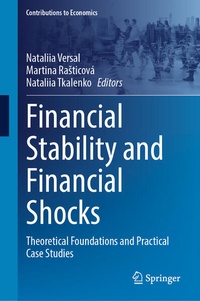
Financial Stability and Financial Shocks
Description

Financial crises are inevitable in economic processes, yet their causes and impacts vary widely. This textbook offers a comprehensive exploration of financial crises, focusing on both theoretical foundations and practical case studies. It explains the nature, causes, and consequences of financial crises, financial shocks, and the role of financial regulators in crisis management.
Each chapter includes a dedicated theoretical section explaining key concepts with literature review support, ensuring that complex topics such as financial stability, systemic risk, and macroprudential policy are well-contextualized and integrated throughout the book. Real-world applications include analyses of the 2008 Global Financial Crisis, Ukraine's financial crises, and the COVID-19 pandemic.
This textbook is an essential resource for graduate students, scholars, professionals in finance, and policymakers. It bridges academic research and policy-making and offers actionable solutions for financial instability in emerging and transition economies.
More details
Other editions
Additional editions

Persons
Nataliia Versal is a Professor at Taras Shevchenko National University of Kyiv, Ukraine, and an Assistant Professor at Mendel University in Brno, Czech Republic, specializing in financial stability and shocks. She has taught in Ukraine, Czechia, Portugal, Spain, Thailand, and Indonesia, covering subjects like financial institutions and markets, central banks and monetary policy, and banking. Versal holds a Ph.D. in Finance, Banking, and Insurance. Her research interests include the financial system and digitalization, financial literacy and well-being, the interplay of monetary and macroprudential policy, and the silver economy. Versal is actively involved in international projects; she also serves as the leader of Jean Monnet Module "EU for People's Digital, Eco, and Financial Awareness" and as the Science Communication Coordinator of COST Action 21107 'DIGI-net'.
Martina Rasticová is an Associate Professor of Business and Economics at Mendel University in Brno, Czech Republic, where she leads the Department of Management and the Research Institute Smart Society. She also chairs the COST Action CA21107 DIGI-net, a European research network bringing together experts from 44 countries. She holds a Ph.D. in Social Psychology from Masaryk University and has been actively engaged in numerous international research projects, including multiple COST Actions and Erasmus+ initiatives. Her research focuses on digitalisation, the ageing workforce, and gender management, with additional contributions in inclusive education and human rights. Rasticová has published widely in international journals and edited volumes, contributing significantly to the fields of social psychology, human resource management, and diversity studies.
Nataliia Tkalenko is Professor at Chernihiv Polytechnic National University, Ukraine and an Assistant Professor at Mendel University in Brno, Czech Republic. Her scholarly interests encompass financial stability, public administration, sustainable development, and digital transformation in education and the economy. Tkalenko has extensive experience in academic leadership and international research collaboration, serving as a co-coordinator and principal investigator in several international projects supported by the Erasmus+ Programme, the Ministry of Foreign Affairs of the Czech Republic, European Cooperation in Science and Technology. In addition, she acts as an expert for the National Agency for Higher Education Quality Assurance of Ukraine. In recognition of her significant contribution to national science and higher education, she has been awarded the honorary title Honored Worker of Science and Technology of Ukraine by the President of Ukraine.
Content
Chapter 1. Financial Institutions and Fragility.- Chapter 2. Financial Shocks: Genesis and Identification.- Chapter 3. Financial Crises: Types, Causes, Overcoming.- Chapter 4. Financial Stability and Financial Soundness Indicators.- Chapter 5. Macroprudential Regulation.- Chapter 6. The Global Financial Crisis: Features and Resolution.- Chapter 7. Covid-19's Impact on Financial Stability.- Chapter 8. Financial Crises in Ukraine: Challenges and Resilience Strategies.- Chapter 9. Financial Stability and Decentralized Finance.
