

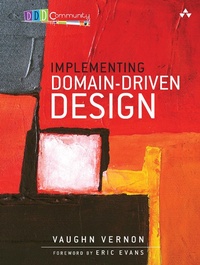
Implementing Domain-Driven Design
1st Edition
Published on 6. February 2013
656 pages
978-0-13-303988-7 (ISBN)
Description

"For software developers of all experience levels looking to improve their results, and design and implement domain-driven enterprise applications consistently with the best current state of professional practice, Implementing Domain-Driven Design will impart a treasure trove of knowledge hard won within the DDD and enterprise application architecture communities over the last couple decades." -Randy Stafford, Architect At-Large, Oracle Coherence Product Development
"This book is a must-read for anybody looking to put DDD into practice."
-Udi Dahan, Founder of NServiceBus
Implementing Domain-Driven Design presents a top-down approach to understanding domain-driven design (DDD) in a way that fluently connects strategic patterns to fundamental tactical programming tools. Vaughn Vernon couples guided approaches to implementation with modern architectures, highlighting the importance and value of focusing on the business domain while balancing technical considerations.
Building on Eric Evans' seminal book, Domain-Driven Design, the author presents practical DDD techniques through examples from familiar domains. Each principle is backed up by realistic Java examples-all applicable to C# developers-and all content is tied together by a single case study: the delivery of a large-scale Scrum-based SaaS system for a multitenant environment.
The author takes you far beyond "DDD-lite" approaches that embrace DDD solely as a technical toolset, and shows you how to fully leverage DDD's "strategic design patterns" using Bounded Context, Context Maps, and the Ubiquitous Language. Using these techniques and examples, you can reduce time to market and improve quality, as you build software that is more flexible, more scalable, and more tightly aligned to business goals.
Coverage includes
Getting started the right way with DDD, so you can rapidly gain value from it
Using DDD within diverse architectures, including Hexagonal, SOA, REST, CQRS, Event-Driven, and Fabric/Grid-Based
Appropriately designing and applying Entities-and learning when to use Value Objects instead
Mastering DDD's powerful new Domain Events technique
Designing Repositories for ORM, NoSQL, and other databases
"This book is a must-read for anybody looking to put DDD into practice."
-Udi Dahan, Founder of NServiceBus
Implementing Domain-Driven Design presents a top-down approach to understanding domain-driven design (DDD) in a way that fluently connects strategic patterns to fundamental tactical programming tools. Vaughn Vernon couples guided approaches to implementation with modern architectures, highlighting the importance and value of focusing on the business domain while balancing technical considerations.
Building on Eric Evans' seminal book, Domain-Driven Design, the author presents practical DDD techniques through examples from familiar domains. Each principle is backed up by realistic Java examples-all applicable to C# developers-and all content is tied together by a single case study: the delivery of a large-scale Scrum-based SaaS system for a multitenant environment.
The author takes you far beyond "DDD-lite" approaches that embrace DDD solely as a technical toolset, and shows you how to fully leverage DDD's "strategic design patterns" using Bounded Context, Context Maps, and the Ubiquitous Language. Using these techniques and examples, you can reduce time to market and improve quality, as you build software that is more flexible, more scalable, and more tightly aligned to business goals.
Coverage includes
Getting started the right way with DDD, so you can rapidly gain value from it
Using DDD within diverse architectures, including Hexagonal, SOA, REST, CQRS, Event-Driven, and Fabric/Grid-Based
Appropriately designing and applying Entities-and learning when to use Value Objects instead
Mastering DDD's powerful new Domain Events technique
Designing Repositories for ORM, NoSQL, and other databases
More details
Edition
1. Auflage
Language
English
Place of publication
Boston
United States
Publishing group
Pearson Education (US)
Target group
Professional and scholarly
File size
45,68 MB
ISBN-13
978-0-13-303988-7 (9780133039887)
Copyright in bibliographic data and cover images is held by Nielsen Book Services Limited or by the publishers or by their respective licensors: all rights reserved.
Schweitzer Classification
Other editions
Additional editions
Vaughn Vernon
Implementing Domain-Driven Design
Book
02/2013
1st Edition
Addison Wesley
€58.99
Available immediately
Person
Vaughn Vernon is a veteran software craftsman with more than twenty-five years of experience in software design, development, and architecture. He is a thought leader in simplifying software design and implementation using innovative methods. He has been programming with object-oriented languages since the 1980s, and applying the tenets of Domain-Driven Design since his Smalltalk domain modeling days in the early 1990s. He consults and speaks internationally, and has taught his Implementing Domain-Driven Design classes on multiple continents.
Content
Chapter 1: Getting Started with DDD
Chapter 2: Domains, Subdomains, and Bounded Contexts
Chapter 3: Context Maps
Chapter 4: Architecture
Chapter 5: Entities
Chapter 6: Value Objects
Chapter 7: Services
Chapter 8: Domain Events
Chapter 9: Modules
Chapter 10: Aggregates
Chapter 11: Factories
Chapter 12: Repositories
Chapter 13: Integrating Bounded Contexts
Chapter 14: Application
Appendix A: Aggregates and Event Sourcing: A+ES
Chapter 2: Domains, Subdomains, and Bounded Contexts
Chapter 3: Context Maps
Chapter 4: Architecture
Chapter 5: Entities
Chapter 6: Value Objects
Chapter 7: Services
Chapter 8: Domain Events
Chapter 9: Modules
Chapter 10: Aggregates
Chapter 11: Factories
Chapter 12: Repositories
Chapter 13: Integrating Bounded Contexts
Chapter 14: Application
Appendix A: Aggregates and Event Sourcing: A+ES
