

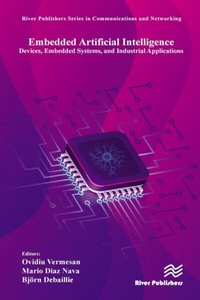
Embedded Artificial Intelligence
Devices, Embedded Systems, and Industrial Applications
1st Edition
Published on 5. May 2023
142 pages
978-1-000-88191-2 (ISBN)
Description

Recent technological developments in sensors, edge computing, connectivity, and artificial intelligence (AI) technologies have accelerated the integration of data analysis based on embedded AI capabilities into resource-constrained, energy-efficient hardware devices for processing information at the network edge.
Embedded AI combines embedded machine learning (ML) and deep learning (DL) based on neural networks (NN) architectures such as convolutional NN (CNN), or spiking neural network (SNN) and algorithms on edge devices and implements edge computing capabilities that enable data processing and analysis without optimised connectivity and integration, allowing users to access data from various sources.
Embedded AI efficiently implements edge computing and AI processes on resource-constrained devices to mitigate downtime and service latency, and it successfully merges AI processes as a pivotal component in edge computing and embedded system devices. Embedded AI also enables users to reduce costs, communication, and processing time by assembling data and by supporting user requirements without the need for continuous interaction with physical locations.
This book provides an overview of the latest research results and activities in industrial embedded AI technologies and applications, based on close cooperation between three large-scale ECSEL JU projects, AI4DI, ANDANTE, and TEMPO.
The book's content targets researchers, designers, developers, academics, post-graduate students and practitioners seeking recent research on embedded AI. It combines the latest developments in embedded AI, addressing methodologies, tools, and techniques to offer insight into technological trends and their use across different industries.
Embedded AI combines embedded machine learning (ML) and deep learning (DL) based on neural networks (NN) architectures such as convolutional NN (CNN), or spiking neural network (SNN) and algorithms on edge devices and implements edge computing capabilities that enable data processing and analysis without optimised connectivity and integration, allowing users to access data from various sources.
Embedded AI efficiently implements edge computing and AI processes on resource-constrained devices to mitigate downtime and service latency, and it successfully merges AI processes as a pivotal component in edge computing and embedded system devices. Embedded AI also enables users to reduce costs, communication, and processing time by assembling data and by supporting user requirements without the need for continuous interaction with physical locations.
This book provides an overview of the latest research results and activities in industrial embedded AI technologies and applications, based on close cooperation between three large-scale ECSEL JU projects, AI4DI, ANDANTE, and TEMPO.
The book's content targets researchers, designers, developers, academics, post-graduate students and practitioners seeking recent research on embedded AI. It combines the latest developments in embedded AI, addressing methodologies, tools, and techniques to offer insight into technological trends and their use across different industries.
More details
Edition
1. Auflage
Language
English
Place of publication
London
United Kingdom
Publishing group
Taylor & Francis Ebooks
Target group
College/higher education
Professional and scholarly
Illustrations
16 Tables, black and white; 18 Line drawings, color; 11 Line drawings, black and white; 84 Halftones, color; 13 Halftones, black and white; 102 Illustrations, color; 24 Illustrations, black and white
ISBN-13
978-1-000-88191-2 (9781000881912)
Copyright in bibliographic data and cover images is held by Nielsen Book Services Limited or by the publishers or by their respective licensors: all rights reserved.
Schweitzer Classification
Other editions
Additional editions
Ovidiu Vermesan | Mario Diaz Nava | Bjoern Debaillie
Embedded Artificial Intelligence
Devices, Embedded Systems, and Industrial Applications
Book
05/2023
1st Edition
River Publishers
€147.50
Article not available for order
Persons
Dr. Ovidiu Vermesan holds a Ph.D. degree in microelectronics and a Master of International Business (MIB) degree. He is Chief Scientist at SINTEF Digital, Oslo, Norway. His research interests are in smart systems integration, mixed-signal embedded electronics, analogue neural networks, edge artificial intelligence and cognitive communication systems. Dr. Vermesan received SINTEF's 2003 award for research excellence for his work on the implementation of a biometric sensor system. He is currently working on projects addressing nanoelectronics, integrated sensor/actuator systems, communication, cyber-physical systems (CPSs) and industrial Internet of things (IIoT), with applications in green mobility, energy, autonomous systems, and smart cities. He has authored or co-authored over 100 technical articles and conference/workshop papers, and holds several patents. He is actively involved in the activities of European partnership for Key Digital Technologies (KDT) and has coordinated and managed various national, EU and other international projects related to smart sensor systems, integrated electronics, electromobility and intelligent autonomous systems such as E3Car, POLLUX, CASTOR, IoE, MIRANDELA, IoF2020, AUTOPILOT, AutoDrive, ArchitectECA2030, AI4DI, AI4CSM. Dr. Vermesan actively participates in national, Horizon Europe and other international initiatives by coordinating the technical activities and managing the various projects. He is the coordinator of the IoT European Research Cluster (IERC) and a member of the board of the Alliance for Internet of Things Innovation (AIOTI). He is currently the technical co-coordinator of the Artificial Intelligence for Digitising Industry (AI4DI) project.
Dr. Mario Diaz Nava has a Ph.D. and M.Sc., both in computer science, from Institut National Polytechnique de Grenoble, France, and a B.Sc. in communications and electronics engineering from Instituto Politecnico National, Mexico. He has worked in STMicroelectronics since 1990. He has occupied different positions (designer, architect, design manager, project leader, program manager) in various STMicroelectronics research and development organisations. His selected project experience is related to the specifications and design of communication circuits (ATM, VDSL, ultra-wideband), digital and analogue design methodologies, system architecture, and program management. He currently has the position of ST Grenoble R&D Cooperative Programs Manager, and for the last five years he has actively participated in several H2020 IoT projects (ACTIVATE, IoF2020, Brain-IoT), working in key areas such as security and privacy, smart farming, IoT system modelling, and edge computing. He is currently leading the ANDANTE project devoted to developing neuromorphic ASICS for efficient AI/ML solutions at the edge. He has published more than 35 articles in these areas. He is currently a member of the Technical Expert Group of the PENTA/Xecs European Eureka cluster and is a chapter chair member of the ECSEL/KDT Strategic Research Innovation Agenda. He is an IEEE member. He participated in the standardisation of several communication technologies in the ATM Forum, ETSI, ANSI, and ITU-T standardisation bodies.
Mr. Bjoern Debaillie leads imec's collaborative R&D activities on cutting-edge IoT technologies. As program manager, he is responsible for the operational management across programs and projects, and focusses on strategic collaborations and partnerships, innovation management, and public funding policies. As chief of staff, he is responsible for executive finance and operations management and transformations. Bjoern coordinates semiconductor-oriented public funded projects and seeds new initiatives on high-speed communications and neuromorphic sensing. He currently leads the EUR35m TEMPO project on neuromorphic hardware technologies, enabling low-power chips for computation-intensive AI applications (www.tempo-ecsel.eu). Bjoern holds patents and has authored international papers published in various journals and conference proceedings. He also received several awards, was elected as an IEEE Senior Member and is acting in a wide range of expert boards, technical program committees, and scientific/strategic think tanks.
Dr. Mario Diaz Nava has a Ph.D. and M.Sc., both in computer science, from Institut National Polytechnique de Grenoble, France, and a B.Sc. in communications and electronics engineering from Instituto Politecnico National, Mexico. He has worked in STMicroelectronics since 1990. He has occupied different positions (designer, architect, design manager, project leader, program manager) in various STMicroelectronics research and development organisations. His selected project experience is related to the specifications and design of communication circuits (ATM, VDSL, ultra-wideband), digital and analogue design methodologies, system architecture, and program management. He currently has the position of ST Grenoble R&D Cooperative Programs Manager, and for the last five years he has actively participated in several H2020 IoT projects (ACTIVATE, IoF2020, Brain-IoT), working in key areas such as security and privacy, smart farming, IoT system modelling, and edge computing. He is currently leading the ANDANTE project devoted to developing neuromorphic ASICS for efficient AI/ML solutions at the edge. He has published more than 35 articles in these areas. He is currently a member of the Technical Expert Group of the PENTA/Xecs European Eureka cluster and is a chapter chair member of the ECSEL/KDT Strategic Research Innovation Agenda. He is an IEEE member. He participated in the standardisation of several communication technologies in the ATM Forum, ETSI, ANSI, and ITU-T standardisation bodies.
Mr. Bjoern Debaillie leads imec's collaborative R&D activities on cutting-edge IoT technologies. As program manager, he is responsible for the operational management across programs and projects, and focusses on strategic collaborations and partnerships, innovation management, and public funding policies. As chief of staff, he is responsible for executive finance and operations management and transformations. Bjoern coordinates semiconductor-oriented public funded projects and seeds new initiatives on high-speed communications and neuromorphic sensing. He currently leads the EUR35m TEMPO project on neuromorphic hardware technologies, enabling low-power chips for computation-intensive AI applications (www.tempo-ecsel.eu). Bjoern holds patents and has authored international papers published in various journals and conference proceedings. He also received several awards, was elected as an IEEE Senior Member and is acting in a wide range of expert boards, technical program committees, and scientific/strategic think tanks.
Content
1. Power Optimised Wafermap Classification for Semiconductor Process Monitoring 2. Low-Power Analog In-memory Computing Neuromorphic Circuits 3. Tools and Methodologies for Edge-AI Mixed-Signal Inference Accelerators 4. Low-power Vertically Stacked One Time Programmable Multi-bit IGZO-Based BEOL Compatible Ferroelectric TFT Memory Devices with Lifelong Retention for Monolithic 3D-Inference Engine Applications 5. Generating Trust in Hardware through Physical Inspection 6. Meeting the Latency and Energy Constraints on Timing-critical Edge-AI Systems 7. Sub-mW Neuromorphic SNN Audio Processing Applications with Rockpool and Xylo 8. An Embedding Workflow for Tiny Neural Networks on ARM Cortex-M0(+) Cores 9. Edge AI Platforms for Predictive Maintenance in Industrial Applications 10. Food Ingredients Recognition Through Multi-label Learning
