

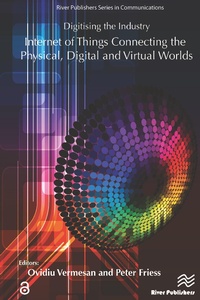
Digitising the Industry Internet of Things Connecting the Physical, Digital and VirtualWorlds
Published on 1. September 2022
364 pages
978-1-000-79204-1 (ISBN)
Description

This book provides an overview of the current Internet of Things (IoT) landscape, ranging from the research, innovation and development priorities to enabling technologies in a global context. A successful deployment of IoT technologies requires integration on all layers, be it cognitive and semantic aspects, middleware components, services, edge devices/machines and infrastructures. It is intended to be a standalone book in a series that covers the Internet of Things activities of the IERC - Internet of Things European Research Cluster from research to technological innovation, validation and deployment. The book builds on the ideas put forward by the European Research Cluster and the IoT European Platform Initiative (IoT-EPI) and presents global views and state of the art results on the challenges facing the research, innovation, development and deployment of IoT in the next years. The IoT is bridging the physical world with virtual world and requires sound information processing capabilities for the "digital shadows" of these real things. The research and innovation in nanoelectronics, semiconductor, sensors/actuators, communication, analytics technologies, cyber-physical systems, software, swarm intelligent and deep learning systems are essential for the successful deployment of IoT applications. The emergence of IoT platforms with multiple functionalities enables rapid development and lower costs by offering standardised components that can be shared across multiple solutions in many industry verticals. The IoT applications will gradually move from vertical, single purpose solutions to multi-purpose and collaborative applications interacting across industry verticals, organisations and people, being one of the essential paradigms of the digital economy. Many of those applications still have to be identified and involvement of end-users including the creative sector in this innovation is crucial. The IoT applications and deployments as integrated building blocks of the new digital economy are part of the accompanying IoT policy framework to address issues of horizontal nature and common interest (i.e. privacy, end-to-end security, user acceptance, societal, ethical aspects and legal issues) for providing trusted IoT solutions in a coordinated and consolidated manner across the IoT activities and pilots. In this, context IoT ecosystems offer solutions beyond a platform and solve important technical challenges in the different verticals and across verticals. These IoT technology ecosystems are instrumental for the deployment of large pilots and can easily be connected to or build upon the core IoT solutions for different applications in order to expand the system of use and allow new and even unanticipated IoT end uses. Technical topics discussed in the book include: * Introduction* Digitising industry and IoT as key enabler in the new era of Digital Economy* IoT Strategic Research and Innovation Agenda* IoT in the digital industrial context: Digital Single Market* Integration of heterogeneous systems and bridging the virtual, digital and physical worlds* Federated IoT platforms and interoperability* Evolution from intelligent devices to connected systems of systems by adding new layers of cognitive behaviour, artificial intelligence and user interfaces.* Innovation through IoT ecosystems* Trust-based IoT end-to-end security, privacy framework* User acceptance, societal, ethical aspects and legal issues* Internet of Things Applications
More details
Language
English
Place of publication
London
United Kingdom
Publishing group
Taylor & Francis Ebooks
Product notice
Reflowable
File size
3,72 MB
ISBN-13
978-1-000-79204-1 (9781000792041)
Copyright in bibliographic data and cover images is held by Nielsen Book Services Limited or by the publishers or by their respective licensors: all rights reserved.
Schweitzer Classification
Other editions
Additional editions
Ovidiu Vermesan | Peter Friess
Digitising the Industry Internet of Things Connecting the Physical, Digital and VirtualWorlds
Book
10/2024
1st Edition
River Publishers
€69.51
Article not available for order
Ovidiu Vermesan | Peter Friess
Digitising the Industry Internet of Things Connecting the Physical, Digital and VirtualWorlds
Digitising the Industry
Book
08/2016
1st Edition
River Publishers
€120.50
Shipment within 10-20 days
Persons
Ovidiu Vermesan, Peter Friess
Content
Preface, Editors Biography, List of Figures, List of Tables, 1. Introduction, 2. IoT Ecosystems Implementing Smart Technologies to Drive Innovation for Future Growth and Development, 3. IoT Digital Value Chain Connecting Research, Innovation and Deployment, 4. Internet of Food and Farm 2020, 5. Internet of Things Applications in Future Manufacturing, 6. Trusted IoT in the Complex Landscape of Governance, Security, Privacy, Availability and Safety, 7. IoT Societal Impact - Legal Considerations and Perspectives, 8. IoT Standards - State-of-the-Art Analysis, 9. IoT Platforms Initiative, 10. European IoT International Cooperation in Research and Innovation, Index
