

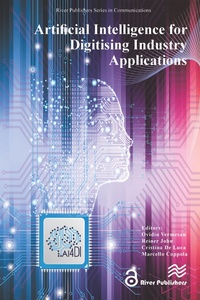
Artificial Intelligence for Digitising Industry ? Applications
Published on 1. September 2022
430 pages
978-1-000-79431-1 (ISBN)
Description

This book provides in-depth insights into use cases implementing artificial intelligence (AI) applications at the edge. It covers new ideas, concepts, research, and innovation to enable the development and deployment of AI, the industrial internet of things (IIoT), edge computing, and digital twin technologies in industrial environments. The work is based on the research results and activities of the AI4DI project, including an overview of industrial use cases, research, technological innovation, validation, and deployment.
This book's sections build on the research, development, and innovative ideas elaborated for applications in five industries: automotive, semiconductor, industrial machinery, food and beverage, and transportation.
The articles included under each of these five industrial sectors discuss AI-based methods, techniques, models, algorithms, and supporting technologies, such as IIoT, edge computing, digital twins, collaborative robots, silicon-born AI circuit concepts, neuromorphic architectures, and augmented intelligence, that are anticipating the development of Industry 5.0. Automotive applications cover use cases addressing AI-based solutions for inbound logistics and assembly process optimisation, autonomous reconfigurable battery systems, virtual AI training platforms for robot learning, autonomous mobile robotic agents, and predictive maintenance for machines on the level of a digital twin.
AI-based technologies and applications in the semiconductor manufacturing industry address use cases related to AI-based failure modes and effects analysis assistants, neural networks for predicting critical 3D dimensions in MEMS inertial sensors, machine vision systems developed in the wafer inspection production line, semiconductor wafer fault classifications, automatic inspection of scanning electron microscope cross-section images for technology verification, anomaly detection on wire bond process trace data, and optical inspection.
The use cases presented for machinery and industrial equipment industry applications cover topics related to wood machinery, with the perception of the surrounding environment and intelligent robot applications. AI, IIoT, and robotics solutions are highlighted for the food and beverage industry, presenting use cases addressing novel AI-based environmental monitoring; autonomous environment-aware, quality control systems for Champagne production; and production process optimisation and predictive maintenance for soybeans manufacturing. For the transportation sector, the use cases presented cover the mobility-as-a-service development of AI-based fleet management for supporting multimodal transport.
This book highlights the significant technological challenges that AI application developments in industrial sectors are facing, presenting several research challenges and open issues that should guide future development for evolution towards an environment-friendly Industry 5.0. The challenges presented for AI-based applications in industrial environments include issues related to complexity, multidisciplinary and heterogeneity, convergence of AI with other technologies, energy consumption and efficiency, knowledge acquisition, reasoning with limited data, fusion of heterogeneous data, availability of reliable data sets, verification, validation, and testing for decision-making processes.
This book's sections build on the research, development, and innovative ideas elaborated for applications in five industries: automotive, semiconductor, industrial machinery, food and beverage, and transportation.
The articles included under each of these five industrial sectors discuss AI-based methods, techniques, models, algorithms, and supporting technologies, such as IIoT, edge computing, digital twins, collaborative robots, silicon-born AI circuit concepts, neuromorphic architectures, and augmented intelligence, that are anticipating the development of Industry 5.0. Automotive applications cover use cases addressing AI-based solutions for inbound logistics and assembly process optimisation, autonomous reconfigurable battery systems, virtual AI training platforms for robot learning, autonomous mobile robotic agents, and predictive maintenance for machines on the level of a digital twin.
AI-based technologies and applications in the semiconductor manufacturing industry address use cases related to AI-based failure modes and effects analysis assistants, neural networks for predicting critical 3D dimensions in MEMS inertial sensors, machine vision systems developed in the wafer inspection production line, semiconductor wafer fault classifications, automatic inspection of scanning electron microscope cross-section images for technology verification, anomaly detection on wire bond process trace data, and optical inspection.
The use cases presented for machinery and industrial equipment industry applications cover topics related to wood machinery, with the perception of the surrounding environment and intelligent robot applications. AI, IIoT, and robotics solutions are highlighted for the food and beverage industry, presenting use cases addressing novel AI-based environmental monitoring; autonomous environment-aware, quality control systems for Champagne production; and production process optimisation and predictive maintenance for soybeans manufacturing. For the transportation sector, the use cases presented cover the mobility-as-a-service development of AI-based fleet management for supporting multimodal transport.
This book highlights the significant technological challenges that AI application developments in industrial sectors are facing, presenting several research challenges and open issues that should guide future development for evolution towards an environment-friendly Industry 5.0. The challenges presented for AI-based applications in industrial environments include issues related to complexity, multidisciplinary and heterogeneity, convergence of AI with other technologies, energy consumption and efficiency, knowledge acquisition, reasoning with limited data, fusion of heterogeneous data, availability of reliable data sets, verification, validation, and testing for decision-making processes.
More details
Language
English
Place of publication
London
United Kingdom
Publishing group
Taylor & Francis Ebooks
Target group
Professional and scholarly
File size
196,61 MB
ISBN-13
978-1-000-79431-1 (9781000794311)
Copyright in bibliographic data and cover images is held by Nielsen Book Services Limited or by the publishers or by their respective licensors: all rights reserved.
Schweitzer Classification
Other editions
Additional editions
Ovidiu Vermesan
Artificial Intelligence for Digitising Industry - Applications
Book
10/2024
1st Edition
River Publishers
€66.50
Article not available for order
Book
09/2021
River Publishers
€190.80
Article not available for order
Person
Ovidiu Vermesan
Content
1 AI Automotive 1.0 AI Reshaping the Automotive Industry 1.1 AI for Inbound Logistics Optimisation in Automotive Industry 1.2 State of Health Estimation using a Temporal Convolutional Network for an Efficient Use of Retired Electric Vehicle 1.3 Optimising Trajectories in Simulations with Deep Reinforcement Learning for Industrial Robots in Automotive Manufacturing 1.4 Foundations of Real Time Predictive Maintenance with Root Cause Analysis 1.5 Real-Time Predictive Maintenance - Model-Based, Simulation- Based and Machine Learning Based Diagnosis1.6 Real-Time Predictive Maintenance - Artificial Neural Network Based Diagnosis 2 AI Semiconductor 2.0 AI in Semiconductor Industry 2.1 AI-Based Knowledge Management System for Risk Assessment and Root Cause Analysis in Semiconductor Industry 2.2 Efficient Deep Learning Approach for Fault Detection in the Semiconductor Industry 2.3 Towards Fully Automated Verification of Semiconductor Technologies 2.4 Automated Anomaly Detection Through Assembly and Packaging Process 2.3 AI Industrial Machinery 3.0 AI in Industrial Machinery 3.1 AI-Powered Collision Avoidance Safety System for Industrial Woodworking Machinery 3.2 Construction of a Smart Vision-Guided Robot System for Manipulation in a Dynamic Environment 3.3 Radar-Based Human-Robot Interfaces 3.4 Touch Identification on Sensitive Robot Skin Using Time 4 AI Food and Beverage 249 4.0 AI in Food and Beverage Industry 4.1 Innovative Vineyards Environmental Monitoring System Using Deep Edge AI 4.2 AI-Driven Yield Estimation Using an Autonomous Robot 4.3 AI-Based Quality Control System at the Pressing Stages of the Champagne Production 4.4 Optimisation of Soybean Manufacturing Process Using Realtime Artificial Intelligence of Things Technology 5 AI Transportation 5.0 Applications of AI in Transportation Industry 5.1 AI-Based Vehicle Systems for Mobility-as-a-Service Application 5.2 Open Traffic Data for Mobility-as-a-Service Applications - Architecture and Challenges
