

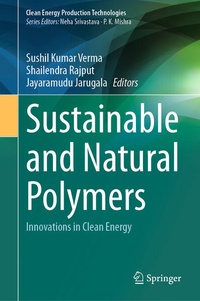
Sustainable and Natural Polymers
Description

The book explores the role of eco-friendly and bio-based materials in driving the global shift toward cleaner and more sustainable energy solutions. It focuses on the growing importance of sustainable polymers-materials derived from natural sources-in improving energy generation, storage, and overall efficiency while minimizing environmental impact. The chapters cover a wide range of applications, including the use of biodegradable and natural polymers in solar panels, wind turbines, batteries, supercapacitors, fuel cells, and other energy storage systems. It includes discussions on advanced materials like carbon nanostructure composites, self-healing coatings, and bio-based catalysts, along with innovative recycling techniques and resource management strategies that extend the lifecycle of energy technologies. The book takes a multidisciplinary approach, combining insights from polymer science, materials engineering, and renewable energy research, offering both theoretical foundations and recent advancements.
This volume under the book series Clean Energy and Production Technologies is an ideal resource for young researchers, scientists, engineers, professionals and students, who are interested in the role of sustainable materials in green energy development. Whether just beginning or already working in the field, readers will gain valuable knowledge and inspiration to contribute to a more sustainable and low-carbon future.
More details
Other editions
Additional editions
Persons
Dr. Sushil Kumar Verma is currently serving as the Chief Operating Officer at Hengul Biotech Pvt. Ltd., located in Guwahati, Assam, India and is also working as a Research Associate at the Centre for Sustainable Polymer, Technology Complex, Indian Institute of Technology (IIT) Guwahati, Assam, India. He has also gained over eight years of experience in the industry.
Dr. Shailendra Rajput is a Research Fellow at Department of Electrical and Electronic Engineering, Ariel University, Israel. He previously served as a postdoctoral fellow at Ariel University, Israel, and Xi'an Jiaotong University, China, between 2015 and 2021.
Dr. Jayaramudu Jarugala is presently a Senior Principal Scientist at the Indian Institute of Chemical Technology (IICT), Hyderabad, Telangana, India. Previously, he held the position of Principal Scientist at the North East Institute of Science & Technology, Assam, India (2017-2023), and served as Assistant Director at the Indian Rubber Manufacturers Research Association (IRMRA), India (2015-2017).
Content
Chapter 1. Synthesis and Fabrication Techniques of Polymer Nanocomposites.- Chapter 2. Polymer Electrolytes for Next Generation Energy Storage Applications.- Chapter 3. Green Carbon Nanostructure-Based Composites for Environmental Applications and Energy Harvesting.- Chapter 4. Sustainable polymeric Materials: Development, Challenges and Future benefits for Industrializations.- Chapter 5. Thermoelectric Materials for Sustainable Energy Conversion: Insights from Defect Engineering Approaches.- Chapter 6. Development of Sustainable Materials for Energy Harvesting: Views and Prospects.- Chapter 7. Emerging Polymers for Green Energy: Roadmap for Sustainable Development.- Chapter 8. Innovative polymer materials for solar energy and industrial applications.- Chapter 9. Recycling of Polymer Nanocomposites in Renewable Energy Systems.- Chapter 10. Resorbable Polymer Nanocomposites: Current Developments and Future Perspectives.- Chapter 11. Sustainable Materials for Energy Harvesting, Piezoelectric Applications, Sensors, and Fuel Cells.- Chapter 12. Renewable energy resource: current status, future prospect and their 3D printing technology.
