

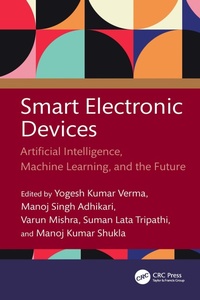
Smart Electronic Devices
Artificial Intelligence, Machine Learning, and the Future
Published on 16. September 2025
318 pages
978-1-040-40646-5 (ISBN)
Description

The book analyzes the use of smart medical devices that use artificial intelligence and machine learning to analyze medical images, detect diseases, and assist in diagnosis. It further focuses on real-world applications of artificial intelligence and machine learning in smart electronic devices, demonstrating how these technologies are being used in various industries, such as healthcare, automotive, finance, and consumer electronics.
Features:
Explores how cloud and edge computing work together to enhance the capabilities and performance of smart devices, enabling a seamless user experience and facilitating the growth of the Internet of Things ecosystem.
Discusses the use of smart devices within a smart home system, exploring the seamless connectivity, interoperability, and centralized control.
Explains the advancements in smart traffic management and smart parking systems, which leverage cutting-edge technologies to address the growing challenges of urban mobility.
Surveys the growing importance of smart energy management and the integration of renewable energy sources in the pursuit of a sustainable and eco-friendly energy landscape.
Covers the dynamic relationship between the adoption of smart devices and artificial intelligence technologies, and the diverse regulatory frameworks governing these innovations.
It is primarily written for senior undergraduates, graduate students, and academic researchers in the fields including electrical engineering, electronics, and communications engineering, computer science and engineering, and biomedical engineering.
Features:
Explores how cloud and edge computing work together to enhance the capabilities and performance of smart devices, enabling a seamless user experience and facilitating the growth of the Internet of Things ecosystem.
Discusses the use of smart devices within a smart home system, exploring the seamless connectivity, interoperability, and centralized control.
Explains the advancements in smart traffic management and smart parking systems, which leverage cutting-edge technologies to address the growing challenges of urban mobility.
Surveys the growing importance of smart energy management and the integration of renewable energy sources in the pursuit of a sustainable and eco-friendly energy landscape.
Covers the dynamic relationship between the adoption of smart devices and artificial intelligence technologies, and the diverse regulatory frameworks governing these innovations.
It is primarily written for senior undergraduates, graduate students, and academic researchers in the fields including electrical engineering, electronics, and communications engineering, computer science and engineering, and biomedical engineering.
More details
Language
English
Place of publication
London
United Kingdom
Publishing group
Taylor & Francis Ltd
Target group
College/higher education
Professional and scholarly
Illustrations
30 Tables, black and white; 115 Line drawings, black and white; 39 Halftones, black and white; 154 Illustrations, black and white
File size
31,19 MB
ISBN-13
978-1-040-40646-5 (9781040406465)
Copyright in bibliographic data and cover images is held by Nielsen Book Services Limited or by the publishers or by their respective licensors: all rights reserved.
Schweitzer Classification
Other editions
Additional editions
Yogesh Kumar Verma | Manoj Singh Adhikari | Varun Mishra
Smart Electronic Devices
Artificial Intelligence, Machine Learning, and the Future
Book
09/2025
1st Edition
CRC Press
€177.60
Shipment within 10-20 days
Persons
Yogesh Kumar Verma is working as an Assistant Professor in School of Electronics & Electrical Engineering, Lovely Professional University, Phagwara, Punjab, India. He received his B.Tech. from Sharda Group of Institutions, Mathura, UP, India in the year 2009. He received his M. Tech. degree in Digital Systems from Madan Mohan Malaviya Engineering College, Gorakhpur, UP, India in 2012. He received his Ph. D. degree from Motilal Nehru National Institute of Technology, Allahabad, Prayagraj, UP, India in 2020. His research interests are simulation and modelling of semiconductor devices. He has seven years teaching experience.
Manoj Adhikari is working as an Assistant Professor in School of Electronics & Electrical Engineering, Lovely Professional University, Phagwara, Punjab, India. He received his M. Tech. degree in digital signal processing engineering from the G. B. Pant Institute of Engineering and Technology (formerly known as G. B. Pant Engineering College), Pauri Garhwal, India, in 2013. He received his Ph. D. degree (Specialization - Solid State Devices) from the G. B. Pant Institute of Engineering and Technology (formerly known as G. B. Pant Engineering College), Pauri Garhwal, India, in 2019. His research interests are simulation and modelling of power semiconductor devices. He has six years teaching experience. He is serving as a reviewer for IEEE Transactions on Electron Devices, AEU - International Journal of Electronics and Communications, Measurement Science and Technology in international science journals.
Varun Mishra has completed his Ph.D. in the area of microelectronics and VLSI from MNNIT, Allahabad. He did his M.Tech in VLSI Design from Uttarakhand Technical University, Dehradun and B.Tech in Electronics and Communication Engineering from Graphic Era University, Dehradun. He is associated with Graphic Era (Deemed to be University) as an Assistant Professor with more than two years of experience in academics. He has published more than 15 research papers in SCI indexed journals and more than 10 research papers in international conference proceedings. His area of expertise includes modeling and simulation of novel semiconductor devices such as Tunnel FETs, Negative Capacitance FETs, HEMTs, etc., low power VLSI circuit design.
Suman Lata Tripathi is working as Professor in Lovely Professional University with more than 23 years of experience in academics and research. She has completed her Ph.D. in the area of microelectronics and VLSI Design from MNNIT, Allahabad. She has completed her remote post-doc from Nottingham Trent University, London, UK in the year 2022-23. She has published more than 164 research papers in international science journals, conference proceeding and e-books. She has also published 20 Indian patents and 4 copyright. She has been listed in world top 2% scientist published by Stanford University for the year 2024.Her area of expertise includes microelectronics device modeling and characterization, low power VLSI circuit design, VLSI design of testing, and advanced FET design for IoT, Embedded System Design, reconfigurable architecture with FPGAs and biomedical applications.
Manoj Kumar Shukla is currently working as an Assistant Professor in School of Electronics and Electrical Engineering at Lovely Professional University, Phagwara, Punjab. He completed his M.Tech and Ph.D. in Electrical Engineering from NIT, Hamirpur (Himachal Pradesh), India. He has 7 years of teaching and research experience. His research interests include control systems, fractional calculus, robotics, automation, artificial intelligence, sensor technology etc. He has published several research papers in reputed international journals and conferences.
Manoj Adhikari is working as an Assistant Professor in School of Electronics & Electrical Engineering, Lovely Professional University, Phagwara, Punjab, India. He received his M. Tech. degree in digital signal processing engineering from the G. B. Pant Institute of Engineering and Technology (formerly known as G. B. Pant Engineering College), Pauri Garhwal, India, in 2013. He received his Ph. D. degree (Specialization - Solid State Devices) from the G. B. Pant Institute of Engineering and Technology (formerly known as G. B. Pant Engineering College), Pauri Garhwal, India, in 2019. His research interests are simulation and modelling of power semiconductor devices. He has six years teaching experience. He is serving as a reviewer for IEEE Transactions on Electron Devices, AEU - International Journal of Electronics and Communications, Measurement Science and Technology in international science journals.
Varun Mishra has completed his Ph.D. in the area of microelectronics and VLSI from MNNIT, Allahabad. He did his M.Tech in VLSI Design from Uttarakhand Technical University, Dehradun and B.Tech in Electronics and Communication Engineering from Graphic Era University, Dehradun. He is associated with Graphic Era (Deemed to be University) as an Assistant Professor with more than two years of experience in academics. He has published more than 15 research papers in SCI indexed journals and more than 10 research papers in international conference proceedings. His area of expertise includes modeling and simulation of novel semiconductor devices such as Tunnel FETs, Negative Capacitance FETs, HEMTs, etc., low power VLSI circuit design.
Suman Lata Tripathi is working as Professor in Lovely Professional University with more than 23 years of experience in academics and research. She has completed her Ph.D. in the area of microelectronics and VLSI Design from MNNIT, Allahabad. She has completed her remote post-doc from Nottingham Trent University, London, UK in the year 2022-23. She has published more than 164 research papers in international science journals, conference proceeding and e-books. She has also published 20 Indian patents and 4 copyright. She has been listed in world top 2% scientist published by Stanford University for the year 2024.Her area of expertise includes microelectronics device modeling and characterization, low power VLSI circuit design, VLSI design of testing, and advanced FET design for IoT, Embedded System Design, reconfigurable architecture with FPGAs and biomedical applications.
Manoj Kumar Shukla is currently working as an Assistant Professor in School of Electronics and Electrical Engineering at Lovely Professional University, Phagwara, Punjab. He completed his M.Tech and Ph.D. in Electrical Engineering from NIT, Hamirpur (Himachal Pradesh), India. He has 7 years of teaching and research experience. His research interests include control systems, fractional calculus, robotics, automation, artificial intelligence, sensor technology etc. He has published several research papers in reputed international journals and conferences.
Content
Chapter 1. AI for Smart Agriculture. Chapter 2. IoT Empower: Your One-Stop Device Manager. Chapter 3. AI and IOT Integration for Smart Agriculture. Chapter 4. Hardware Prototype of RIW Algorithm on FPGA and P-SoC Platform: A Trade-off between Resource and Time Constraint. Chapter 5. Framework for UAV based Wireless Power Harvesting. Chapter 6. Smart Healthcare Devices. Chapter 7. Envisioning Tomorrow: Exploring the Future of Smart Electronic Devices: AI, ML. Chapter 8. Exploring Deep Learning Methods for detecting heart Abnormalities by analysing heart sound. Chapter 9. Advancements in Wearable Devices and Machine Learning for Disease Identification and Management: A Comprehensive Survey. Chapter 10. Blockchain and Machine learning based User Authentication for Healthcare system. Chapter 11. Smart Text Extraction System for Bank Cheque Images using DWT and Dynamic Thresholding. Chapter 12. Vehicle Accident Detection and Smart Notification Systems. Chapter 13. HEMT Biosensors Integrated with AI and ML for IoT Devices. Chapter 14. Beamforming and its Significance. Chapter 15. Exploring the Evolution of Artificial Intelligence Methods: Tracing the Path from Traditional to Contemporary Approaches. Chapter 16. Sustainable Computing, Greener Design for Computer Server Systems and Softwares. Chapter 17. IoMT: The Key to Affordable and Accessible Healthcare for All. Chapter 18. Next Generation Cyber Security System in Integration with Artificial Intelligence and Blockchain
