

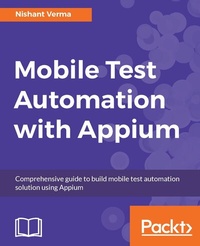
Mobile Test Automation with Appium
Mobile application testing made easy
Published on 8. July 2025
256 pages
978-1-78728-818-8 (ISBN)
Description

Comprehensive guide to build mobile test automation solution using Appium
Key Features
How to automate testing with Appium
Apply techniques for creating comprehensive tests
How to test on physical devices or emulators
Book DescriptionAppium is an open source test automation framework for mobile applications. It allows you to test all three types of mobile applications: native, hybrid, and mobile web. It allows you to run the automated tests on actual devices, emulators, and simulators. Today, when every mobile app is made on at least two platforms, iOS and Android, you need a tool that allows you to test across platforms. Having two different frameworks for the same app increases the cost of the product and time to maintain it as well. Appium helps save this cost. With mobile app growth exploding, mobile app automation is mainstream now. In this book, author Nishant Verma provides you with a firm grounding in the concepts of Appium while diving into how to set up appium & Cucumber-jvm test automation framework, implement page object design pattern, automate gestures, test execution on emulators and physical devices, and implement continuous integration with Jenkins. The mobile app we have referenced in this book is Quikr because of its relatively lower learning curve to understand the application. It's a local classifieds shopping app.What you will learn
Discover Appium and how to set up an automation framework for mobile testing
Understand desired capabilities and learn to find element locators
Learn to automate gestures and synchronize tests using Appium
Take an incremental approach to implement page object pattern
Learn to run Appium tests on emulators or physical devices
Set up Jenkins to run mobile automation tests by easy to learn steps
Discover tips and tricks to record video of test execution, inter app automation concepts
Learn to run Appium tests in parallel on multiple devices simultaneously
Who this book is forAre you a mobile developer or a software tester who wishes to use Appium for your test automation? If so, then this is the right book for you .You must have basic Java programming knowledge. You don't need to have prior knowledge of Appium.
Key Features
How to automate testing with Appium
Apply techniques for creating comprehensive tests
How to test on physical devices or emulators
Book DescriptionAppium is an open source test automation framework for mobile applications. It allows you to test all three types of mobile applications: native, hybrid, and mobile web. It allows you to run the automated tests on actual devices, emulators, and simulators. Today, when every mobile app is made on at least two platforms, iOS and Android, you need a tool that allows you to test across platforms. Having two different frameworks for the same app increases the cost of the product and time to maintain it as well. Appium helps save this cost. With mobile app growth exploding, mobile app automation is mainstream now. In this book, author Nishant Verma provides you with a firm grounding in the concepts of Appium while diving into how to set up appium & Cucumber-jvm test automation framework, implement page object design pattern, automate gestures, test execution on emulators and physical devices, and implement continuous integration with Jenkins. The mobile app we have referenced in this book is Quikr because of its relatively lower learning curve to understand the application. It's a local classifieds shopping app.What you will learn
Discover Appium and how to set up an automation framework for mobile testing
Understand desired capabilities and learn to find element locators
Learn to automate gestures and synchronize tests using Appium
Take an incremental approach to implement page object pattern
Learn to run Appium tests on emulators or physical devices
Set up Jenkins to run mobile automation tests by easy to learn steps
Discover tips and tricks to record video of test execution, inter app automation concepts
Learn to run Appium tests in parallel on multiple devices simultaneously
Who this book is forAre you a mobile developer or a software tester who wishes to use Appium for your test automation? If so, then this is the right book for you .You must have basic Java programming knowledge. You don't need to have prior knowledge of Appium.
More details
Edition
Digital original
Language
English
Place of publication
Birmingham
United Kingdom
Target group
US School Grade: College Graduate Student
Edition type
Digital original
File size
24,70 MB
ISBN-13
978-1-78728-818-8 (9781787288188)
Copyright in bibliographic data and cover images is held by Nielsen Book Services Limited or by the publishers or by their respective licensors: all rights reserved.
Schweitzer Classification
Other editions
Additional editions
Nishant Verma
Mobile Test Automation with Appium
Book
06/2017
Packt Publishing
€50.70
Shipment within 3-4 weeks
Person
Verma Nishant :
Nishant Verma is a co-founder of TestVagrant Technologies. Its a service start-up addressing testing solutions for B2C companies with a focus on mobile and web, and helps companies deliver faster and reliably. Nishant has 11 years of experience in software development and testing. He has worked with IT companies such as ThoughtWorks Inc., Aditi Technologies, and Altisource. He has extensive experience in setting up agile testing practices, functional and non-functional test automation, mentoring, and coaching. In the past, he has worked on web UIs and specializes in building test solutions in the mobile domain. He has hands-on experience with test automation tools such as WebDriver (Selenium2), Calabash, Frank, Appium, Watin, Sikuli, QTP, and DeviceAnywhere. He actively maintains his own website on testing techniques, agile testing, automation techniques, and general learning. He has contributed to leading testing journals such as Testing Circus and Software Developer's Journal, and has been an active speaker at vodQA (testing event of Thoughtworks). Nishant has authored a reference book on how to use Appium for automating Android apps using Java, which is available on Gitbook. It has received close to 200,000 views, 40,000 readers online, and has been downloaded around 3,000 times.
Nishant Verma is a co-founder of TestVagrant Technologies. Its a service start-up addressing testing solutions for B2C companies with a focus on mobile and web, and helps companies deliver faster and reliably. Nishant has 11 years of experience in software development and testing. He has worked with IT companies such as ThoughtWorks Inc., Aditi Technologies, and Altisource. He has extensive experience in setting up agile testing practices, functional and non-functional test automation, mentoring, and coaching. In the past, he has worked on web UIs and specializes in building test solutions in the mobile domain. He has hands-on experience with test automation tools such as WebDriver (Selenium2), Calabash, Frank, Appium, Watin, Sikuli, QTP, and DeviceAnywhere. He actively maintains his own website on testing techniques, agile testing, automation techniques, and general learning. He has contributed to leading testing journals such as Testing Circus and Software Developer's Journal, and has been an active speaker at vodQA (testing event of Thoughtworks). Nishant has authored a reference book on how to use Appium for automating Android apps using Java, which is available on Gitbook. It has received close to 200,000 views, 40,000 readers online, and has been downloaded around 3,000 times.
Content
Table of Contents
Introduction to Appium
Machine Set-up
Writing your first Appium Test
Understanding Desired Capabilities
Understanding Appium Inspector to Find Locators
How to Synchronize Tests
How to Automate Gestures
Design patterns in test automation
How to run Appium test on devices and emulators
Continuous Integration with Jenkins
Appium Tips and Tricks
Appium Desktop App
Appendix
Introduction to Appium
Machine Set-up
Writing your first Appium Test
Understanding Desired Capabilities
Understanding Appium Inspector to Find Locators
How to Synchronize Tests
How to Automate Gestures
Design patterns in test automation
How to run Appium test on devices and emulators
Continuous Integration with Jenkins
Appium Tips and Tricks
Appium Desktop App
Appendix
