

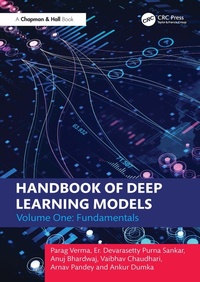
Handbook of Deep Learning Models
Volume One: Fundamentals
Published on 18. November 2025
314 pages
978-1-040-44391-0 (ISBN)
Description

This volume covers a comprehensive range of fundamental concepts in deep learning and artificial neural networks, making it suitable for beginners looking to learn the basics.
Using Keras, a popular neural network API in Python, this book offers practical examples that reinforce the theoretical concepts discussed. Real-world case studies add relevance by showing how deep learning is applied across various domains. The book covers topics such as layers, activation functions, optimization algorithms, backpropagation, convolutional neural networks (CNNs), data augmentation, and transfer learning - providing a solid foundation for building effective neural network models.
This book is a valuable resource for anyone interested in deep learning and artificial neural networks, offering both theoretical insights and practical implementation experience.
Using Keras, a popular neural network API in Python, this book offers practical examples that reinforce the theoretical concepts discussed. Real-world case studies add relevance by showing how deep learning is applied across various domains. The book covers topics such as layers, activation functions, optimization algorithms, backpropagation, convolutional neural networks (CNNs), data augmentation, and transfer learning - providing a solid foundation for building effective neural network models.
This book is a valuable resource for anyone interested in deep learning and artificial neural networks, offering both theoretical insights and practical implementation experience.
More details
Language
English
Place of publication
London
United Kingdom
Publishing group
Taylor & Francis Ltd
Target group
College/higher education
Professional and scholarly
Illustrations
70 Line drawings, black and white; 70 Illustrations, black and white
File size
6,18 MB
ISBN-13
978-1-040-44391-0 (9781040443910)
Copyright in bibliographic data and cover images is held by Nielsen Book Services Limited or by the publishers or by their respective licensors: all rights reserved.
Schweitzer Classification
Other editions
Additional editions
Parag Verma | Er. Devarasetty Purna Sankar | Anuj Bhardwaj
Handbook of Deep Learning Models
Volume One: Fundamentals
Book
11/2025
1st Edition
CRC Press
€233.60
Shipment within 15-20 days
Persons
Anuj Bhardwaj is a distinguished author, educator, and entrepreneur, currently serving as the director, IQAC, and professor of computer science and engineering at Chandigarh University, and Founder of Data Matrix Experts Pvt. Ltd. With over 17 years of academic and research experience, he holds a PhD in computer science and a master's from BIT Mesra. Dr. Bhardwaj has authored six books with leading publishers, filed multiple patents, contributed nine book chapters, and published over 56 research papers. His expertise spans AI, neural networks, parallel computing, and computer vision. A mentor to many MTech and PhD scholars, he actively contributes to educational initiatives and continues to inspire through his work in advancing education technology.
Vaibhav Chaudhari obtained his integrated dual degree in BE computer science and MSc physics from BITS Pilani K.K. Birla Goa Campus in 2022. Vaibhav is currently working as a member of Technical Staff-3 in Nutanix. He is a member of the AHV Management team and works on distributed systems and VM Management Lifecycle. He has done multiple interdisciplinary projects in the fields of artificial intelligence, astrophysics, high-throughput biological analysis, and satellite data analysis, and his research interests lie in the field of application of artificial intelligence tools to solve real-world problems. He has published 12 research articles and two patents under his name.
Ankur Dumka is an associate professor with additional responsibilities as the dean (academic and research) and head of department, Computer Science and Engineering, the Women Institute of Technology, Dehradun. He has more than 14 years of experience and contributed 140 research papers, 15 book chapters, seven authored books, eight patents granted under his name, and seven patents published. Currently, he holds one R&D project with a grant exceeding ?10 lakh and has completed one consultancy project of Government Medical College, Haldwani. Also, he was the coordinator of Smart City Dehradun for the drafting of the proposal.
Arnav Pandey is a graduate of St. Joseph's Academy, Dehradun, and has been accepted into the University of California, Los Angeles (UCLA), USA, as a bachelor of technology student majoring in computer science. He has more than three years of experience in the field, with his primary areas of research being deep learning, artificial intelligence, and machine learning. He has authored four research papers, two authored books' proposal accepted, two book chapters, and has one patent filed under his name. He is currently serving as a research trainee on a project exceeding ?10 lakh in value and is actively working in the domain of generative AI.
Er. Devarasetty Purna Sankar is a seasoned senior software engineer at Data Foundry Pvt. Ltd., specializing in machine learning solutions for the health and finance sectors. With over seven years of experience and a postgraduate diploma in artificial intelligence and machine learning from IIIT Bangalore, he has contributed to impactful projects for Fortune 500 companies. Purna is an award-winning professional recognized for innovation, performance, and excellence in hackathons. Moreover, he is AWS certified, demonstrating strong expertise in cloud-enabled ML solutions. Beyond work, he enjoys hiking, playing badminton, and blending his technical acumen with creativity as an author, aiming to inspire and explore AI's societal impact through his writing.
Parag Verma is an accomplished AI data scientist and technical lead, associated with AIGC, a vertical of Algihaz Holding. With over a decade of experience in artificial intelligence and machine learning, he has specialized in delivering cutting-edge solutions across healthcare, life sciences, and robotics. His professional journey includes impactful roles at Data Foundry Pvt. Ltd., R2E Technologies, and Yuvayana Tech and Craft, along with contributions to various government projects with DST, UCOST, and UBMS. Dr. Verma holds a PhD in artificial intelligence and machine learning, a postgraduate degree in robotics engineering, and a bachelor's in computer science. His work is backed by multiple certifications from renowned institutions such as Stanford, Duke, Google Cloud, and the University of Pennsylvania. A recognized innovator and hackathon winner, he continues to push the boundaries of AI through research and real-world application.
Vaibhav Chaudhari obtained his integrated dual degree in BE computer science and MSc physics from BITS Pilani K.K. Birla Goa Campus in 2022. Vaibhav is currently working as a member of Technical Staff-3 in Nutanix. He is a member of the AHV Management team and works on distributed systems and VM Management Lifecycle. He has done multiple interdisciplinary projects in the fields of artificial intelligence, astrophysics, high-throughput biological analysis, and satellite data analysis, and his research interests lie in the field of application of artificial intelligence tools to solve real-world problems. He has published 12 research articles and two patents under his name.
Ankur Dumka is an associate professor with additional responsibilities as the dean (academic and research) and head of department, Computer Science and Engineering, the Women Institute of Technology, Dehradun. He has more than 14 years of experience and contributed 140 research papers, 15 book chapters, seven authored books, eight patents granted under his name, and seven patents published. Currently, he holds one R&D project with a grant exceeding ?10 lakh and has completed one consultancy project of Government Medical College, Haldwani. Also, he was the coordinator of Smart City Dehradun for the drafting of the proposal.
Arnav Pandey is a graduate of St. Joseph's Academy, Dehradun, and has been accepted into the University of California, Los Angeles (UCLA), USA, as a bachelor of technology student majoring in computer science. He has more than three years of experience in the field, with his primary areas of research being deep learning, artificial intelligence, and machine learning. He has authored four research papers, two authored books' proposal accepted, two book chapters, and has one patent filed under his name. He is currently serving as a research trainee on a project exceeding ?10 lakh in value and is actively working in the domain of generative AI.
Er. Devarasetty Purna Sankar is a seasoned senior software engineer at Data Foundry Pvt. Ltd., specializing in machine learning solutions for the health and finance sectors. With over seven years of experience and a postgraduate diploma in artificial intelligence and machine learning from IIIT Bangalore, he has contributed to impactful projects for Fortune 500 companies. Purna is an award-winning professional recognized for innovation, performance, and excellence in hackathons. Moreover, he is AWS certified, demonstrating strong expertise in cloud-enabled ML solutions. Beyond work, he enjoys hiking, playing badminton, and blending his technical acumen with creativity as an author, aiming to inspire and explore AI's societal impact through his writing.
Parag Verma is an accomplished AI data scientist and technical lead, associated with AIGC, a vertical of Algihaz Holding. With over a decade of experience in artificial intelligence and machine learning, he has specialized in delivering cutting-edge solutions across healthcare, life sciences, and robotics. His professional journey includes impactful roles at Data Foundry Pvt. Ltd., R2E Technologies, and Yuvayana Tech and Craft, along with contributions to various government projects with DST, UCOST, and UBMS. Dr. Verma holds a PhD in artificial intelligence and machine learning, a postgraduate degree in robotics engineering, and a bachelor's in computer science. His work is backed by multiple certifications from renowned institutions such as Stanford, Duke, Google Cloud, and the University of Pennsylvania. A recognized innovator and hackathon winner, he continues to push the boundaries of AI through research and real-world application.
Content
Part I - Fundamentals of Deep Learning 1. Introduction to Deep Learning 2. Machine Learning Fundamentals 3. Neural Networks Fundamentals Part II -Deep Learning Models with Use Case Studies 4. Convolutional Neural Networks 5. Recurrent Neural Networks 6. Generative Adversarial Networks 7. Radial Basis Function Networks 8. Self Organizing Maps
