

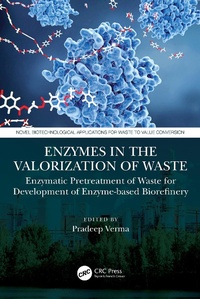
Enzymes in the Valorization of Waste
Enzymatic Pretreatment of Waste for Development of Enzyme-based Biorefinery
1st Edition
Published on 19. December 2022
258 pages
978-1-000-68308-0 (ISBN)
Description

"Enzymes in Valorization of waste: Enzymatic pre-treatment of waste for development of enzyme based biorefinery" focusses on the role of key delignifying enzymes (Laccase, MnP, LiP and LPMO's) involved in biomass pre-treatment. The role of these enzymes such as hemicellulose, chitinases, and pectinases are discussed exhaustively including enzyme assisted recovery of high value phenolic compounds and value-added compounds generated during the pre-treatment process. All chapters cover broad topics and thematic areas associated with the pre-treatment step of biorefinery including enzyme mediated water treatment and its associated applications in biofuels, biorefineries and bioconversion.
Features:
Highlights mechanistic approach how the enzyme being able to regulate the delignification.
Discusses advantages of the enzymatic delignification over other physical and chemical methods.
Illustrates role of enzymes such as pectinase and chitinases and breaking down of biomass recalcitrance due to presence of pectin and chitin.
Consolidates details on de-lignifying enzymes ((Laccase, MnP, LiP and LPMO's) suitable in biomass pretreatment.
Explores role of delignifying enzymes in high value phenolic compounds recovery during the enzymatic delignification.
This book aims at Graduate students, Researchers and related Industry Professionals in Biochemical Engineering, Environmental Science, Wastewater Treatment, Biotechnology, Applied Microbiology, Biomass Based Biorefinery, Biochemistry, Green Chemistry, Sustainable Development, Waste Treatment, Enzymology, Microbial Biotechnology, and Waste Valorization.
Features:
Highlights mechanistic approach how the enzyme being able to regulate the delignification.
Discusses advantages of the enzymatic delignification over other physical and chemical methods.
Illustrates role of enzymes such as pectinase and chitinases and breaking down of biomass recalcitrance due to presence of pectin and chitin.
Consolidates details on de-lignifying enzymes ((Laccase, MnP, LiP and LPMO's) suitable in biomass pretreatment.
Explores role of delignifying enzymes in high value phenolic compounds recovery during the enzymatic delignification.
This book aims at Graduate students, Researchers and related Industry Professionals in Biochemical Engineering, Environmental Science, Wastewater Treatment, Biotechnology, Applied Microbiology, Biomass Based Biorefinery, Biochemistry, Green Chemistry, Sustainable Development, Waste Treatment, Enzymology, Microbial Biotechnology, and Waste Valorization.
More details
Series
Edition
1. Auflage
Language
English
Place of publication
London
United Kingdom
Publishing group
Taylor & Francis Ltd
Target group
Professional and scholarly
Illustrations
19 Tables, black and white; 43 Line drawings, black and white; 2 Halftones, black and white; 45 Illustrations, black and white
ISBN-13
978-1-000-68308-0 (9781000683080)
Copyright in bibliographic data and cover images is held by Nielsen Book Services Limited or by the publishers or by their respective licensors: all rights reserved.
Schweitzer Classification
Other editions
Additional editions
Pradeep Verma
Enzymes in the Valorization of Waste
Enzymatic Pretreatment of Waste for Development of Enzyme-based Biorefinery
Book
10/2024
1st Edition
CRC Press
€71.50
Shipment within 10-20 days
Pradeep Verma
Enzymes in the Valorization of Waste
Enzymatic Pretreatment of Waste for Development of Enzyme-based Biorefinery
Book
12/2022
1st Edition
CRC Press
€176.10
Shipment within 10-20 days
Person
Prof. Pradeep Verma completed his PhD from Sardar Patel University Gujarat, India in 2002. In the same year he was selected as UNESCO fellow and joined Czech Academy of Sciences Prague, Czech Republic. He later moved to Charles University, Prague to work as Post-Doctoral Fellow. In 2004 he joined as a visiting scientist at UFZ Centre for Environmental Research, Halle, Germany. He was awarded a DFG fellowship which provided him another opportunity to work as a Post-Doctoral Fellow at Gottingen University, Germany. He moved to India in 2007 where he joined Reliance Life Sciences, Mumbai and worked extensively on biobutanol production which attributed few patents to his name. Later he was awarded with JSPS Post-Doctoral Fellowship Programme and joined Laboratoy of Biomass Conversion, Research Institute of Sustainable Humanosphere (RISH), Kyoto University, Japan. He is also a recipient of various prestigious awards such as Ron-Cockcroft award by Swedish society, UNESCO Fellow ASCR Prague. He has been awarded with Fellow of Mycological society of India (MSI-2020), Prof. P.C. Jain Memorial Award, Mycological society of India 2020 and Fellow of Biotech Research Society, India (2021).
Prof. Verma began his independent academic career in 2009 as a Reader and Founder Head at the Department of Microbiology at Assam University. In 2011 he moved to Department of Biotechnology at Guru Ghasidas Vishwavidyalaya (A Central University), Bilaspur, and served as an Associate professor till 2013. He is currently working as Professor (former Head and Dean, School of Life Sciences) at Department of Microbiology, CURAJ. He is a member of various National & International societies/academies. He has completed two collaborated projects worth 150 million INR in the area of microbial diversity and bioenergy.
Prof. Verma is a Group leader of Bioprocess and Bioenergy laboratory at Department of Microbiology, School of Life Sciences, CURAJ. His area of expertise involves Microbial Diversity, Bioremediation, Bioprocess Development, Lignocellulosic and Algal Biomass based Biorefinery. He also holds 12 International patents in the field of microwave assisted biomass pretreatment and bio-butanol production. He has more than 62 research articles in peer reviewed international journals and contributed to several book chapters (36 published; 10 in press) in different edited books. He has also edited 4 books in international publishers such as Springer, Taylor and Francis CRC Press and Elsevier. He is a Guest editor to several journals such as Biomass Conversion and Biorefinery (Springer), Frontier in nanotechnology (Frontiers), and International Journal of Environmental Research and Public Health (mdpi). He is also an editorial board member for the Journal Current Nanomedicine (Bentham Sciences). He is acting as reviewers for more than 40 journals in different publication houses such as Springer, Elsevier, RSC, ACS, Nature, Frontiers, mdpi etc.
Prof. Verma began his independent academic career in 2009 as a Reader and Founder Head at the Department of Microbiology at Assam University. In 2011 he moved to Department of Biotechnology at Guru Ghasidas Vishwavidyalaya (A Central University), Bilaspur, and served as an Associate professor till 2013. He is currently working as Professor (former Head and Dean, School of Life Sciences) at Department of Microbiology, CURAJ. He is a member of various National & International societies/academies. He has completed two collaborated projects worth 150 million INR in the area of microbial diversity and bioenergy.
Prof. Verma is a Group leader of Bioprocess and Bioenergy laboratory at Department of Microbiology, School of Life Sciences, CURAJ. His area of expertise involves Microbial Diversity, Bioremediation, Bioprocess Development, Lignocellulosic and Algal Biomass based Biorefinery. He also holds 12 International patents in the field of microwave assisted biomass pretreatment and bio-butanol production. He has more than 62 research articles in peer reviewed international journals and contributed to several book chapters (36 published; 10 in press) in different edited books. He has also edited 4 books in international publishers such as Springer, Taylor and Francis CRC Press and Elsevier. He is a Guest editor to several journals such as Biomass Conversion and Biorefinery (Springer), Frontier in nanotechnology (Frontiers), and International Journal of Environmental Research and Public Health (mdpi). He is also an editorial board member for the Journal Current Nanomedicine (Bentham Sciences). He is acting as reviewers for more than 40 journals in different publication houses such as Springer, Elsevier, RSC, ACS, Nature, Frontiers, mdpi etc.
Content
1. Pretreatment methods for overcoming biomass recalcitrance
2. Lignocellulosic Biomass for Biofuels Production, an Integrated Approach
3. Laccase mediated pre-treatment of lignocellulosic biomass: Current status and Future Prospective
4. Lignin peroxidases and its relevance in lignin based circular bio-economy: A microbial treasure towards sustainable development
5. Structure, properties, and functions of manganese peroxidase for enzymatic pretreatment of waste biomass
6. An overview of pretreatment strategies for the development of enzyme-based biorefinery with special emphasis on Pectinases
7. Chitinases: structure, function, and valorization of marine shell waste
8. Pre-treatment and Valorization of textile -wastewaters by Haloarchaea
9. Evolution of biological pretreatment methods of agricultural residues and defatted microalgae for overcoming biomass recalcitrance in biofuel generation
2. Lignocellulosic Biomass for Biofuels Production, an Integrated Approach
3. Laccase mediated pre-treatment of lignocellulosic biomass: Current status and Future Prospective
4. Lignin peroxidases and its relevance in lignin based circular bio-economy: A microbial treasure towards sustainable development
5. Structure, properties, and functions of manganese peroxidase for enzymatic pretreatment of waste biomass
6. An overview of pretreatment strategies for the development of enzyme-based biorefinery with special emphasis on Pectinases
7. Chitinases: structure, function, and valorization of marine shell waste
8. Pre-treatment and Valorization of textile -wastewaters by Haloarchaea
9. Evolution of biological pretreatment methods of agricultural residues and defatted microalgae for overcoming biomass recalcitrance in biofuel generation
