

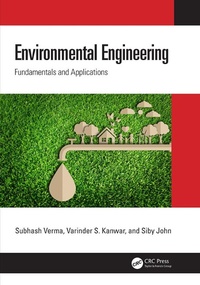
Environmental Engineering
Fundamentals and Applications
1st Edition
Published on 9. March 2022
592 pages
978-1-000-53356-9 (ISBN)
Description

Presenting an in-depth coverage, this textbook brings together and integrates key topics including water resources, wastewater, air, and solid waste in a single volume.
The textbook introduces a unique approach that emphases on the water and wastewater treatments with its distribution system and engineering. It begins by discussing the public health and sanitation, then covers the wastewater collection system and design, wastewater characteristics, natural purification water, different wastewater treatments, industrial and rural wastewater. Finally, the emerging technologies in the reuse/recycle of waste and processes to conserve the environmental resources are discussed.
The text will be useful for senior undergraduate and graduate students in the fields of civil and environmental engineering. Pedagogical features including solved problems, exercises and multiple-choice questions are interspersed throughout the book for better understanding.
Discusses latest technologies and engineering design in water and wastewater management.
Focusses on reuse and conservation of natural resources.
Comprehensively covers topics on air pollution and noise pollution.
Explains important topics including coagulation and flocculation, sedimentation, filtration, disinfection, water softening and water distribution.
Includes pedagogical features including solved examples, exercises and multiple-choice questions with answers for better understanding of concepts.
The textbook introduces a unique approach that emphases on the water and wastewater treatments with its distribution system and engineering. It begins by discussing the public health and sanitation, then covers the wastewater collection system and design, wastewater characteristics, natural purification water, different wastewater treatments, industrial and rural wastewater. Finally, the emerging technologies in the reuse/recycle of waste and processes to conserve the environmental resources are discussed.
The text will be useful for senior undergraduate and graduate students in the fields of civil and environmental engineering. Pedagogical features including solved problems, exercises and multiple-choice questions are interspersed throughout the book for better understanding.
Discusses latest technologies and engineering design in water and wastewater management.
Focusses on reuse and conservation of natural resources.
Comprehensively covers topics on air pollution and noise pollution.
Explains important topics including coagulation and flocculation, sedimentation, filtration, disinfection, water softening and water distribution.
Includes pedagogical features including solved examples, exercises and multiple-choice questions with answers for better understanding of concepts.
More details
Edition
1. Auflage
Language
English
Place of publication
London
United Kingdom
Publishing group
Taylor & Francis Ltd
Target group
College/higher education
Illustrations
81 Tables, black and white; 158 Line drawings, black and white; 5 Halftones, black and white; 163 Illustrations, black and white
ISBN-13
978-1-000-53356-9 (9781000533569)
Copyright in bibliographic data and cover images is held by Nielsen Book Services Limited or by the publishers or by their respective licensors: all rights reserved.
Schweitzer Classification
Other editions
Additional editions
Subhash Verma | Varinder S. Kanwar | Siby John
Environmental Engineering
Fundamentals and Applications
Book
10/2024
1st Edition
CRC Press
€82.10
Shipment within 10-20 days
Subhash Verma | Varinder S. Kanwar | Siby John
Environmental Engineering
Fundamentals and Applications
Book
03/2022
1st Edition
CRC Press
€240.90
Shipment within 15-20 days
Persons
Prof Subhash Verma
Subhash Verma retired as Professor from Sault College of Applied Arts and Technology, Canada, where he also headed a program in Water Resources Engineering Technology. During his teaching career at Sault college, Subhash taught courses including hydraulics, hydrology, water and wastewater engineering. He was responsible for developing lab manuals for the said courses. As part of the distance education program in Environmental engineering technology, Subhash prepared course manuals and study guides in the above mentioned courses.
He was leader of the team for developing training program in sampling and monitoring for the Ontario Ministry of environment. He developed and delivered training program to water and wastewater plants operators to prepare them for writing license examinations. Before leaving for Canada, Subhash was assistant professor in college of Agricultural Engineering of Punjab Agricultural University, Ludhiana.
His current pastime is developing and teaching online courses related to water and wastewater technology. Till date he has developed ten courses under the Ontario learn program of the province of Ontario. Subhash is also working on authoring three titles, applied hydraulics, engineering hydrology and ground water and wells for the undergraduate engineering programs.
Prof (Dr.) Varinder S Kanwar
Dr. Varinder S. Kanwar, is a Professor of Civil Engineering Department also holding responsibilities of Vice Chancellor, at Chitkara University, Himachal Pradesh, obtained his Masters in Structural Engineering and his Ph.D. in Civil Engineering from Thapar University, Patiala. He also has a Post Graduate Diploma in Rural Development. Dr. Kanwar carries more than 24 years of research, teaching and administrative experience. He is an active member of various professional societies, including ASCE, IEEE, IRC, Indian Concrete Institute, Institution of Engineers (India) and Punjab Science Congress. He is a Fellow of Institution of Engineers (India). His major research areas include health monitoring of structures and alternate construction materials for which, he has obtained research funding from various government funding agencies. He has authored 5 books; on Water Supply Engineering, Health Monitoring of Structures, Modern Temples of Resurgent India - Engineering Pilgrimage to Bhakra, Beas and Ranjit Sagar Dams, Sustainable Civil Engineering Practices, Characteristics of Asphalt Modified with Industrial Waste Sludge; published 40 journal articles/research papers and 17 research papers in conference proceedings; edited 10 conference proceedings. He has filed 9 Patents in India. He is also actively involved in joint research activities carried out by Chitkara University, Glasgow Caledonian University, ESTP Paris, Edith Cowan University and Federation University Australia. He is recipient of several national and international academic awards.
Prof (Dr.) Siby John
Dr Siby John is a Professor of Civil Engineering Department at Punjab Engineering College (Deemed To Be University), Chandigarh. Currently he is also holding responsibilities of Deputy Director of the said institute. He did his doctorate from IIT, Kanpur. Dr. John has more than 30 years of academic and research experience, during which he authored more than 70 peer reviewed articles. He has contributed more than 150 papers in conferences and seminars and has also authored four books in environmental engineering. He is member of major professional societies in Civil and Environmental Engineering. He is recipient of several national and international academic awards and scholarships.
Subhash Verma retired as Professor from Sault College of Applied Arts and Technology, Canada, where he also headed a program in Water Resources Engineering Technology. During his teaching career at Sault college, Subhash taught courses including hydraulics, hydrology, water and wastewater engineering. He was responsible for developing lab manuals for the said courses. As part of the distance education program in Environmental engineering technology, Subhash prepared course manuals and study guides in the above mentioned courses.
He was leader of the team for developing training program in sampling and monitoring for the Ontario Ministry of environment. He developed and delivered training program to water and wastewater plants operators to prepare them for writing license examinations. Before leaving for Canada, Subhash was assistant professor in college of Agricultural Engineering of Punjab Agricultural University, Ludhiana.
His current pastime is developing and teaching online courses related to water and wastewater technology. Till date he has developed ten courses under the Ontario learn program of the province of Ontario. Subhash is also working on authoring three titles, applied hydraulics, engineering hydrology and ground water and wells for the undergraduate engineering programs.
Prof (Dr.) Varinder S Kanwar
Dr. Varinder S. Kanwar, is a Professor of Civil Engineering Department also holding responsibilities of Vice Chancellor, at Chitkara University, Himachal Pradesh, obtained his Masters in Structural Engineering and his Ph.D. in Civil Engineering from Thapar University, Patiala. He also has a Post Graduate Diploma in Rural Development. Dr. Kanwar carries more than 24 years of research, teaching and administrative experience. He is an active member of various professional societies, including ASCE, IEEE, IRC, Indian Concrete Institute, Institution of Engineers (India) and Punjab Science Congress. He is a Fellow of Institution of Engineers (India). His major research areas include health monitoring of structures and alternate construction materials for which, he has obtained research funding from various government funding agencies. He has authored 5 books; on Water Supply Engineering, Health Monitoring of Structures, Modern Temples of Resurgent India - Engineering Pilgrimage to Bhakra, Beas and Ranjit Sagar Dams, Sustainable Civil Engineering Practices, Characteristics of Asphalt Modified with Industrial Waste Sludge; published 40 journal articles/research papers and 17 research papers in conference proceedings; edited 10 conference proceedings. He has filed 9 Patents in India. He is also actively involved in joint research activities carried out by Chitkara University, Glasgow Caledonian University, ESTP Paris, Edith Cowan University and Federation University Australia. He is recipient of several national and international academic awards.
Prof (Dr.) Siby John
Dr Siby John is a Professor of Civil Engineering Department at Punjab Engineering College (Deemed To Be University), Chandigarh. Currently he is also holding responsibilities of Deputy Director of the said institute. He did his doctorate from IIT, Kanpur. Dr. John has more than 30 years of academic and research experience, during which he authored more than 70 peer reviewed articles. He has contributed more than 150 papers in conferences and seminars and has also authored four books in environmental engineering. He is member of major professional societies in Civil and Environmental Engineering. He is recipient of several national and international academic awards and scholarships.
Content
1. INTRODUCTION. 2. SOURCES OF WATER SUPPLY. 3. WATER WELLS. 4. WATER DEMAND. 5. WATER QUALITY AND TREATMENT. 6. COAGULATION AND FLOCCULATION. 7. SEDIMENTATION. 8. FILTRATION. 9. DISINFECTION. 10. WATER SOFTENING. 11. MISCELLANEOUS WATER TREATMENT METHODS-I. 12. MISCELLANEOUS WATER TREATMENT METHODS II. 13. WATER DISTRIBUTION. 14. PIPELINE SYSTEMS. 15. PUMPS AND PUMPING. 16. WASTEWATER COLLECTION SYSTEM. 17. DESIGN OF SEWERS. 18. CONSTRUCTION OF SEWERS. 19. LIFT STATIONS. 20. NATURAL PURIFICATION. 21. WASTEWATER CHARACTERISTICS. 22. PRELIMINARY TREATMENT. 23. PRIMARY TREATMENT. 24. ACTIVATED SLUDGE PROCESS. 25. STABILIZATION PONDS. 26. ATTACHED GROWTH SYSTEMS. 27. ANAEROBIC SYSTEMS. 28. BIO-SOLIDS. 29. ADVANCED WASTEWATER TREATMENT. 30. INDUSTRIAL WASTEWATER TREATMENT. 31. SOURCES OF AIR POLLUTION. 32. METEOROLOGICAL ASPECTS OF AIR POLLUTION. 33. AIR POLLUTION CONTROL. 34. INTRODUCTION TO SOLID WASTE. 35. SOLID WASTE MANAGEMENT. 36. HAZARDOUS WASTE. 37. NOISE POLLUTION. 38. NOISE POLLUTION AND CONTROL. 39. ENVIRONMENTAL IMPACT ASSESSMENT. 40. RURAL SANITATION.
