

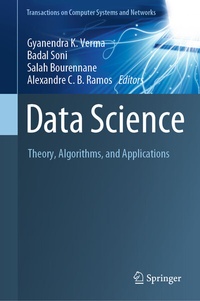
Data Science
Description

This book targets an audience with a basic understanding of deep learning, its architectures, and its application in the multimedia domain. Background in machine learning is helpful in exploring various aspects of deep learning. Deep learning models have a major impact on multimedia research and raised the performance bar substantially in many of the standard evaluations. Moreover, new multi-modal challenges are tackled, which older systems would not have been able to handle. However, it is very difficult to comprehend, let alone guide, the process of learning in deep neural networks, there is an air of uncertainty about exactly what and how these networks learn. By the end of the book, the readers will have an understanding of different deep learning approaches, models, pre-trained models, and familiarity with the implementation of various deep learning algorithms using various frameworks and libraries.
More details
Other editions
Additional editions
Persons
Gyanendra K. Verma
is currently working as Assistant Professor at the Department of Computer Engineering, National Institute of Technology Kurukshetra, India. He has completed his B. Tech. from Harcourt Butler Technical University (formerly HBTI) Kanpur, India, and M. Tech. & Ph.D. from Indian Institute of Information Technology Allahabad (IIITA), India. His all degrees are in Information Technology. He has teaching and research experience of over six years in the area of Computer Science and Information Technology with a special interest in image processing, speech and language processing, human-computer interaction. His research work on affective computing and the application of wavelet transform in medical imaging and computer vision problems have been cited extensively. He is a member of various professional bodies like IEEE, ACM, IAENG & IACSIT.
Badal Soni
is currently working as Assistant Professor at the Department of Computer Engineering, National Institute of Technology Silchar, India. He has completed his B. Tech. from Rajiv Gandhi Technical University (formerly RGPV) Bhopal, India, and M. Tech from Indian Institute of Information Technology, Design, and Manufacturing (IITDM), Jabalpur, India. He received Ph.D. from the National Institute of Technology Silchar, India. His all degrees are in Computer Science and Engineering. He has teaching and research experience of over seven years in the area of computer science and information technology with a special interest in computer graphics, image processing, speech and language processing. He has published more than 35 papers in refereed Journals, contributed books, and international conference proceedings. He is the Senior member of IEEE and professional members of various bodies like IEEE, ACM, IAENG & IACSIT.
Salah Bourennane
received his Ph.D. degree from Institut National Polytechnique de Grenoble, France. Currently, he is a Full Professor at the Ecole Centrale Marseille, France. He is the head of the Multidimensional Signal Processing Group of Fresnel Institute. His research interests are in statistical signal processing, remote sensing, telecommunications, array processing, image processing, multidimensional signal processing, and performance analysis. He has published several papers in reputed international journals.
Alexandre Carlos B Ramos is the associate Professor of Mathematics and Computing Institute - IMC from Federal University of Itajubá - UNIFEI (MG). His interest areas are multimedia, artificial intelligence, human-computer interface, computer-based training, and e-learning. Dr. Ramos has over 18 years of research and teaching experience. He did his Post-doctorate at the EcoleNationale de l`AviationCivile - ENAC (France, 2013-2014), PhD and Master in Electronic and Computer Engineering from InstitutoTecnológico de Aeronáutica -ITA (1996 and 1992). He completed his graduation in Electronic Engineering from the University of Vale do Paraíba - UNIVAP (1985) and sandwich doctorate at Laboratoired'Analyse et d'Architecture des Systèmes - LAAS (France, 1995-1996). He has professional experience in the areas of Process Automation with an emphasis on chemical and petrochemical processes (Petrobras 1983-1995); and Computer Science, with emphasis on Information Systems (ITA/ Motorola 1997-2001), acting mainly on the following themes: Development of Training Simulators with the support of Intelligent Tutoring Systems, Hybrid Intelligent Systems, and Computer Based Training, Neural Networks in Trajectory Control in Unmanned Vehicles, Pattern Matching and Image Digital Processing.
