

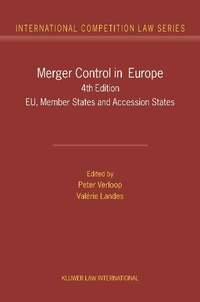
Merger Control in Europe
EU, Member States and Accession States
4th Edition
Published on 26. June 2003
459 pages
978-90-411-7992-0 (ISBN)
Description

Merger control in Europe has continued to evolve rapidly. In addition to significant changes in the national merger control regimes in Denmark, France, Germany, the United Kingdom, and Portugal, a new EU Merger Regulation is expected to enter into force on 1 May 2004 - a measure that will launch the most far-reaching reform of European merger control since the adoption of the EC Merger Regulation in December 1989. This updated edition of the pre-eminent work in the field offers practitioners expert guidance through the next phase of this crucial aspect of business and economic activity in Europe.
Like earlier editions, this new edition of Merger Control in Europe introduces practitioners and interested academics to the issues of merger control which are relevant when preparing an acquisition within the European Union. In order to provide insight into problem areas at each national level, and to allow possible comparisons, it includes a chapter on each of the 14 EU countries with a merger control regime, as well as one on the EU itself. In addition, as a first step towards the expected enlargement of the European Union in 2004, this new edition welcomes contributions on Hungary, Poland, the Czech Republic, and Cyprus.
For each jurisdiction, the major elements of merger control law - the definition of concentration, control or notification thresholds, procedure, and substantive test clearance or appraisal, as well as other issues unique to each country - are all covered in some detail. For any of the jurisdictions, the practitioner will quickly be able to determine the precise scope of such important considerations as the following:
- concept of concentration;
- notification requirements;
- procedural time-frame;
- sanctions for violation of procedural rules;
- special rules governing banks, building and loan associations, the media sector, insurance, and other specific areas of business;
- political intervention possibilities;
- publicity and confidentiality;
- consultation of works council;
- co-operation within the framework of the European Competition Authorities (ECA);
- test for clearance;
- economic benefits and disadvantages analysis;
- what constitutes substantial lessening of competition;
- remedies (both behavioural and structural); and
- appeal against decisions regarding the test for clearance.
Each chapter, written by one or more practising lawyers from major European law firms, is expertly grounded in the relevant law and takes into account changes in legislation and recent decisions. The book also contains a detailed introductory 20-page chart allowing readers to compare the basic elements of merger control law in all of the countries covered and in the EU.
Like its three predecessors, this 4th Edition of Merger Control in Europe will quickly become the most relied-upon handbook in the field for business people and their counsel doing business in Europe.
Like earlier editions, this new edition of Merger Control in Europe introduces practitioners and interested academics to the issues of merger control which are relevant when preparing an acquisition within the European Union. In order to provide insight into problem areas at each national level, and to allow possible comparisons, it includes a chapter on each of the 14 EU countries with a merger control regime, as well as one on the EU itself. In addition, as a first step towards the expected enlargement of the European Union in 2004, this new edition welcomes contributions on Hungary, Poland, the Czech Republic, and Cyprus.
For each jurisdiction, the major elements of merger control law - the definition of concentration, control or notification thresholds, procedure, and substantive test clearance or appraisal, as well as other issues unique to each country - are all covered in some detail. For any of the jurisdictions, the practitioner will quickly be able to determine the precise scope of such important considerations as the following:
- concept of concentration;
- notification requirements;
- procedural time-frame;
- sanctions for violation of procedural rules;
- special rules governing banks, building and loan associations, the media sector, insurance, and other specific areas of business;
- political intervention possibilities;
- publicity and confidentiality;
- consultation of works council;
- co-operation within the framework of the European Competition Authorities (ECA);
- test for clearance;
- economic benefits and disadvantages analysis;
- what constitutes substantial lessening of competition;
- remedies (both behavioural and structural); and
- appeal against decisions regarding the test for clearance.
Each chapter, written by one or more practising lawyers from major European law firms, is expertly grounded in the relevant law and takes into account changes in legislation and recent decisions. The book also contains a detailed introductory 20-page chart allowing readers to compare the basic elements of merger control law in all of the countries covered and in the EU.
Like its three predecessors, this 4th Edition of Merger Control in Europe will quickly become the most relied-upon handbook in the field for business people and their counsel doing business in Europe.
More details
Other editions
Additional editions
Book
06/2003
4th Edition
Kluwer Law International
€279.29
Shipment within 10-20 days
Content
- Cover
- Half Title Page
- Title Page
- Copyright Page
- Table of Contents
- INTRODUCTION BY THE EDITORS
- SURVEY OF MERGER CONTROL IN EUROPE
- EUROPEAN UNION
- 1. INTRODUCTION
- 2. DEFINITION OF CONCENTRATION
- 2.1. Operations Which Qualify as Concentrations
- 2.2. Joint Ventures
- 3. CONTROL THRESHOLDS
- 3.1. Thresholds
- 3.2. Foreign-to-foreign Mergers
- 3.3. Criteria for Calculation of Turnover
- 3.4. Special Rules
- 3.5. Exceptions to the One-stop Shop Principle
- 3.6. Applicability of Articles 81 and 82 Post-Merger Regulation
- 4. PROCEDURE
- 4.1. Notification
- 4.1.1. Mandatory Obligation/Suspension Effect
- 4.1.2. Time-limit
- 4.1.3. Contents of the Notification
- 4.2. Investigation
- 4.2.1. First Phase Procedure
- 4.2.2. Second Phase Procedure
- 4.2.3. Simplified Procedure
- 4.3. Sanctions for Violation of Procedural Rules
- 4.4. Publicity and Confidentiality
- 4.5. Judicial Review
- 5. SUBSTANTIVE TEST FOR CLEARANCE
- 5.1. Dominance
- 5.1.1. Relevant Market
- 5.1.2. Concept of Dominance
- 5.1.3. Vertical, Conglomerate Mergers, Indirect Effects
- 5.2. Other Tests
- 5.3. Remedies
- 5.4. Ancillary Restraints
- AUSTRIA
- 1. INTRODUCTION
- 1.1. Overview
- 1.2. Competent Authorities
- 2. DEFINITION OF CONCENTRATIONS
- 2.1. Operations Which Qualify as Concentrations
- 2.1.1. Acquisition of a Business
- 2.1.2. Acquisition of Rights over Another's Business
- 2.1.3. Acquisition of Shares
- 2.1.4. Interlocking Boards
- 2.1.5. Catch-all Clause
- 2.2. Joint Ventures
- 3. CONTROL THRESHOLDS
- 3.1. Notification Thresholds
- 3.2. Foreign-to-Foreign Mergers
- 3.3. Criteria for Calculation of Turnover
- 3.4. Special Rules
- 3.4.1. Banks or Building and Loan Associations
- 3.4.2. Media Sector
- 3.4.3. Insurance Undertakings
- 3.5. Exemption from Any Notification Requirement
- 4. PROCEDURE
- 4.1. Notification
- 4.1.1. Mandatory Obligation/Suspension Requirements
- 4.1.2. Time-limit
- 4.1.3. Content
- 4.2. Investigation
- 4.2.1. First Phase - Preliminary Investigation Procedure
- 4.2.2. Second Phase - Investigation Procedure
- 4.3. Sanctions for Violation of Procedural Rules
- 4.3.1. Failure to Notify
- 4.3.2. Incomplete/Incorrect Information
- 4.4. Publicity and Confidentiality
- 4.5. Judicial Review
- 5. SUBSTANTIVE TEST FOR CLEARANCE
- 5.1. Dominance
- 5.2. Other Test: Balancing Clause
- 5.3. Remedies
- 6. OTHER ISSUES
- 6.1. Relations EU/National
- 7. SUMMARY
- 7.1. Definition of Concentrations
- 7.2. Joint Ventures
- 7.3. Notification Thresholds
- 7.4. Notification and Sanctions
- 7.5. Time Limits for Notification
- 7.6. Procedural Time Frame and Suspension Requirements
- 7.6.1. Large Concentrations
- 7.7. Substantive Test for Clearance and Political Intervention Possibilities
- 7.8. Competent Authorities
- BELGIUM
- 1. INTRODUCTION
- 1.1. Main Provisions
- 1.2. Competent Authorities
- 2. THE DEFINITION OF A CONCENTRATION
- 2.1. Operations Which Qualify as Concentrations
- 2.2. Joint Ventures
- 2.3. Operations which do not Constitute Concentrations
- 3. CONTROL THRESHOLDS
- 3.1. Thresholds
- 3.2. Foreign-to-foreign Mergers
- 4. PROCEDURE
- 4.1. Notification
- 4.1.1. Mandatory Obligation/Suspension Requirements
- 4.1.2. The Term for Notification
- 4.1.3. Contents of the Notification
- 4.2. Investigation
- 4.2.1. First Phase Procedure
- 4.2.2. Second Phase Procedure
- 4.2.3. Exceptional Procedure
- 4.3. Sanctions for Violation of Procedural Rules
- 4.4. Judicial Review
- 5. SUBSTANTIVE TEST
- 5.1. Dominance
- 5.1.1. Dominance Issues
- 5.1.2. Criteria for the Assessment of Concentrations
- 5.1.3. The Prohibition Decisions so far
- 5.2. Remedies
- 5.3. Ancillary Restraints
- 6. CONCLUSION
- CYPRUS
- 1. INTRODUCTION
- 2. DEFINITION OF A CONCENTRATION
- 3. CONTROL THRESHOLDS
- 4. PROCEDURE
- 4.1. Notification
- 4.2. Investigation
- 5. SUBSTANTIVE TEST FOR CLEARANCE
- CZECH REPUBLIC
- 1. INTRODUCTION
- 2. DEFINITION OF A CONCENTRATION
- 2.1. Operations Which Qualify as Concentrations
- 2.2. Joint Ventures
- 2.3. Operations which do not Constitute a Concentration
- 3. NOTIFICATION THRESHOLDS
- 3.1. Turnover Thresholds
- 3.2. Foreign-to-Foreign Concentrations
- 3.3. Criteria for the Calculation of Turnover
- 3.4. Special Rules
- 4. PROCEDURE
- 4.1. Notification
- 4.1.1. Mandatory Notification/Suspension Requirements
- 4.1.2. Time Limits
- 4.1.3. Content of the Notification
- 4.2. Procedure
- 4.2.1. Phase One Proceedings
- 4.2.2. Phase Two Proceedings
- 4.3. Sanctions for Breach of Merger Clearance Rules
- 4.3.1. Pecuniary Sanctions
- 4.3.2. Remedial Measures
- 4.3.3. Involvement of European Commission
- 4.3.4. Revocation of Clearance
- 5. TEST FOR CLEARANCE
- 5.1. Dominance
- 5.2. Conditions
- 5.3. Ancillary Restraints
- DENMARK
- 1. INTRODUCTION
- 2. CONCEPT OF CONCENTRATION
- 2.1. Operations which Qualify as Concentrations
- 2.2 Joint Ventures
- 2.3. Operations which do not Constitute a Concentration
- 3. CONTROL THRESHOLDS
- 3.1. Jurisdictional Thresholds
- 3.2. Criteria for the Calculation of Turnover
- 4. PROCEDURE
- 4.1. Notification
- 4.2. Investigation
- 4.2.1. Two Phases
- 4.2.2. The Simplified Procedure
- 4.3. Sanctions for Violation of Procedural Rules
- 4.4. Publicity and Confidentiality
- 5. SUBSTANTIVE TEST
- 5.1. Dominance
- 5.2. Impediment of Effective Competition
- 5.3. Remedies
- 5.4. Ancillary Restraints
- 6. SUMMARY
- FINLAND
- 1. INTRODUCTION
- 2. DEFINITION OF A CONCENTRATION
- 2.1. Operations which Qualify as Concentrations
- 2.2. Joint Ventures
- 3. CONTROL THRESHOLDS
- 3.1. Thresholds
- 3.2. Foreign-to-Foreign Mergers
- 3.3. Criteria for the Calculation of Turnover
- 3.4. Special Rules
- 4. PROCEDURE
- 4.1. Notification
- 4.1.1. Mandatory Obligation/Suspension Requirements
- 4.1.2. Time-Limit
- 4.1.3. Content of the Notification
- 4.2. Investigation
- 4.2.1. Phase I
- 4.2.2. Phase II
- 4.2.3. Special procedure for Insurance Companies
- 4.3. Sanctions for Violation of Procedural Rules
- 4.4. Judicial Review
- 5. SUBSTANTIVE TEST
- 5.1. Dominance
- 5.2. Other Test/Exception
- 5.3. Remedies
- 5.4. Ancillary Restraints
- FRANCE
- 1. INTRODUCTION
- 2. DEFINITION OF A CONCENTRATION
- 2.1. Operations which Qualify for a Concentration
- 2.2. Joint Ventures
- 3. CONTROL THRESHOLDS
- 3.1. Thresholds
- 3.2. Foreign-to-Foreign Mergers
- 3.3. Criteria for the Calculation of Turnover
- 3.4. Special Rules
- 4. PROCEDURE
- 4.1. Notification
- 4.1.1. Mandatory Notification and Suspension Requirements
- 4.1.2. Time-limits
- 4.1.3. Content
- 4.2. Investigation
- 4.2.1. Phase I/Phase II
- 4.2.2. Final decision of the Minister of the Economy
- 4.2.3. Consultation of Works Council
- 4.2.4. Co-operation within the Framework of the European Competition Authorities (ECA)
- 4.2.5. Relationship between the French Authorities and the European Commission
- 4.3. Sanction for Violation of Procedural Rules
- 4.4. Publicity and Confidentiality
- 4.5. Judicial Review
- 5. SUBSTANTIVE TEST
- 5.1. First Step of the Analysis: Consequences of the Concentration on the Competitive Market Situation
- 5.1.1. Product Market Definition
- 5.1.2. Geographic Market Definition
- 5.1.3. Other Market Definition Considerations
- 5.2. Second Step of the Analysis: Economic Benefits/Disadvantages Analysis
- 5.3. Remedies
- 5.4. Ancillary Restraints
- 6. SUMMARY
- GERMANY
- 1. INTRODUCTION
- 2. DEFINITION OF CONCENTRATION
- 2.1. Overview
- 2.2. General: Merger Control Applies to "Enterprises" Only
- 2.3. Merger by Acquisition of Assets
- 2.4. Merger by Acquisition of Shares
- 2.5. Merger by Acquisition of Control
- 2.6. Merger by Exercise of Influence which is Substantial as Regards Competition
- 2.7. Exceptions
- 2.7.1. Transactions between Affiliated Companies, Restructuring of Groups
- 2.7.2. Acquisition of Shares by Banks, etc.
- 3. JOINT VENTURES
- 4. NOTIFICATION THRESHOLDS/JURISDICTION ISSUES
- 4.1. Basic Turnover Thresholds for German Merger Control to Apply
- 4.2. Effect of Mergers in Germany, in Particular: Foreign-to-Foreign Mergers
- 4.3. De Minimis Thresholds for Exceptions from German Merger Control
- 4.3.1. Small-Scale Enterprises
- 4.3.2. De Minimis market
- 4.4. Specific Thresholds for Newspaper/Magazine Publishing and Broadcasting
- 4.5. Method of Calculating Turnover
- 5. NOTIFICATION/SANCTIONS
- 5.1. Mandatory Pre-merger Notification without Official Form
- 5.2. Content of Notification
- 5.3. Exception from Notification Requirement: Referral by European Commission
- 5.4. Sanctions
- 5.4.1. Incomplete notification
- 5.4.2. Failure to Notify
- 5.4.3. Prohibition to Consummate
- 5.4.4. Dissolution of Consummated Mergers
- 6. NO TIME-LIMITS FOR NOTIFICATIONS
- 7. PROCEDURE
- 7.1. Time-frame and Standstill Obligation
- 7.2. Imposition of Conditions/Undertakings by Clearance Decision
- 7.3. Fees Charged by the FCO
- 7.4. Written Statement of Reasons: Increased Transparency
- 8. SUBSTANTIVE TEST: DOMINANCE
- 8.1. General Rule: Prohibition of Dominant Positions/Possibility to Override Anti-competitive Effects of Merger
- 8.2. Creation of Market Dominance or Strengthening of an Already Existing Position of Market Dominance
- 8.2.1. Definition of Market Dominance
- 8.2.2. Assessment of Market Dominance
- 8.2.3. Creation of a Dominant Position
- 8.2.4. Strengthening of a Dominant Position
- 8.3. Presumption of Market Dominance
- 8.4. Balancing Clause
- 8.4.1. Improvement of Competitive Conditions
- 8.4.2. Balancing
- 8.4.3. Examples
- 9. COMPETENT AUTHORITIES
- 9.1. Federal Cartel Office
- 9.2. Approval by Federal Minister of Economics
- 9.3. Judicial Review
- 9.3.1. General
- 9.3.2. Third Party Rights
- 10. SUMMARY
- GREECE
- 1. INTRODUCTION
- 1.1. Development of the Law
- 1.2. First and Second Amendment of Act 703/1977 by Acts 1934/1991, 2000/1991
- 1.3. Third Amendment of Act 703/1977 by Act 2296/1995
- 1.4. The Provisions of Act 2837/2000
- 2. DEFINITION OF CONCENTRATION
- 2.1. Operations which Qualify for a Concentration
- 2.2. Joint Ventures
- 2.3. Operations which do not Constitute a Concentration
- 3. CONTROL THRESHOLDS
- 4. PROCEDURE
- 4.1. Notification/Pre-notification
- 4.1.1. Mandatory Obligation/Suspension Requirements
- 4.1.2. Time Limits
- 4.1.3. Content
- 4.2. Investigation
- 4.3. Sanctions for Violation of Procedural Rules
- 4.4. Judicial Review
- 5. SUBSTANTIVE TEST
- HUNGARY
- 1. INTRODUCTION
- 2. THE DEFINITION OF CONCENTRATION
- 3. CONTROL THRESHOLDS
- 3.1. General
- 3.2. The HUF 500 Million Threshold
- 3.3. The HUF 10 Billion Threshold
- 3.4. Criteria for Calculation of Turnover
- 3.5. Filing Fees
- 4. PROCEDURE
- 4.1. Mandatory Obligation
- 4.2. Investigation
- 4.3. Sanctions for the Violation of Procedural Rules
- 5. SUBSTANTIVE TEST
- IRELAND
- 1. INTRODUCTION
- 1.1. Main Legislative Provisions
- 1.1.1. The Mergers and Take-overs (Control) Act, 1978
- 1.1.2. The Competition Act
- 1.1.3. Summary of the Merger Control Provisions in the 2002 Act
- 1.1.4. The General Provisions on Competition Law in the 2002 Act
- 1.1.5. Other Relevant Legislation
- 1.2. Competent Authorities
- 1.2.1. The Competition Authority
- 1.2.2. The Minister for Enterprise, Trade and Employment
- 1.3. Other Regulatory Authorities
- 2. DEFINITION OF A CONCENTRATION
- 2.1. Overview
- 2.2. Operation which Qualifies as a Concentration
- 2.3. Mergers
- 2.4. The Acquisition of Control
- 2.5. Asset Acquisitions
- 2.6. Joint Ventures
- 2.7. Operations which do not Constitute a Concentration
- 3. THRESHOLDS
- 3.1. Thresholds
- 3.2. Undertakings Involved
- 3.3. Calculation of Turnover
- 3.4. "Carrying on Business"
- 3.5. Foreign-to-Foreign Transaction
- 3.6. Exemptions/Exceptions
- 3.6.1. Specified Class
- 3.6.2. Media Mergers
- 4. PROCEDURE
- 4.1. Notification
- 4.1.1. Mandatory Notification
- 4.1.2. Suspension Requirement
- 4.1.3. Time Limit
- 4.1.4. Content
- 4.1.5. Fee
- 4.2. Investigation
- 4.2.1. Time Limits
- 4.2.2. Initial Examination
- 4.2.3. Full Investigation
- 4.3. Sanctions for Violation of Procedural rules
- 4.3.1. Failure to Notify
- 4.3.2. Incomplete/Incorrect Information
- 4.3.3. Completion before Clearance
- 4.4. Publicity and Confidentiality
- 4.4.1. Publicity, Complaints and Interveners
- 4.4.2. Protection of Business Secrets and Confidentiality
- 4.5. Appeals
- 4.6. Procedure in Relation to Media Mergers
- 4.7. Procedure in Relation to Voluntary Notification
- 5. SUBSTANTIVE APPRAISAL
- 5.1. Substantial Lessening of Competition
- 5.2. Horizontal Transactions
- 5.2.1. Market Definition
- 5.2.2. Concentration analysis
- 5.2.3. Competitive Effects Analysis
- 5.2.4. Unilateral Effects
- 5.2.5. Coordinated Effects Analysis
- 5.2.6. Entry as a Constraint
- 5.2.7. Efficiencies
- 5.2.8. Failing Firm
- 5.3. Non-horizontal Mergers
- 5.3.1. The Overall Approach to Non-horizontal Mergers
- 5.3.2. Market Foreclosure
- 5.3.3. Coordinated Effects
- 5.3.4. Portfolio Effects
- 5.4. Remedies
- 5.5. Ancillary Restrictions
- 6. OTHER ISSUES
- 6.1. Relationship between Irish and EU Merger Control Law
- 6.2. Other Regulatory Approvals536
- 6.3. Central Bank Act, 1989 - Acquiring Transactions
- 6.4. 2BCD Regulations - Acquisition of Ownership Interests
- 6.5. Investment Business Firms and Fund Management and Administration
- 6.6. 1994 Non-Life Insurance Regulations and 1994 Life Assurance Regulations
- ITALY
- 1. INTRODUCTION
- 1.1. The Italian Merger Control System
- 1.2. The Italian Antitrust Authority
- 1.3. Relationship between the Authority and the European Commission and other Authorities
- 2. DEFINITION OF CONCENTRATION
- 2.1. Operations which Qualify for Concentrations
- 2.2. Joint Ventures
- 2.3. Operations which do not Constitute a Concentration
- 3. CONTROL THRESHOLDS
- 3.1. Thresholds
- 3.2. Special Rules
- 4. PROCEDURE
- 4.1. Notification
- 4.1.1. Mandatory Obligation/Suspension Requirements
- 4.1.2. Time-limit
- 4.1.3. Content of the Notification
- 4.2. Investigation
- 4.2.1. First Phase Procedure
- 4.2.2. Second Phase Procedure
- 4.3. Sanctions for Violation of Procedural Rules
- 4.4. Publicity and Confidentiality
- 4.5. Judicial Review and Redress
- 5. SUBSTANTIVE TEST FOR CLEARANCE
- 5.1. Dominance
- 5.1.1. Market Definition
- 5.1.2. Concept of Dominance
- 5.1.3. Oligopolistic Dominance
- 5.1.4. Operations Forbidden by the Authority
- 5.2. Clearance or Prohibition due to National Economic Interest
- 5.3. Remedies
- 5.3.1. Behavioural Remedies
- 5.3.2. Structural Remedies
- 5.4. Ancillary Restraints
- 6. CONCLUSION
- THE NETHERLANDS
- 1. INTRODUCTION
- 2. DEFINITION OF A CONCENTRATION
- 2.1. Operations which Qualify for Concentrations
- 2.2. Joint Ventures
- 2.3. Exceptions
- 3. CONTROL THRESHOLDS
- 3.1. Thresholds
- 3.2. Criteria for the Calculation of Turnover
- 3.3. Special Rules
- 3.4. Exemption/Exceptions
- 4. PROCEDURE
- 4.1. Notification
- 4.1.1. Mandatory/Suspension Requirements
- 4.1.2. Time-limit
- 4.1.3. Content
- 4.2. Investigation
- 4.2.1. Phase I: Notification of the Proposed Concentration
- 4.2.2. Phase II: Application for a Licence
- 4.3. Sanctions for Violation of Procedural Rules
- 4.4. Publicity and Confidentiality
- 4.5. Judicial Protection and Request to the Minister
- 4.5.1. Appeal against the NMa's Decisions
- 4.5.2. Request to the Minister of Economic Affairs
- 5. SUBSTANTIVE TEST
- 5.1. Dominance
- 5.2. Remedies
- 5.3. Ancillary Restraints
- POLAND
- 1. INTRODUCTION
- 2. CONCEPT OF A CONCENTRATION
- 2.1. Operations which Qualify for Concentrations
- 2.2. Joint Ventures
- 3. NOTIFICATION THRESHOLDS
- 3.1. Turnover Thresholds
- 3.2. Market Share Threshold
- 3.3. Foreign-to-Foreign Concentrations
- 3.4. Exemptions from the Notification Obligation
- 4. PROCEDURE
- 4.1. Notification
- 4.1.1. Mandatory Obligation/Suspension Requirements
- 4.1.2. Time Limits for Notification
- 4.1.3. Notification Form and Fees
- 4.2. Investigation
- 4.3. Sanctions for Violation of Procedural Rules
- 4.4. Confidentiality and Third Party Rights
- 4.5. Judicial Review
- 5. SUBSTANTIVE TEST
- 5.1. Dominance
- 5.2. Remedies
- PORTUGAL
- 1. INTRODUCTION
- 2. DEFINITION OF A CONCENTRATION
- 2.1. Overview
- 2.2. Operations that Qualify as a Concentration
- 2.3. Operations which do not Qualify as a Concentration
- 3. CONTROL THRESHOLDS
- 3.1. The Act Foresees Two Alternative Thresholds that may Trigger the Obligation to Notify
- 3.1.1. Creation or Reinforcement of Market Share
- 3.1.2. Turnover Threshold
- 3.2. Territorial Scope of the Act (Foreign to Foreign Mergers)
- 3.3. Exceptions
- 4. PROCEDURE
- 4.1. Notification
- 4.2. Content
- 4.3. Investigation
- 4.4. Sanctions for Violation of Procedural Rules
- 4.5. Completion before Clearance
- 4.6. Publicity and Confidentiality
- 4.7. Judicial Review
- 5. SUBSTANTIVE TEST
- 5.1. The Dominance Test
- 5.2. Practical Application
- SPAIN
- 1. INTRODUCTION
- 2. DEFINITION OF "CONCENTRATION"
- 2.1. Overview/Operations which Qualify for Concentrations
- 2.1.1. Merger
- 2.1.2. Division
- 2.1.3. Acquisition of Control
- 2.2. Joint Ventures
- 3. CONTROL THRESHOLDS
- 3.1. Jurisdictional Thresholds
- 3.2. Foreign-to-Foreign Mergers
- 3.3. Market Share Threshold
- 3.4. Criteria for the Calculation of Turnover
- 3.4.1. Groups of Companies
- 3.4.2. Joint Control of a Company
- 3.4.3. Acquisition of Part of One or More Companies
- 3.5. Special Rules
- 3.5.1. Credit Institutions and Other Financial Institutions
- 3.5.2. Insurance Companies
- 3.6. Control of Concentrations and Restrictive Practices
- 4. PROCEDURE
- 4.1. Notification
- 4.1.1. Mandatory Obligation/Suspension Requirement
- 4.1.2. Time Limits for Notification
- 4.1.3. Content of the Notification
- 4.2. Investigation
- 4.2.1. First Stage Procedure: the Service for the Defence of Competition
- 4.2.2. Second Stage Procedure: the Council for the Defence of Competition
- 4.2.3. Third Stage Procedure: the Government
- 4.2.4. Subsidiarity of the Administrative Procedure Law
- 4.3. Relationship between the Spanish Authorities and the European Commission
- 4.3.1. Referrals under Article 9 of the EC Merger Regulation
- 4.3.2. Requests under Article 22(3) of the EC Merger Regulation
- 4.4. Publicity and Confidentiality
- 4.5. Judicial Review
- 5. SUBSTANTIVE TEST FOR CLEARANCE
- 5.1. Maintenance of Effective Competition
- 5.2. Remedies
- 6. SPECIAL PROVISIONS REGULATING CONCENTRATIONS CARRIED OUT THROUGH PUBLIC BIDS: ROYAL DECREE 1197/1991, OF 26 JULY
- 6.1. Notification by the Bidder
- 6.2. Referral of Non-notified Transactions to the Service for the Defence of Competition by the National Stock Exchange Commission
- 6.3. Publicity
- SWEDEN
- 1. INTRODUCTION
- 2. DEFINITION OF CONCENTRATION
- 2.1. Operations which Qualify for Concentrations
- 2.1.1. Definition of a Concentration
- 2.1.2. Definition of an Undertaking
- 2.1.3. Definition of Undertakings Concerned
- 2.1.4. Jurisdictional issues
- 2.1.5. Joint Ventures
- 3. NOTIFICATION THRESHOLDS
- 3.1. Two Thresholds
- 3.2. Foreign-to-Foreign Concentrations
- 3.3. Criteria for Calculation of Turnover
- 4. THE PROCEDURAL RULES
- 4.1. Notification
- 4.1.1. Mandatory Notification/Suspension Requirements
- 4.1.2. Time Limits
- 4.1.3. Content of Notifications
- 4.2. Investigation
- 4.2.1. First Phase Investigation
- 4.2.2. Second Phase Investigation
- 4.3. Enforcement Agencies and Adjudicative Bodies
- 4.3.1. Enforcement Agencies
- 4.3.2. Adjudicative Bodies
- 4.4. Confidentiality, Trade Secrets and Disclosure
- 5. SUBSTANTIVE TEST
- 5.1. The Dominance Test
- 5.2. Other Test: The National Interest Test
- 5.3. Decisions and Case-law Regarding the Test for Clearance
- 5.4. Remedies
- 5.5. Ancillary Restrictions
- 6. SPECIAL RULES
- UNITED KINGDOM
- 1. INTRODUCTION
- 1.1. General Principles of UK Merger Control
- 1.2. Competent Authorities
- 1.2.1. Director General of Fair Trading
- 1.2.2. Secretary of State for Trade and Industry
- 1.2.3. Competition Commission
- 2. DEFINITION OF A CONCENTRATION
- 2.1. Qualifying Merger
- 2.2. "Enterprise"
- 2.3. "Ceasing to be Distinct"
- 2.3.1. De Iure Control
- 2.3.2. De Facto Control
- 2.3.3. Material Influence
- 3. CONTROL THRESHOLDS
- 3.1. Thresholds
- 3.2. The "Assets" Test
- 3.3. The "Share of Supply" Test
- 3.3.1. Measuring Share of Supply
- 3.3.2. Description of Goods or Services: Market Definition
- 3.3.3. "Substantial Part of the United Kingdom"
- 3.4. Competition Act 1998
- 4. PROCEDURE
- 4.1. No Mandatory Notification
- 4.1.1. "Standard" OFT Clearance
- 4.1.2. Merger Notice Procedure
- 4.1.3. Confidential Guidance
- 4.1.4. Merger Fees
- 4.2. Reference to the CC
- 4.2.1. Time Limits for Reference
- 4.2.2. Interim Measures
- 4.2.3. Period of Reference
- 4.2.4. CC Procedure
- 4.2.5. Powers of the CC to Compel Evidence
- 4.3. Confidentiality in Cases Referred to the CC
- 4.4. Judicial Review
- 5. SUBSTANTIVE TESTS
- 5.1. Public Interest Test/Substantial Lessening of Competition
- 5.2. Assessment Criteria
- 5.3. Remedies
- 5.3.1. Undertakings in Lieu of Reference to the CC
- 5.3.2. Remedies in Cases Referred to the CC
- CONTRIBUTORS
- Back Cover
