

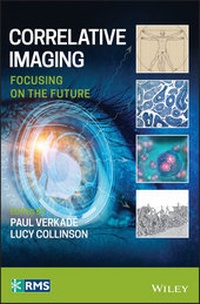
Correlative Imaging
Description

This book provides contributions from international experts on correlative imaging, describing their vision of future developments in the field based on where it is today. Starting with a brief historical overview of how the field evolved, it presents the latest developments in microscopy that facilitate the correlative workflow. It also discusses the need for an ideal correlative probe, applications in proteomic and elemental analysis, interpretation methods, and how correlative imaging can incorporate force microscopy, soft x-ray tomography, and volume electron microscopy techniques. Work on placing individual molecules within cells is also featured.
Correlative Imaging: Focusing on the Future offers in-depth chapters on: correlative imaging from an LM perspective; the importance of sample processing for correlative imaging; correlative light and volume EM; correlation with scanning probe microscopies; and integrated microscopy. It looks at: cryo-correlative microscopy; correlative cryo soft X-ray imaging; and array tomography. Hydrated-state correlative imaging in vacuo, correlating data from different imaging modalities, and big data in correlative imaging are also considered.
* Brings a fresh view to one of the hottest topics within the imaging community: the correlative imaging field
* Discusses current research and offers expert thoughts on the field's future developments
* Presented by internationally-recognized editors and contributors with extensive experience in research and applications
* Of interest to scientists working in the fields of imaging, structural biology, cell biology, developmental biology, neurobiology, cancer biology, infection and immunity, biomaterials and biomedicine
* Part of the Wiley-Royal Microscopical Society series
Correlative Imaging: Focusing on the Future will appeal to those working in the expanding field of the biosciences, correlative microscopy and related microscopic areas. It will also benefit graduate students working in microscopy, as well as anyone working in the microscopy imaging field in biomedical research.
More details
Other editions
Additional editions
Persons
PROFESSOR PAUL VERKADE, PHD, has been working in the field of Correlative Microscopy for over 15 years and is currently based at the School of Biochemistry at the University of Bristol, United Kingdom.
DR LUCY COLLINSON, PHD, has been working in the field of Correlative Microscopy for the last 18 years and is currently Head of Electron Microscopy at the Francis Crick Institute, London, United Kingdom.
Content
List of Contributors xi
Preface xiii
1 It's a Small, Small World: A Brief History of Biological Correlative Microscopy 1
Christopher J. Guérin, Nalan Liv, and Judith Klumperman
1.1 It All Began with Photons 1
1.2 The Electron Takes Its Place 2
1.3 Putting It Together, 1960s to 1980s 3
1.4 CLEM Matures as a Scientific Tool 1990 to 2017 4
Acknowledgments 13
References 13
2 Challenges for CLEM from a Light Microscopy Perspective 23
Kurt Anderson, Tommy Nilsson, and Julia Fernandez-Rodriguez
2.1 Introduction 23
2.1.1 Electron and Light Microscopy 23
2.1.2 Correlative Microscopy: Two Cultures Collide 25
2.2 Microscopy Multiculturalism 26
2.2.1 When Fluorescence Light Microscopy Resolution is Not Enough 26
2.2.2 The Fluorescence Microscopy (FM), Needle/Haystack Localization 27
2.2.3 Electron Microscopy, Visualizing the Ultrastructure 27
2.2.4 Finding Coordinates 28
2.3 Bridging the Gap between Light and Electron Microscopy 29
2.3.1 Finding the Same Cell Structure in Light and Electron Microscopes 29
2.3.2 Making the Fluorescence Labels Visible in the Electron Microscope 29
2.3.3 Visualizing Membrane Trafficking Using CLEM 30
2.4 Future CLEM Applications and Modifications 31
2.4.1 Correlative Reflection Contrast Microscopy and Electron Microscopy in Tissue Sections 31
2.4.2 Dynamic and Functional Probes for CLEM 32
References 34
3 The Importance of Sample Processing for Correlative Imaging (or, Rubbish In, Rubbish Out) 37
Christopher J. Peddie and Nicole L. Schieber
3.1 Introduction 37
3.2 Searching for Correlative Electron Microscopy Utopia 40
3.3 Sample Processing for Correlative Imaging: A Primer for the First Steps 40
3.4 Making It Go Faster (We Want More Speed, More Speed...) 42
3.5 Embedding Resins 44
3.6 Keeping the Region of Interest in Sight 45
3.7 Correlation and Relocation with Dual Modality Probes 48
3.8 Integration of Imaging Modalities, and In-Resin Fluorescence 49
3.9 Streamlining the Correlative Approaches of the Future: SmartCLEM 51
3.10 How Deep Does the Rabbit Hole Go? 52
3.11 Hold That Thought, Though - Is This All Completely Necessary? 53
3.12 Improving Accessibility to Correlative Workflows 54
3.13 Coming to the End 55
References 55
4 3D CLEM: Correlating Volume Light and Electron Microscopy 67
Saskia Lippens and Eija Jokitalo
4.1 Introduction 67
4.2 Imaging in 3D 68
4.3 Comparative and Correlative LM and EM Imaging 69
4.4 CLEM is More than LM + EM 69
4.5 3D CLEM 70
4.6 Two Workflows for 3D CLEM 71
4.7 Where is CLEM Going in the Future? 74
Acknowledgments 76
References 77
5 Can Correlative Microscopy Ever Be Easy? An Array Tomography Viewpoint 81
Irina Kolotuev and Kristina D. Micheva
5.1 Introduction 81
5.2 Why Array Tomography? 81
5.3 Array Tomography of Abundant Subcellular Structures: Synapses 82
5.4 Array Tomography of Sparsely Distributed Structures: Cisternal Organelle 84
5.5 Array Tomography of Small Model Organisms: C. elegans 87
5.6 To Summarize: Finding the Right AT Approach 90
5.7 Areas of Improvement 91
5.7.1 Resin 91
5.7.2 Serial Ultrathin Sectioning 91
5.7.3 Antibodies 92
5.7.4 EM Compatible Fluorophores 92
5.7.5 Detectors and EM Resolution 92
5.7.6 Image Registration and Alignment Tools 93
5.7.7 Data Sharing 93
5.7.8 "Dream" Resource 93
5.7.9 Dream Experiments 94
Acknowledgments 95
References 95
6 Correlative Microscopy Using Scanning Probe Microscopes 99
Georg Fantner and Frank Lafont
6.1 Introduction 99
6.2 Principles of AFM 100
6.3 AFM and Optical Microscopy Correlative Approaches 103
6.4 Correlation with CLSM 104
6.5 Correlation with Cell Mechanics 104
6.5.1 Correlation with Super-Resolution Light Microscopy (SRLM) 105
6.5.2 Future Developments 107
6.6 AFM and Correlation with Electron Microscopy 109
6.6.1 Correlation Involving AFM, EM, and Chemical Surface Characterization 110
6.6.2 Future Developments 113
6.7 Future Developments Involving Correlation Microscopy Using HS-AFM 113
6.8 Concluding Remarks 114
Acknowledgments 114
References 115
7 Integrated Light and Electron Microscopy 119
R. I. Koning, A. Srinivasa Raja, R. I. Lane, A. J. Koster, and J. P. Hoogenboom
7.1 Introduction 119
7.2 Large-Scale and High-Throughput (Volume) Microscopy 120
7.2.1 Advantages and Challenges for Large-Scale EM 120
7.2.2 Advantages of CLEM for Large-Scale EM 121
7.2.3 Prospects for Integrated Microscopy 121
7.3 Super-Resolution Fluorescence Microscopy 123
7.3.1 Advantages and Challenges for CLEM with Super-Resolution Fluorescence 123
7.3.2 Implementation of SR-FM with CLEM 124
7.3.3 Prospects for Integrated SR-CLEM 124
7.4 Cryo-Electron Microscopy 125
7.4.1 Advantages of CryoEM 125
7.4.2 Possibilities and Challenges for Correlative Cryo-Microscopy 126
7.4.2.1 Super-Resolution Fluorescence Cryo-Microscopy: Probes and Instruments 126
7.4.2.2 Transfer of Cryo-Samples between Microscopes 127
7.4.2.3 Sample Thickness 127
7.4.2.4 Data Collection Speed 128
7.4.3 Integrated Systems for CryoCLEM 129
7.4.4 Prospects for Integrated Cryo-Microscopy 129
7.5 Outlook 130
Acknowledgments 131
References 131
8 Cryo-Correlative Light and Electron Microscopy: Toward in situ Structural Biology 137
Tanmay A.M. Bharat and Wanda Kukulski
8.1 Introduction 137
8.2 Cryo-CLEM to Support Single Particle Analysis of Purified Macromolecules 138
8.3 Capturing Structural Dynamics of in vitro Reconstituted Systems 141
8.4 Identifying Macromolecules in Plunge-Frozen Whole Cells 142
8.5 Macromolecular Structures in Thinned Samples from Thick Cell Areas 144
8.6 Enabling Structural Biology in Multicellular Organisms and Tissues by Cryo-CLEM 145
8.7 Conclusions 147
Acknowledgments 147
References 147
9 Correlative Cryo Soft X-ray Imaging 155
Eva Pereiro, Francisco Javier Chichón, and Jose L. Carrascosa
9.1 Introduction to Cryo Soft X-ray Microscopy 155
9.2 Cryo-SXT Correlation with Visible Light Microscopy 159
9.3 Cryo-SXT Correlation with Cryo X-ray Fluorescence 160
9.4 Cryo-SXT Correlation with TEM 163
9.5 Multiple Correlation and Integration of Methods 165
Acknowledgments 165
References 166
10 Correlative Light- and Liquid-Phase Scanning Transmission Electron Microscopy for Studies of Protein Function in Whole Cells 171
Niels de Jonge
10.1 Introduction 171
10.2 Limitations of State-of-the-Art Methods 172
10.3 Principle of Liquid STEM 173
10.3.1 Example 1: Determination of ORAI Channel Subunit Stoichiometry by Visualizing Single Molecules Using STEM 175
10.3.1.1 Conclusions 179
10.3.2 Example 2: New Insights into the Role of HER2 179
10.3.2.1 Conclusions 182
10.4 Advantages of Liquid STEM 182
10.5 Future Prospects 184
Acknowledgments 185
References 185
11 Correlating Data from Imaging Modalities 191
Perrine Paul-Gilloteaux and Martin Schorb
11.1 Introduction 191
11.2 Registration during CLEM Stages 194
11.2.1 Registration to Guide Sample Preparation 194
11.2.2 Registration to Guide the Acquisition 195
11.2.2.1 Software Packages 195
11.2.2.2 Typical Features and Fields of View 195
11.2.3 Post-Acquisition Registration (Accurate Relocation) 196
11.2.3.1 Software and Approaches for Post-Acquisition Registration 196
11.2.4 Trust in Alignment: Accuracy in Practice 198
11.3 Registration Paradigm 198
11.3.1 Image Features to Guide the Registration 198
11.3.2 Distance Function 199
11.3.3 Transformation Basis 199
11.3.4 Optimization Strategy 200
11.4 Envisioned Future Developments 201
11.4.1 Integrative Microscopy versus Correlative Microscopy 201
11.4.2 Incorporate a Priori Knowledge of the Specimen 202
11.4.3 Toward the Use of Machine Learning 202
11.5 Visualization of Correlation 204
11.6 Conclusion 204
Acknowledgments 205
References 205
12 Big Data in Correlative Imaging 211
Ardan Patwardhan and Jason R. Swedlow
12.1 Introduction 211
12.2 The Protein Data Bank 212
12.3 Resources for Cryo-EM 212
12.4 Light Microscopy Data Resources 214
12.5 EMPIAR 215
12.6 IDR: A Prototype Image Data Resource 216
12.7 Public Resources for Correlative Imaging 217
12.7.1 CLEM Data Formats 217
12.8 Future Directions 218
12.8.1 A BioImage Archive 218
12.8.2 CLEM Data Submission Pipelines 219
12.8.3 Scaling Data Volumes and Usage 219
12.8.4 Community Adoption and International Engagement 220
Acknowledgments 220
References 221
13 The Future of CLEM: Summary 223
Lucy Collinson and Paul Verkade
Index 227
1
It's a Small, Small World: A Brief History of Biological Correlative Microscopy
Christopher J. Guérin1, Nalan Liv2, and Judith Klumperman2
1 VIB Bioimaging Core, Ghent, VIB Inflammation Research Center, Ghent and Department of Molecular Biomedical Research, University of Ghent, Belgium
2 Section Cell Biology, Center for Molecular Medicine, University Medical Center Utrecht, The Netherlands
1.1 It All Began with Photons
Light microscopy (LM) is arguably the oldest technology still used in scientific research today. Until the mid-1600s, the world of structures smaller than about 400 microns was unseen and unknown. While the principles of using lenses to magnify were known as far back as Euclid (c. 300 BCE) [1], microscopy had to await technical developments in the manufacture of lenses and the casings to hold and position them, before they could be used to extend the power of human visual resolution. The earliest published description of a biological sample viewed using a simple one lens microscope was probably in 1658's Scrutinium pestis physico-medicum [2] written by a German friar Athanasius Kircher. In this manuscript he describes the presence of "little worms" in blood that he associates with disease; thus anticipating the germ theory by almost 100 years.
Around the same period, Dutchman Antonie van Leeuwenhoek used his single-lens microscope to examine samples of mold, bees, and lice, and reported these and other observations to the Royal Society in a series of letters beginning in 1673. It was when he went on to look at samples of blood, tooth plaque, and sperm that he observed that individual small structures that moved of their own volition! When he reported his observations in a letter to the Royal Society in London in 1676, they were met with great skepticism. In 1677, a delegation was sent to determine if he was brilliant or demented. Having vindicated his observations, he was elected to the Royal Society in 1680. However, while the best of van Leeuwenhoek's microscopes had an impressive maximum magnification of 260 times, their resolving power was limited to about 1.4 µm [3].
Although simple one-lens microscopes like Van Leeuwenhoek's were impressive, a Dutch inventor by the name of Cornelius Jacobszoon Drebbel brought a new device to London [4] even earlier (1619), a two-lens microscope that possessed higher magnification capacity than the Van Leeuwenhoek instrument since it was based on the principle that in a two-lens microscope the total magnification of the lenses was multiplicative [5]; although the resolution was limited by optical aberrations.
Using a microscope very much like Drebbel's, but with an improved source of illumination, the Englishman Robert Hooke was able to see details in pieces of plants, animals, and insects that had previously been unknown. For example, he observed that a piece of cork bark was composed of many small rectangular compartments. They reminded him of the small rooms that monks slept in. He called them cells, a name we still use today; had he called them chambers we might be studying chamber biology instead. He published these observations as well as the first recorded attempt to make measurements using a microscope in his 1665 book Micrographia[6]. These early studies of the invisible world of cells represent the birth of modern microscopy.
In the eighteenth and nineteenth centuries, microscopes became progressively more powerful, lens design was improved to remove aberrations, and innovations such as the use of polarized illumination were introduced. In the 1880s the German scientists Ernst Abbe and August Valentin Köhler working with Carl Zeiss brought together a sophisticated lens design [7] and improved illumination methods [8, 9] to create microscopes that could resolve subcellular structures. Abbe was the first to mathematically calculate the limits of microscope resolution using photons [10]. His calculations showed that the wavelength of visible light and the angle from which the diffracted light is collected defined the limits for microscopic resolution. Thus, the Abbe diffraction barrier of 188 nm was elucidated, and this would remain the limit of light microscopy until the advent of super-resolution techniques some 125 years later.
1.2 The Electron Takes Its Place
In the 1920s, while light microscopy still had to fully exploit its resolution possibilities, a young French physics student was pondering the theories of Einstein, in particular the nature of electrons, and wondering if they had a wavelength. His name was Louis de Broglie and the equation describing the wave nature of electrons was at the heart of his PhD thesis [11]. In a triumph of early career achievement his thesis secured him the 1929 Nobel prize in physics! Being a theoretician, he had no practical use for his work and went on to the next equation. Fortunately, there were more practically minded physicists who did see the use of the wave nature of electrons. Ladislaus Marton in Brussels, and Ernst Ruska, Max Knoll, and Ernst Brüche in Berlin developed simultaneous prototype transmission electron microscopes, which proved that not only did electrons have a wavelength but also that they could be focused by electromagnetic lenses and used in the same manner as light was used in optical microscopy [12]. Ruska theorized that under the right conditions these microscopes could achieve a resolution of 2Ä, which was proved correct almost 40 years later [13].
Biologists rejoiced at the news that smaller subcellular structures could finally be resolved; however, it came at a price. Specimens had to be imaged in high vacuum and radiation damage from the strong electron beam was intense. Despite that, Marton published the first biological electron micrograph of a sample of Drosera intermedia, sundew, in the journal Nature in 1934 [14]. While this was a breakthrough, the actual resolution of electron micrographs would be insufficient to produce useful scientific data for another 20 years. So until almost the 1960s, electron microscopes were like the optical microscopes of the seventeenth century, largely curiosities.
1.3 Putting It Together, 1960s to 1980s
Although both light and electron microscopy continued to improve, it wasn't until the 1960s that researchers tried to combine the two imaging techniques. When searching the early literature for correlative microscopy publications, it becomes obvious that the term as we now use it, to indicate light and electron microscopic studies on the same area of the same sample, has evolved over time. The earliest references are frequently studies of the same tissue or sample type but not necessarily on the same specimen; thus, they are more comparative than truly correlative. The earliest paper that we have found that imaged a sample in a light microscope with a similarly prepared sample in an electron microscope is from the pioneering work of Keith Porter, where chick embryonic fibroblasts were cultured on a formvar substrate, fixed and imaged (Figure 1.1) [15]. This was only done as a proof of principle for developing EM techniques, though, and no attempt was made to draw conclusions from any correlation. A correlative study from 1960 by Goodman and Morgan was performed on separate cell cultures and published as two papers, one for light [16] and one for transmission electron microscopy (TEM)[17].
Figure 1.1 The first micrograph to compare a sample imaged with a light microscope; 1) and an electron microscope; 2), was published by Keith Porter in 194515. While not truly correlative, e.g. of the same specimen, this did demonstrate that samples prepared with the same procedures could be imaged using multiple methods.
Reproduced with permission of ROCKEFELLER UNIVERSITY PRESS via Copyright Clearance Center ©1945.
Other correlative studies from 1969 [18] and 1970 [19, 20] used biopsy samples that had been divided and processed for either light or electron microscopy, and then extrapolated between the morphological findings in each. Additional studies of correlative microscopy went a step further and used the same sample but adjacent sections. In 1970, Watari and coworkers published a study of the islets of Langerhans using adjacent resin-embedded sections [21], and in 1979, Hyde et al. used the same block to first cut thick sections and inspect them by LM, then selected areas were cut out from these samples, and thin sectioned for TEM [22]. A very early attempt to combine immunohistochemistry with TEM was published in 1974 by Bordi and Bussolati [23].
In 1980, Gonda and Hsu combined LM, scanning electron microscopy (SEM) and TEM to study developing mouse blastocysts [24]. These early studies, although not meeting the criteria for correlative microscopy that we use today, were examples of researchers trying to use multiple microscopy methods to bridge the resolution gap between photons and electrons.
It was probably the 1967 article by McDonald, Pease, and Hayes [25] that examined sectioned rabbit tissues by LM and SEM, that marks the first use of correlative microscopy with the specific purpose of adding the extra resolution available in the EM to the LM data (Figure 1.2). A 1969 paper by McDonald and Hayes used fixed,...
