

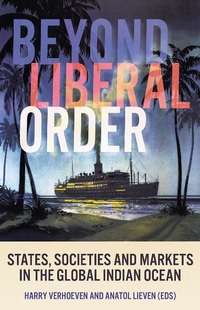
Beyond Liberal Order
Description

What does liberal order actually amount to outside the West, where it has been most institutionalised? Contrary to the Atlantic or Pacific, liberal hegemony is thin in the Indian Ocean World; there are no equivalents of NATO, the EU or the US-Japan defence relationship.
Yet what this book calls the 'Global Indian Ocean' was the beating heart of earlier epochs of globalisation, where experiments in international order, market integration and cosmopolitanisms were pioneered. Moreover, it is in this macro-region that today's challenges will face their defining hour: climate change, pandemics, and the geopolitical contest pitting China and Pakistan against the USA and India. The Global Indian Ocean states represent the greatest range of political systems and ideologies in any region, from Hindu-nationalist India and nascent democracy in Indonesia and South Africa, to the Gulf's mixture of tribal monarchy and high modernism.
These essays by leading scholars examine key aspects of political order, and their roots in the colonial and pre-colonial past, through the lenses of state-building, nationalism, international security, religious identity and economic development. The emergent lessons are of great importance for the world, as the 'global' liberal order fades and new alternatives struggle to be born.
More details
Other editions
Additional editions
Persons
Harry Verhoeven is a Senior Research Scholar at the Center on Global Energy Policy, School of International and Public Affairs at Columbia University. He is the Convenor of the Oxford University China-Africa Network and a Senior Adviser at the European Institute of Peace. He is the author of Water, Civilisation and Power in Sudan, Why Comrades Go To War and editor of Environmental Politics in the Middle East. Anatol Lieven is a senior fellow of the Quincy Institute for Responsible Statecraft in Washington DC, and was formerly a professor at Georgetown University in Qatar and King's College London. In the 1980s and 1990s he worked as a British journalist in South Asia and the former Soviet Union, and is the author of several books on these regions including Pakistan: A Hard Country. His most recent book, Climate Change and the Nation State, appeared in paperback in 2021.
Content
1. Ordering the Global Indian Ocean: The Enduring Condition of Thin Hegemony ? Harry Verhoeven
2. A History of Distributed Sovereignty: Trade, Migration and Rule in the Global Indian Ocean ? Thomas Blom Hansen
3. Liberal Order's Illiberal Prodigy: Singapore as a Non-liberal Electoral Democratic State ? Chua Beng Huat
4. Hybrid Clientelism as Democracy in the Global Indian Ocean ? Shandana Khan Mohmand
5. The Arabian Oil State: Infrastructural Power and Social Segmentation ? Steffen Hertog
6. Women as Objects of Development: Neoliberalism in Bangladesh ? Lamia Karim
7. Divide and Rule: Partition and Illiberal State-Building in the Horn of Africa ? Mike Woldemariam
8. Intervention and Order in Failed States ? Will Reno
9. China in the Indian Ocean: The Search for a New Hegemon? ? Rana Mitter
10. Conclusion: The Indian Ocean and Global Patterns of Order and Disorder ? Anatol Lieven
