

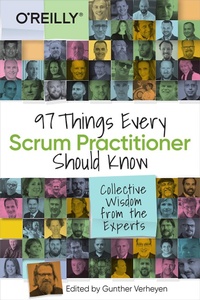
97 Things Every Scrum Practitioner Should Know
Collective Wisdom from the Experts
Published on 27. April 2020
278 pages
978-1-4920-7381-9 (ISBN)
Description

Improve your understanding of Scrum through the proven experience and collected wisdom of experts around the world. Based on real-life experiences, the 97 essays in this unique book provide a wealth of knowledge and expertise from established practitioners who have dealt with specific problems and challenges with Scrum.
You''ll find out more about the rules and roles of this framework, as well as tactics, strategies, specific patterns to use with Scrum, and stories from the trenches. You''ll also gain insights on how to apply, tune, and tweak Scrum for your work. This guide is an ideal resource for people new to Scrum and those who want to assess and improve their understanding of this framework.
- "Scrum Is Simple. Just Use It As Is.," Ken Schwaber
- "The ''Standing Meeting,''" Bob Warfield
- "Specialization Is for Insects," James O. Coplien
- "Scrum Events Are Rituals to Ensure Good Harvest," Jasper Lamers
- "Servant Leadership Starts from Within," Bob Galen
- "Agile Is More than Sprinting," James W. Grenning
More details
Other editions
Additional editions
Book
05/2020
O'Reilly
€47.00
Shipment within 15-20 days
Content
- Intro
- Copyright
- Table of Contents
- Preface
- How This Book Is Organized
- Acknowledgments
- O'Reilly Online Learning
- How to Contact Us
- Part I. Start, Adopt, Repeat
- Chapter 1. Five Things Nobody Tells You About Scrum
- Marc Loeffler
- 1. Scrum Will Not Solve Your Problems
- 2. Scrum Offers No Benefits When You Only Follow the Process
- 3. There Is No "Scrum Switch"
- 4. Transforming to Scrum Means Transforming Your Organization
- 5. Scrum Is Not Faster
- Chapter 2. Mindset Matters Much More Than Practices
- Gil Broza
- Chapter 3. Actually, It's Not Really About Scrum
- Stacia Viscardi
- Chapter 4. Scrum Is Simple. Just Use It As Is.
- Ken Schwaber
- Chapter 5. Start with the Why of Your Scrum
- Peter Goetz & Uwe Schirmer
- Chapter 6. Adopt Before You Adapt
- Steve Berczuk
- Chapter 7. Regularly Revert to the Simplest Thing That Might Work
- Todd Miller
- Chapter 8. Will Scrum Work for Multi-Location Development?
- Pete Deemer
- Chapter 9. Know the Difference Between Multiple Scrum Teams and Multi-Team Scrum
- Markus Gaertner
- Multiple Scrum Teams
- Multi-Team Scrum
- Chapter 10. What Will You Define as "Done"?
- Gunther Verheyen
- Chapter 11. How I Learned to Stop Worrying and Start Using Scrum
- Simon Reindl
- Part II. Products Deliver Value
- Chapter 12. Successful Projects That...Fail
- Ralph Jocham & Don McGreal
- Chapter 13. Answer This Question: "What Is Your Product?"
- Ellen Gottesdiener
- Chapter 14. Scrum: Giving the Steering Wheel Back to Business
- Rafael Sabbagh
- Chapter 15. Beware the Product Management Vacuum
- Ralph Jocham & Don McGreal
- Chapter 16. Scaling Scrum to the Entire Organization with the Flow Framework
- Mik Kersten
- Chapter 17. Put Business Value Front and Center
- Alan O'Callaghan
- Chapter 18. Product Owner, Not an Information Barrier
- Markus Gaertner
- Chapter 19. Mastering the Art of "No" to Maximize Value
- Willem Vermaak & Robbin Schuurman
- Chapter 20. Communicating Prioritized Requirements Through the Product Backlog
- James O. Coplien
- Chapter 21. Why There Are No User Stories at the Top of Your Product Backlog
- James O. Coplien
- Chapter 22. Mind Your Outcomes. Pay Attention to Value.
- Jeff Patton
- Focus on Outcome
- Bad Scrum Focuses on Output
- Keep Effort and Outcome Visible
- Part III. Collaboration Is Key
- Chapter 23. Is There Anything to Learn from Football Hooligans?
- Jasper Lamers
- Chapter 24. And Then a Miracle Occurs
- Konstantin Razumovsky
- Chapter 25. Put Customer Focus at the Top of Your Decision-Making Stack
- Mitch Lacey
- Chapter 26. Is Your Team Working as a Team?
- Rich Hundhausen
- Chapter 27. "That's Not My Job!"
- Markus Gaertner
- Chapter 28. Specialization Is for Insects
- James O. Coplien
- Chapter 29. Digital Tools Considered Harmful: Sprint Backlog
- Bas Vodde
- Chapter 30. Digital Tools Considered Harmful: Jira
- Bas Vodde
- Scrum Confusion
- Product and Sprint Backlog Integration
- No Shared Team Responsibility
- We're Stuck with Jira. Now What?
- Chapter 31. The Vicious Effects of Managing for Utilization
- Daniel Heinen & Konstantin Ribel
- Chapter 32. Becoming a Radiating Team
- Len Lagestee
- Part IV. Development Is Multifaceted Work
- Chapter 33. Agile Is More Than Sprinting
- James W. Grenning
- Chapter 34. Patricia's Product Management Predicament
- Chris Lukassen
- Chapter 35. The Five Stages of Product Backlog Item Sizing
- Len Lagestee
- Chapter 36. Three Common Misconceptions About User Stories
- Marcus Raitner
- 1. User Stories Are Part of Scrum
- 2. User Stories Are Specifications
- 3. The Product Owner Writes the User Stories
- Chapter 37. Introducing Abuser Stories
- Judy Neher
- Chapter 38. What's in Your Sprint Plan?
- Rich Hundhausen
- Expressing the Sprint Plan Using Tasks
- Expressing the Sprint Plan Using Tests
- Expressing the Sprint Plan Using a Diagram
- Not Expressing the Sprint Plan
- Chapter 39. Sprint Backlogs Deserve a Life Beyond Your Electronic Tool
- Mark Levison
- Chapter 40. Testing Is a Team Sport
- Lisa Crispin
- As a Team, Commit to Your Desired Level of Quality
- Design Small Experiments for Your Biggest Problems
- Make Problems Visible
- Keep Talking
- Take It Slow
- Chapter 41. Rethinking Bugs
- Rich Hundhausen
- Chapter 42. Product Backlog Refinement Is an Important Team Activity
- Anu Smalley
- Chapter 43. Automating Agility
- David Starr
- Chapter 44. The Evergreen Tree
- Jesse Houwing
- Part V. Events, Not Meetings
- Chapter 45. Sprints Are for Progress, Not to Become the New Treadmill
- Jutta Eckstein
- Chapter 46. How to Have an Effective Sprint Planning
- Luis Gonçalves
- Chapter 47. Sprint Goals Provide Purpose (Beyond Merely Completing Work Lists)
- Mark Levison
- Chapter 48. Sprint Goals: The Forgotten Keys of Scrum
- Ralph Jocham & Don McGreal
- Chapter 49. The Daily Scrum Is the Developers' Agile Heartbeat
- James O. Coplien
- Chapter 50. The Sprint Review Is Not a Phase-Gate
- Dave West
- Chapter 51. The Purpose of Sprint Review Is to Gather Feedback-Period
- Rafael Sabbagh
- Chapter 52. A Demo Is Not Enough-Go and Deploy for Better Feedback
- Sanjay Saini
- Chapter 53. Have Sprint Retrospectives and Structure Them
- Steve Berczuk
- Chapter 54. The Most Important Thing Isn't What You Think It Is
- Bob Hartman
- Part VI. Mastery Does Matter
- Chapter 55. Understanding the Scrum Master Role
- Luis Gonçalves
- Chapter 56. How I Learned That It's Not About Me, the Scrum Master
- Ryan Ripley
- Chapter 57. Servant-Leadership Starts from Within
- Bob Galen
- Chapter 58. The Court Jester at the Touchline
- Marcus Raitner
- Chapter 59. The Scrum Master as Coach
- Geoff Watts
- Chapter 60. The Scrum Master as a Technical Coach
- Bas Vodde
- Chapter 61. Scrum Master, Not Impediment Hunter
- Derek Davidson
- Chapter 62. Anatomy of an Impediment
- Len Lagestee
- Anything Constricting Flow or Constraining Pull in the System
- Anything Causing Team Tension to Rise Beyond Constructive Conflict
- Anything Keeping a Team from Self-Healing
- Chapter 63. The Scrum Master's Most Important Tool
- Stephanie Ockerman
- Chapter 64. When in Trouble...Break Glass!
- Bob Galen
- Chapter 65. Actively Doing Nothing (Is Actually Hard Work)
- Bas Vodde
- Chapter 66. Guiding Scrum Masters on Their Never-Ending Journey with the #ScrumMasterWay Concept
- Zuzi Sochová
- Part VII. People, All Too Human
- Chapter 67. Teams Are More Than Collections of Technical Skills
- Uwe Schirmer
- Chapter 68. Are People Impediments?
- Bob Galen
- Chapter 69. How Human Nature Overcomplicates What Is Already Complex
- Stijn Decneut
- Chapter 70. How to Design Your Scrum for A-ha! Moments
- Stijn Decneut
- Chapter 71. Use Brain Science to Make Your Scrum Events Stick
- Evelien Acun-Roos
- Chapter 72. The Power of Standing Up
- Linda Rising
- Chapter 73. The Effects of Working from Home
- Daniel James Gullo
- Chapter 74. The Gentle Way of Change
- Chris Lukassen
- 1. Individual Motivation
- 2. Individual Ability
- 3. Team Motivation
- 4. Team Ability
- 5. Systematic Motivation
- 6. Systematic Ability
- Part VIII. Values Drive Behavior
- Chapter 75. Scrum Is More About Behavior Than It Is About Process
- Gunther Verheyen
- Chapter 76. What It Means to Self-Organize
- Michael K. Spayd
- Chapter 77. Treating Defects as Treasures (the Value of Openness)
- Jorgen Hesselberg
- Chapter 78. "That Won't Work Here!"
- Derek Davidson
- Chapter 79. Five Sublime Aspects for Being a More Humane Scrum Master
- Hiren Doshi
- Chapter 80. The Sixth Scrum Value
- Derek Davidson
- Part IX. Organizational Design
- Chapter 81. Agile Leadership and Culture Design
- Ron Eringa
- Chapter 82. Scrum Is "Agile Leadership"
- Andreas Schliep & Peter Beck
- Chapter 83. Scrum Is Also About Improving the Organization
- Kurt Bittner
- Chapter 84. Networks and Respect
- Paul Oldfield
- Chapter 85. The Power of Play in a Safe (but Not Too Safe) Environment
- Jasper Lamers
- Chapter 86. The Trinity of Agile Leadership
- Marcus Raitner
- Self-Organization
- Orientation
- Humane Leadership
- What Else?
- Chapter 87. The "MetaScrum" Pattern to Drive Agile Transformation
- Alan O'Callaghan
- Chapter 88. Scrum and Organizational Design in Practice
- Fabio Panzavolta
- Chapter 89. Thinking Big
- James O. Coplien
- Part X. Scrum Off Script
- Chapter 90. The Origins of Scrum Might Not Be What You Think They Are
- Rafael Sabbagh
- Chapter 91. The "Standing Meeting"
- Bob Warfield
- Chapter 92. Scrum: Problem-Solving and the Scientific Method in Practice
- Si Alhir
- Chapter 93. Scrum Events Are Rituals to Ensure Good Harvest
- Jasper Lamers
- Chapter 94. How We Used Scrum to Work with an External Agency
- Eric Naiburg
- Chapter 95. Scrum Applied in Police Work
- Sjoerd Kranendonk
- Chapter 96. Born to Be Agile: A Case for Scrum in the Classroom
- Arno Delhij
- Chapter 97. Agile in Education with eduScrum
- Willy Wijnands
- Contributors
- Evelien Acun-Roos
- Si Alhir
- Peter Beck
- Steve Berczuk
- Kurt Bittner
- Gil Broza
- James O. Coplien
- Lisa Crispin
- Derek Davidson
- Stijn Decneut
- Pete Deemer
- Arno Delhij
- Hiren Doshi
- Jutta Eckstein
- Ron Eringa
- Markus Gaertner
- Bob Galen
- Peter Goetz
- Luis Gonçalves
- Ellen Gottesdiener
- James W. Grenning
- Daniel James Gullo
- Bob Hartman
- Daniel Heinen
- Jorgen Hesselberg
- Jesse Houwing
- Rich Hundhausen
- Ralph Jocham
- Mik Kersten
- Sjoerd Kranendonk
- Mitch Lacey
- Len Lagestee
- Jasper Lamers
- Mark Levison
- Marc Loeffler
- Chris Lukassen
- Don McGreal
- Todd M. Miller
- Eric Naiburg
- Judy Neher
- Alan O'Callaghan
- Stephanie Ockerman
- Paul Oldfield
- Fabio Panzavolta
- Jeff Patton
- Marcus Raitner
- Konstantin Razumovsky
- Simon Reindl
- Konstantin Ribel
- Ryan Ripley
- Linda Rising
- Rafael Sabbagh
- Sanjay Saini
- Uwe Schirmer
- Andreas Schliep
- Robbin Schuurman
- Ken Schwaber
- Anu Smalley
- Zuzana Sochová
- Michael K. Spayd
- David Starr
- Gunther Verheyen
- Willem Vermaak
- Stacia Viscardi
- Bas Vodde
- Bob Warfield
- Geoff Watts
- Dave West
- Willy Wijnands
- Scrum Glossary
- Index
- About the Editor
- Gunther Verheyen
