

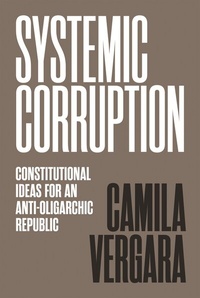
Systemic Corruption
Constitutional Ideas for an Anti-Oligarchic Republic
1st Edition
Published on 30. September 2020
312 pages
978-0-691-20873-2 (ISBN)
Description

A bold new approach to combatting the inherent corruption of representative democracy
This provocative book reveals how the majority of modern liberal democracies have become increasingly oligarchic, suffering from a form of structural political decay first conceptualized by ancient philosophers. Systemic Corruption argues that the problem cannot be blamed on the actions of corrupt politicians but is built into the very fabric of our representative systems.
Camila Vergara provides a compelling and original genealogy of political corruption from ancient to modern thought, and shows how representative democracy was designed to protect the interests of the already rich and powerful to the detriment of the majority. Unable to contain the unrelenting force of oligarchy, especially after experimenting with neoliberal policies, most democracies have been corrupted into oligarchic democracies. Vergara explains how to reverse this corrupting trajectory by establishing a new counterpower strong enough to control the ruling elites. Building on the anti-oligarchic institutional innovations proposed by plebeian philosophers, she rethinks the republic as a mixed order in which popular power is institutionalized to check the power of oligarchy. Vergara demonstrates how a plebeian republic would establish a network of local assemblies with the power to push for reform from the grassroots, independent of political parties and representative government.
Drawing on neglected insights from Niccolò Machiavelli, Nicolas de Condorcet, Rosa Luxemburg, and Hannah Arendt, Systemic Corruption proposes to reverse the decay of democracy with the establishment of anti-oligarchic institutions through which common people can collectively resist the domination of the few.
This provocative book reveals how the majority of modern liberal democracies have become increasingly oligarchic, suffering from a form of structural political decay first conceptualized by ancient philosophers. Systemic Corruption argues that the problem cannot be blamed on the actions of corrupt politicians but is built into the very fabric of our representative systems.
Camila Vergara provides a compelling and original genealogy of political corruption from ancient to modern thought, and shows how representative democracy was designed to protect the interests of the already rich and powerful to the detriment of the majority. Unable to contain the unrelenting force of oligarchy, especially after experimenting with neoliberal policies, most democracies have been corrupted into oligarchic democracies. Vergara explains how to reverse this corrupting trajectory by establishing a new counterpower strong enough to control the ruling elites. Building on the anti-oligarchic institutional innovations proposed by plebeian philosophers, she rethinks the republic as a mixed order in which popular power is institutionalized to check the power of oligarchy. Vergara demonstrates how a plebeian republic would establish a network of local assemblies with the power to push for reform from the grassroots, independent of political parties and representative government.
Drawing on neglected insights from Niccolò Machiavelli, Nicolas de Condorcet, Rosa Luxemburg, and Hannah Arendt, Systemic Corruption proposes to reverse the decay of democracy with the establishment of anti-oligarchic institutions through which common people can collectively resist the domination of the few.
More details
Other editions
Additional editions
Book
06/2022
Princeton University Press
€27.50
Shipment within 10-20 days
Book
09/2020
Princeton University Press
€47.04
Shipment within 10-20 days
Person
Camila Vergara is a postdoctoral research scholar and lecturer at the Eric H. Holder Jr. Initiative for Civil and Political Rights at Columbia Law School. A former journalist in Chile, she is the coeditor of Machiavelli on Liberty and Conflict. Twitter @Camila_Vergara
Content
- Cover
- Contents
- List of Illustrations
- Acknowledgments
- Introduction: Crisis of the Representative Republic
- PART I: SYSTEMIC CORRUPTION AND THE MATERIAL CONSTITUTION
- 1. Corruption as Political Decay
- 2. Elitist Interpretations of the Republic
- 3. On Material Constitutional Thought
- PART II: PLEBEIAN CONSTITUTIONAL THOUGHT
- 4. Machiavelli on the Plebeian Power to Create and Punish
- 5. Condorcet on Primary Assemblies
- 6. Luxemburg on Popular Emancipation
- 7. Arendt on the Republic of Parties and Councils
- PART III: ANTI-OLIGARCHIC INSTITUTIONS FOR THE TWENTY-FIRST CENTURY
- 8. Contemporary Plebeian Thought
- 9. Constitutionalizing the Power of Those Who Do Not Rule
- Epilogue What Is to Be Done?
- Bibliography
- Index
