

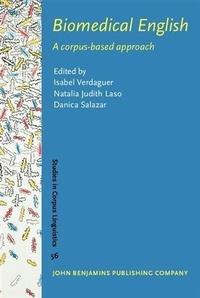
Biomedical English
A corpus-based approach
1st Edition
Published in July 2013
XIII, 214 pages
978-90-272-7192-1 (ISBN)
Description

The corpus-based studies in this volume explore biomedical research writing in English from a variety of perspectives. The articles in this collection delve into the lexicographic issues involved in building an electronic database of collocations and lexical bundles, offer insight on the teaching and learning of prototypical multiword units of meaning in biomedical discourse, and view written scientific English through the lens of such diverse fields as phraseology, metaphor, gender and discourse analysis. The research presented in this book forms the theoretical and methodological foundation of SciE-Lex, a lexical database of collocations and prefabricated expressions designed to help scientists write scientific papers in English accurately. The concluding chapter on FrameNet addresses frame semantics, whose application to the cross-linguistic study of scientific language will open new and promising avenues of research in the study of specialized languages.
More details
Other editions
Additional editions
Book
06/2013
John Benjamins Publishing Co
€95.40
Shipment within 10-15 days
Persons
Content
- Biomedical English
- Editorial page
- Title page
- LCC data
- In memory of
- Table of contents
- Introduction
- References
- Collocations, lexical bundles and SciE-Lex
- 1. Introduction
- 2. Sinclair's notion of collocation
- 3. Different approaches to collocation
- 4. Corpus-based vs. corpus-driven approaches to phraseology
- 5. Phraseological status of lexical bundles
- 6. Conclusion
- Acknowledgements
- References
- SciE-Lex
- 1. Introduction
- 2. Purpose
- 3. Corpus description
- 4. SciE-Lex: First stage
- 5. SciE-Lex: Second stage
- 6. Conclusion
- Acknowledgements
- References
- Formal and functional variation of lexical bundles in biomedical English
- 1. Introduction
- 2. Morphosyntactic and lexical variation
- 3. Functional variation
- 3.1 Functional classification of lexical bundles
- 3.2. Multifunctionality of lexical bundles
- 4. Conclusions
- Acknowledgements
- References
- A corpus-based analysis of the collocational patterning of adjectives with abstract nouns in medical English
- 1. Introduction
- 2. The concepts of lexis, grammar and collocation in discourse
- 3. Corpus and method
- 3.1 Corpus-based methodological approach
- 3.2 Method
- 4. Results
- 4.1 The pattern adjective + conclusion
- 4.2 The pattern adjective + agreement
- 4.3 The pattern adjective + comparison
- 4.4 The pattern adjective + decision
- 4.5 Summary of results
- 5. Conclusion and implications
- 5.1 Main conclusions
- 5.2 Implications
- Acknowledgements
- References
- As described below
- 1. Introduction
- 2. Corpora and methodology
- 3. Research questions
- 4. Results and discussion
- 4.1 Case study: The verb describe in health science register
- 4.1.1 Overall frequency: Word class and morphological variants
- 4.1.2 Main patterns of the verb describe
- 4.1.2.1 Group pattern 1: V n (active pattern)/be V-ed (passive pattern). The simple pattern V n (1, 2) corresponds to the transitive use of the active form of the verb describe, which is followed by a noun group functioning as the object of the sentence (
- 4.1.2.2 Group pattern 2: N [Adv] V-ed [Adv]/[PP] or N [Adv] V-ing [Adv]/[PP] (V-ed-as-a-post-modifier pattern) and (Adv) V-ed N (V-ed-as-a-pre-modifier pattern). When comparing group pattern 1 with group pattern 2, a clear difference depending on the fin
- 4.1.2.3 Group pattern 3: N V-ed as N (Simple categorisation pattern)/N (be) V-ed as N (Complex categorisation pattern). This group pattern is composed of at least four different elements: a noun group N that precedes the pattern, followed by the past part
- 4.1.2.4 Group pattern 4: as [Adv] V-ed [Adv] (temporal guiding pattern)/as V-ed [Adv]/[PP] (spatial guiding pattern). The particle as, followed by the past participle form of the V-ed, introduces a verbless clause, which can be transformed into a finite c
- 4.2 Interconnection between patterns, meaning, and lexis
- 5. Verbal form describe vs. Nominal form description
- 5.1 V description
- 5.1.1 Verbs of 'giving' + description
- 5.1.2 Verbs of 'receiving' + description
- 5.1.3 Other type of semantically equivalent transformations
- 5.2 Description + preposition
- 6. Concluding remarks
- Acknowledgements
- References
- Websites
- References for examples taken from the Health Science Corpus
- Negation in biomedical English
- 1. Introduction
- 2. Results and discussion
- 2.1 The phraseology of the adjectives likely and unlikely
- 2.2 The phraseology of the adjectives clear and unclear
- 2.3 The phraseology of the adjectives able and unable
- 3. Conclusion
- Acknowledgements
- References
- References for examples
- A cross-disciplinary analysis of personal and impersonal features in English and Spanish scientific writing
- 1. Introduction
- 2. Previous studies on personal and impersonal features in academic writing
- 3. Research questions
- 4. Corpora and methodology
- 5. Results and discussion
- 5.1 Overall frequency results
- 5.2 Usage patterns of personal and impersonal features in Medicine
- 5.2.1 Personal forms in Medicine
- 5.2.2 Impersonal forms in Medicine
- 5.3 Usage patterns of personal and impersonal features in Mathematics
- 5.3.1 Personal forms in Mathematics
- 5.3.2 Impersonal forms in Mathematics
- 5.4 The rhetorical functions of personal and impersonal forms
- 6. Conclusions and recommendations
- Acknowledgements
- References
- References for examples taken from the corpora
- Gender assignment in present-day scientific English
- 1. Introduction
- 2. The grammatical category of gender in English
- 2.1 Gender and nouns of animals in English
- 3. The Health Science Corpus-Zoology
- 3.1 Units of Anaphoric Reference (UARs)
- 3.2 Nouns in the corpus
- 4. Data analysis
- 5. Conclusions
- Acknowledgements
- References
- References for the UARs in HSC-Z
- The metaphorical basis of discourse structure
- 1. Introduction
- 2. Metaphor in language and discourse
- 3. Metaphor and discourse structure
- 4. An insight into source-path-goal and force-dynamic image schemas
- The source-path-goal schema
- a. Bodily experience
- b. Structural elements
- c. Basic logic
- The force dynamics image schema
- a. Bodily experience
- b. Structural elements
- c. Basic logic
- a. Source/introduction unit
- b. Obstacle/gap in the knowledge on the field under study
- c. Stating an intended goal/outlining the means
- d. Displaying results/forces that push toward a conclusion
- e. Reaching a goal/reaching a conclusion
- 5. discourse is a form of motion along a path influenced by force dynamics: Ontological and epistemic correspondences
- 6. Scientific abstracts, paths and forces
- 7. Conclusion
- Acknowledgements
- References
- References for examples taken from corpus
- Frames, constructions, and metaphors in Spanish FrameNet
- 1. Frame semantics and FrameNet(s)
- 2. Semantic annotation
- 3. Automatic semantic-role labelling
- 4. Building the Spanish Constructicon
- 5. Frames and metaphor
- 6. Next Steps for Spanish FrameNet
- Acknowledgments
- References
- Subject index
