

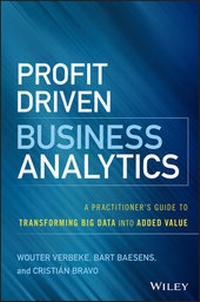
Profit Driven Business Analytics
A Practitioner's Guide to Transforming Big Data into Added Value
Published on 22. September 2017
416 pages
978-1-119-28699-8 (ISBN)
Description

Maximize profit and optimize decisions with advanced business analytics
Profit-Driven Business Analytics provides actionable guidance on optimizing the use of data to add value and drive better business. Combining theoretical and technical insights into daily operations and long-term strategy, this book acts as a development manual for practitioners seeking to conceive, develop, and manage advanced analytical models. Detailed discussion delves into the wide range of analytical approaches and modeling techniques that can help maximize business payoff, and the author team draws upon their recent research to share deep insight about optimal strategy. Real-life case studies and examples illustrate these techniques at work, and provide clear guidance for implementation in your own organization. From step-by-step instruction on data handling, to analytical fine-tuning, to evaluating results, this guide provides invaluable guidance for practitioners seeking to reap the advantages of true business analytics.
Despite widespread discussion surrounding the value of data in decision making, few businesses have adopted advanced analytic techniques in any meaningful way. This book shows you how to delve deeper into the data and discover what it can do for your business.
* Reinforce basic analytics to maximize profits
* Adopt the tools and techniques of successful integration
* Implement more advanced analytics with a value-centric approach
* Fine-tune analytical information to optimize business decisions
Both data stored and streamed has been increasing at an exponential rate, and failing to use it to the fullest advantage equates to leaving money on the table. From bolstering current efforts to implementing a full-scale analytics initiative, the vast majority of businesses will see greater profit by applying advanced methods. Profit-Driven Business Analytics provides a practical guidebook and reference for adopting real business analytics techniques.
More details
Other editions
Additional editions
Wouter Verbeke | Bart Baesens | Cristian Bravo
Profit Driven Business Analytics
A Practitioner's Guide to Transforming Big Data into Added Value
Book
12/2017
Wiley
€47.00
Shipment within 15-20 days
Persons
WOUTER VERBEKE is assistant professor of Business Informatics and Data Analytics at Vrije Universiteit Brussel (Belgium). He is the coauthor of Fraud Analytics using Descriptive, Predictive, and Social Network Techniques.
BART BAESENS is a professor at KU Leuven (Belgium) and a lecturer at the University of Southampton (United Kingdom). He is the author of Credit Risk Management and Analytics in a Big Data World, as well as coauthor of Fraud Analytics using Descriptive, Predictive, and Social Network Techniques.
CRISTIÁN BRAVO is a lecturer in business analytics in the department of Decision Analytics and Risk at the University of Southampton.
Content
- Cover
- Title Page
- Copyright
- Contents
- Foreword
- Acknowledgments
- Chapter 1: A Value-Centric Perspective Towards Analytics
- Introduction
- Business Analytics
- Profit-Driven Business Analytics
- Analytics Process Model
- Analytical Model Evaluation
- Analytics Team
- Profiles
- Data Scientists
- Conclusion
- Review Questions
- Multiple Choice Questions
- Open Questions
- References
- Chapter 2: Analytical Techniques
- Introduction
- Data Preprocessing
- Denormalizing Data for Analysis
- Sampling
- Exploratory Analysis
- Missing Values
- Outlier Detection and Handling
- Principal Component Analysis
- Types of Analytics
- Predictive Analytics
- Introduction
- Linear Regression
- Logistic Regression
- Decision Trees
- Neural Networks
- Ensemble Methods
- Bagging
- Boosting
- Random Forests
- Evaluating Ensemble Methods
- Evaluating Predictive Models
- Splitting Up the Dataset
- Performance Measures for Classification Models
- Performance Measures for Regression Models
- Other Performance Measures for Predictive Analytical Models
- Descriptive Analytics
- Introduction
- Association Rules
- Sequence Rules
- Clustering
- Survival Analysis
- Introduction
- Survival Analysis Measurements
- Kaplan Meier Analysis
- Parametric Survival Analysis
- Proportional Hazards Regression
- Extensions of Survival Analysis Models
- Evaluating Survival Analysis Models
- Social Network Analytics
- Introduction
- Social Network Definitions
- Social Network Metrics
- Social Network Learning
- Relational Neighbor Classifier
- Probabilistic Relational Neighbor Classifier
- Relational Logistic Regression
- Collective Inferencing
- Conclusion
- Review Questions
- Multiple Choice Questions
- Open Questions
- Notes
- References
- Chapter 3: Business Applications
- Introduction
- Marketing Analytics
- Introduction
- RFM Analysis
- Response Modeling
- Churn Prediction
- X-selling
- Customer Segmentation
- Customer Lifetime Value
- Customer Journey
- Recommender Systems
- Fraud Analytics
- Credit Risk Analytics
- HR Analytics
- Conclusion
- Review Questions
- Multiple Choice Questions
- Open Questions
- Note
- References
- Chapter 4: Uplift Modeling
- Introduction
- The Case for Uplift Modeling: Response Modeling
- Effects of a Treatment
- Experimental Design, Data Collection, and Data Preprocessing
- Experimental Design
- Campaign Measurement of Model Effectiveness
- Uplift Modeling Methods
- Two-Model Approach
- Regression-Based Approaches
- Tree-Based Approaches
- Ensembles
- Continuous or Ordered Outcomes
- Evaluation of Uplift Models
- Visual Evaluation Approaches
- Performance Metrics
- Practical Guidelines
- Two-Step Approach for Developing Uplift Models
- Implementations and Software
- Conclusion
- Review Questions
- Multiple Choice Questions
- Open Questions
- Note
- References
- Chapter 5: Profit-Driven Analytical Techniques
- Introduction
- Profit-Driven Predictive Analytics
- The Case for Profit-Driven Predictive Analytics
- Cost Matrix
- Cost-Sensitive Decision Making with Cost-Insensitive Classification Models
- Cost-Sensitive Classification Framework
- Cost-Sensitive Classification
- Pre-Training Methods
- During-Training Methods
- Post-Training Methods
- Evaluation of Cost-Sensitive Classification Models
- Imbalanced Class Distribution
- Implementations
- Cost-Sensitive Regression
- The Case for Profit-Driven Regression
- Cost-Sensitive Learning for Regression
- During Training Methods
- Post-Training Methods
- Profit-Driven Descriptive Analytics
- Profit-Driven Segmentation
- Profit-Driven Association Rules
- Conclusion
- Review Questions
- Multiple Choice Questions
- Open Questions
- Notes
- References
- Chapter 6: Profit-Driven Model Evaluation and Implementation
- Introduction
- Profit-Driven Evaluation of Classification Models
- Average Misclassification Cost
- Cutoff Point Tuning
- ROC Curve-Based Measures
- Profit-Driven Evaluation with Observation-Dependent Costs
- Profit-Driven Evaluation of Regression Models
- Loss Functions and Error-Based Evaluation Measures
- REC Curve and Surface
- Conclusion
- Review Questions
- Multiple Choice Questions
- Open Questions
- Notes
- References
- Chapter 7: Economic Impact
- Introduction
- Economic Value of Big Data and Analytics
- Total Cost of Ownership (TCO)
- Return on Investment (ROI)
- Profit-Driven Business Analytics
- Key Economic Considerations
- In-Sourcing versus Outsourcing
- On Premise versus the Cloud
- Open-Source versus Commercial Software
- Improving the ROI of Big Data and Analytics
- New Sources of Data
- Data Quality
- Management Support
- Organizational Aspects
- Cross-Fertilization
- Conclusion
- Review Questions
- Multiple Choice Questions
- Open Questions
- Notes
- References
- About the Authors
- Index
- EULA
