

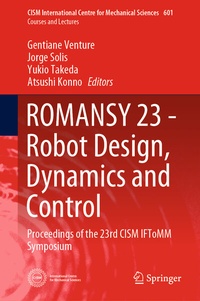
ROMANSY 23 - Robot Design, Dynamics and Control
Description

This book highlights the latest innovations and applications in robotics, as presented by leading international researchers and engineers at the ROMANSY 2020, the 23rd CISM IFToMM Symposium on Theory and Practice of Robots and Manipulators. The ROMANSY symposium is the first established conference that focuses on robotics theory and research, rather than industrial aspects. Bringing together researchers from a broad range of countries, the symposium is held bi-annually and plays a vital role in the development of the theory and practice of robotics, as well as the mechanical sciences. ROMANSY 2020 marks the 23rd installment in a series that began in 1973. The event was also the first topic-specific conference of the IFToMM, though not exclusively intended for the IFToMM community.
More details
Other editions
Additional editions
Content
- Intro
- Preface
- Contents
- Active Visualization of Non-destructive Inspection for Metal Using Terahertz Camera and Light Source
- 1 Introduction
- 2 Non-destruction Detection
- 2.1 Terahertz Camera and Light Source
- 2.2 Detectable Size of Terahertz Image at 1 m
- 2.3 Reflective Image of Square and Triangular Metallic Pieces
- 3 Conclusions
- References
- Model-Based Dynamic Human Tracking and Reconstruction During Dynamic SLAM
- 1 Introduction
- 2 Related Works
- 3 System Overview and Method
- 3.1 Dynamic Human Body Extraction and Static Background Segmentation
- 3.2 Dynamic Human Motion Tracking and Reconstruction
- 4 Experimental Results and Discussions
- 5 Conclusions
- References
- Development of Robust Ridge Detection Method and Control System for Autonomous Navigation of Mobile Robot in Agricultural Farm
- 1 Introduction
- 2 Background
- 3 System Architecture
- 4 Method
- 4.1 Ridge Center Estimator
- 4.2 Robot Controller
- 4.3 Wheel Controller
- 5 Modeling
- 5.1 Robot
- 5.2 Coordinate System
- 5.3 Modeling
- 6 Traveling Experiment in Farm Field
- 6.1 Experiment Contents
- 6.2 Results
- 7 Summary
- References
- Continuous Jumping Control Based on Virtual Model Control for a One-Leg Robot Platform
- 1 Introduction
- 2 Dynamic Model for One-Leg Jumping Platform Based on VMC
- 3 Finite State Machine for Continuous Jumping
- 4 Simulations
- 5 Conclusion
- References
- Investigation of Parallel Connection Circuit by Hydraulic Direct-Drive System for Biped Humanoid Robot Focusing on Human Running Motion
- 1 Introduction
- 2 Consideration of the Proposed Hydraulic Circuit
- 3 Evaluation of the Proposed Hydraulic Circuit
- 4 Conclusion
- References
- Maximal Output Admissible Set of Foot Position Control in Humanoid Walking
- 1 Introduction
- 2 Control of COG Based on LIP Model and Its MOA Set
- 2.1 LIP Model and State Feedback of COG
- 2.2 System Constraint and Support Polygon Approximation
- 2.3 MOA Set
- 3 Integration of COG Control and Foot Landing Position
- 3.1 Foot Position Control
- 3.2 Control in Support Coordinate
- 3.3 Simulation of Foot Position Control
- 4 MOA Set Considering Foot Position Control
- 5 Conclusion
- References
- Control System Design for Human Assisting Robot
- 1 Introduction
- 2 State of the Art
- 3 Objective
- 4 Human-Robot Interface
- 5 General Architecture of Control System
- 6 Detailed Architecture
- 6.1 Division of System Tasks
- 6.2 Selecting the Most Efficient Solution
- 7 Conclusions
- References
- Development of a Switchable Wearable Robot for Rehabilitation After Surgery of Knee
- 1 Introduction
- 2 Previous Developed Robot
- 2.1 Shape of the Previous Robot
- 2.2 Roll-Back Motion
- 3 New Switchable Robot
- 3.1 Concept of the Robot
- 3.2 Bilateral Roll-Back Gear
- 3.3 Non Directional Brace
- 4 Evaluation of the Switchable Robot
- 4.1 Sensory Evaluation
- 4.2 Myoelectricity
- 4.3 Movement of the Brace
- 5 Conclusion
- References
- Design and Testing of BIT Flying Robot
- 1 Introduction
- 2 Design Issues and Requirements
- 3 The BIT Flying Robot
- 4 Performance Characteristics
- 5 Prototype and Tests
- 6 Conclusions
- References
- Surgical Skill Analysis Based on the Way of Grasping Organs with Forceps in Dissection Procedure of Laparoscopic Surgery
- 1 Introduction
- 2 Measurement Experiments
- 2.1 Experimental Environment Setup
- 2.2 Subjects and Task
- 2.3 Experimental Results
- 3 Skill Analysis
- 3.1 Data and Analysis Indices
- 3.2 Results of Analysis
- 4 Conclusion
- References
- Mechanism and Control of Powered Prosthesis with Bi-articular Muscle-Type Hydraulic Bilateral Servo Actuator
- 1 Introduction
- 2 Basic Mechanisms of Powered Prosthesis
- 3 Control of the Shoulder and Elbow Joints by the Bi-articular Muscle-Type HBSA
- 4 Disturbance Force Detection with Pressure Sensors Mounted on a Bi-articular Muscle-Type Actuator for Safety Control
- 5 Conclusions
- References
- Development of a Remote-Controlled Drone System by Using Only Eye Movements for Bedridden Patients
- 1 Introduction
- 2 System
- 2.1 Overview
- 2.2 Control Method
- 3 Experiment
- 3.1 Subjects
- 3.2 Experimental Procedure
- 3.3 Flight Course
- 3.4 Evaluation Method
- 3.5 Results and Discussion
- 4 What Should Be Improved in This System?
- 5 Conclusion
- References
- Development of a Climbing-Robot for Spruce Pruning: Preliminary Design and First Results
- 1 Introduction
- 2 Modelling and Conceptual Design
- 3 Mechatronic Design and Prototyping
- 4 Results and Discussion
- 5 Conclusions
- References
- A Suspended Cable-Driven Parallel Robot for Human-Cooperative Object Transportation
- 1 Introduction
- 2 Prototype
- 3 Controller
- 3.1 Power Assist Using Impedance Control
- 3.2 Workspace Departure Avoidance Control Using Potential Field
- 4 Experiments
- 5 Conclusions and Future Work
- References
- Automatic Planning of Psychologically Less-Stressful Trajectories in Collaborative Workstations: An Integrated Toolbox for Unskilled Users
- 1 Introduction
- 2 Motion Planning for Collaborative Robots
- 2.1 Minimum-Jerk Trajectory Based on a Variational Approach
- 2.2 The Invariance Property of the Extremals
- 3 Development of a Toolbox for Non-skilled Users
- 3.1 UR Control Architecture
- 3.2 Psafe-Toolbox and GUI
- 4 Validation and Discussion
- 5 Conclusions
- References
- A New Method of Climbing Downstairs by Changing Layers of Gears of Planetary Wheels for Wheelchair
- 1 Introduction
- 2 Newly Proposed Mechanism
- 2.1 Previous Mechanism for Climbing Upstairs and Downstairs
- 2.2 New Mechanism for Climbing Downstairs
- 3 Theoretical Calculation and Experiments of Scaled Models
- 4 Conclusion
- References
- Design and Analysis of Cable-Driven Parallel Robot CaRISA: A Cable Robot for Inspecting and Scanning Artwork
- 1 Introduction
- 2 Application Requirements and Specification
- 3 Structural Design
- 4 Workspace Analysis
- 4.1 Kinematics Model
- 4.2 Workspace Archetype and Criterion
- 4.3 Application-Optimal Workspace
- 5 Conclusions
- References
- A Low Cost Introductory Platform for Advanced Robotic Control
- 1 Background
- 2 Design Process
- 2.1 3D Printed Arm Segments
- 2.2 Servo Controlled Revolute Joints
- 2.3 Arduino Microcontroller
- 2.4 Design Simulation
- 3 Comparison
- 3.1 VEX Robotics
- 3.2 OWI Robotic Arm Edge OWI535
- 3.3 Lego Mindstorms EV3
- 3.4 Our Design
- 4 Comparison
- 4.1 Function: DH2JntSpc(DH
- q
- q t
- m
- I)
- 4.2 Initialization of Symbolic Matrices and Other Entities
- 4.3 DH Parameters Joint Space for N Joints
- 5 Outputs
- 6 Graphical Control Interface
- 6.1 Time Optimization
- 6.2 Comparison
- 7 Conclusion
- References
- Experimental Study Regarding Needle Deflection in Robotic Assisted Brachytherapy of Hepatocellular Carcinoma
- 1 Introduction
- 2 Methods
- 2.1 Robotic Assisted HCC Brachytherapy
- 2.2 The Experiment Set-Up
- 3 Results
- 4 Conclusions
- References
- Experimental Study of Force Transmission in 4-DOF Parallel Manipulator and Its Educational Applications
- 1 Introduction
- 2 The Mechanism
- 3 Carriage Failure Experiment
- 4 Stiffness Correlation Experiment
- 5 Conclusion
- References
- Dynamic Model of Servo Mechanical Press
- 1 Introduction
- 2 Reverse Kinematic Analysis of the Servo Mechanical Press Actuator
- 3 Dynamic Model of Servo Mechanical Press on SimulationX
- 3.1 Results of Simulation of 50-Ton Servo Mechanical Press with an Actuator Based on Slider-Crank Mechanism
- 4 Conclusion
- References
- A Decentralized Structure for the Digital Shadows of Internet of Production
- 1 The Essence of Internet of Production
- 2 Essential Key Enablers of Digital Twin
- 2.1 Data Lakes and Big Data
- 2.2 Cloud and Edge Computing
- 2.3 Data-Knowledge Graph and Interoperability
- 3 Digital Shadow of Internet of Production
- 4 Structure of Decentralized Digital Shadow dDS
- 4.1 An Exemplary Case Study
- 5 Conclusion and Future Works
- References
- Motion Trajectory Optimization of an Assistive Device During Stairs Ascending
- 1 Introduction
- 2 Walking Assistive Device
- 2.1 Mechanism and Function of the Assistive Device
- 2.2 Trajectory Teaching Mode
- 3 Torque-Based Optimization for Foot Trajectory
- 3.1 Calculation of User Outputted Torque
- 3.2 Principle of Optimization Method
- 4 Study of Experiments
- 5 Conclusion
- References
- Autonomous Flight of a Quad Tilt-Rotor UAV at Constant Altitude
- 1 Introduction
- 2 Quad Tilt-Rotor UAV
- 3 Autonomous Flight System
- 3.1 A Framework of the Autonomous Flight System
- 3.2 SLAM Comparison
- 3.3 Localization
- 3.4 Path Generation
- 4 Experimental Verification
- 5 Conclusions
- References
- Control-Based Design of a DELTA Robot
- 1 Introduction
- 2 Robot Architecture and Specifications
- 3 Controller-Based Robot Performance
- 3.1 Positioning Error Models
- 3.2 Controller Singularities
- 4 Optimal Design Process
- 5 Simulation and Result Analysis
- 6 Conclusion
- References
- Minimizing the Energy Consumption of a Delta Robot by Exploiting the Natural Dynamics
- 1 Introduction
- 2 Physical Background
- 2.1 Dynamic Model of Delta Robot with Variable Stiffness Springs in Parallel to the Motors
- 2.2 Energy Consumption Modeling
- 3 Exploiting Robot Natural Motions for Reducing the Energy Consumption
- 4 Simulation Results
- 5 Conclusions and Future Works
- References
- Preliminary Design and Modeling of a Robot for Pipe Navigation with a Novel Wheel-Leg Architecture
- 1 Introduction
- 2 Overall Robot Design
- 3 Wheel-Leg Design
- 4 Modeling and Simulation
- 5 Conclusions
- References
- Sensitivity Analysis of Cable Actuations for Moving a Tensegrity Mechanism Along a Specified Path
- 1 Introduction
- 2 Gait Generation Technique in Tensegrity Mechanisms
- 3 Pattern of Locomotion of Tensegrity Based Robots
- 4 Sensitivity Analysis of Tensegrity Structure
- 5 Simulation of Gait of Four Bar Tensegrities
- 6 Ground Node's Movement for Six and Eight Noded Tensegrity Mechanisms
- 7 Conclusion
- References
- An Approach to Motion Task-Oriented, Computer-Aided Design of Origami-Inspired Mechanisms
- 1 Introduction
- 2 Related Work
- 3 Methodology
- 4 Optimization Outline
- 4.1 Optimization Variables
- 4.2 Cost Function
- 4.3 Boundary Conditions and Constraints
- 5 Computation Example
- 6 Conclusion and Future Work
- References
- Asymmetric Spatial Beams with Symmetric Kinetostatic Behaviour
- 1 Introduction
- 2 Methods
- 3 Results
- 4 Discussion
- 5 Conclusion
- References
- A Semi-automatic Type Synthesis of a Closed-Loop Spatial Path-Generator
- 1 Introduction
- 2 Generalized Kinematic Model
- 3 Semi-automatic Type Synthesis
- 3.1 Adding Chain Process
- 3.2 Mobility-Restriction Process
- 4 Dimensional Synthesis
- 5 Design Example
- 6 Conclusion
- References
- Walking Robot Leg Design Based on Translatory Straight-Line Generator
- 1 Introduction
- 2 Six Link Leg Mechanism Structures with Translatory Output Motion
- 3 Approximate Synthesis of Path Generator by Minimizing Directly the Output Accuracy
- 4 Testing the Results
- 5 Optimal Leg Design
- 6 Conclusions
- References
- Developing a Flexible Segment Unit for Redundant-DOF Manipulator Using Bending Type Pneumatic Artificial Muscle
- 1 Introduction
- 2 Bending-Type Pneumatic Rubber Artificial Muscle (BPAM)
- 3 Flexible Bending Unit
- 3.1 Mechanism and Drive Principle of the Unit
- 4 Trajectory Tracking Experiment Using Neural-Network Learning
- 5 Conclusion
- References
- Gravity Compensation of Delta Parallel Robot Using a Gear-Spring Mechanism
- 1 Introduction
- 2 Description of the Balancing Robot
- 3 Design for Gravity Compensation
- 3.1 Torque Calculation
- 3.2 Determination of the Spring Stiffness and Installation Angles
- 4 An Illustrative Example: FANUC M-3iA/12H Delta Robot
- 5 Conclusion
- References
- Design of the Mobile Robot Agri.q
- 1 Introduction
- 2 Functional Design
- 2.1 Rocker Arm Mechanism
- 2.2 Landing Platform and Solar Panels
- 2.3 Robotic Arm
- 3 Design of the Actuation System
- 3.1 Kinematic Analysis
- 3.2 Quasi-static Analysis
- 3.3 Parametric Analysis
- 4 Preliminary Tests
- 4.1 Test 1
- 4.2 Test 2
- 4.3 Analysis of Results
- 5 Conclusions
- References
- Kinematic Design of an Adjustable Foot Motion Generator for Gait Rehabilitation
- 1 Introduction
- 2 Preliminary Mechanism Design
- 3 Kinematic Design of the Slider Crank-Cam-Slotted Bar Mechanism
- 4 Results
- 5 Optimization Possibilities
- 6 Conclusion
- References
- Design and Construction of the DragonBall
- 1 Introduction
- 2 Previous Work
- 3 Physical Design and Construction
- 3.1 Shell
- 3.2 Drive System
- 3.3 Turning
- 3.4 Electronics
- 4 Visual Tele-Operation
- 5 Summary and Future Work
- References
- Wire-Pulling Mechanism with Embedded Soft Tubes for Robot Tongue
- 1 Introduction
- 2 Mechanical Configuration
- 3 Kinematic Modeling
- 4 Durability Test
- 5 Deformation Test
- 6 Conclusion
- References
- Kineto-static Analysis of a Compact Wrist Rehabilitation Robot Including the Effect of Human Soft Tissue to Compensate for Joint Misalignment
- 1 Introduction
- 2 Method
- 2.1 Mechanical Design
- 2.2 Kineto-static Analysis
- 3 Results and Discussion
- 4 Conclusion
- References
- A Mobile Robot Which Locomotes on Walls to Interact with Rodents
- 1 Introduction
- 2 Mechanism for Locomotion Both on Floor and Wall
- 2.1 Target Environment
- Box for Interaction Experiment
- 2.2 Locomotion on Wall by Magnetic Attraction
- 2.3 Arrangement of Magnets
- 3 Mechanical Design of Mobile Robot
- 3.1 Feature and Specifications
- 3.2 Mechanical Design
- 3.3 Onboard Control System and Its Electric Configuration
- 4 Performance of Mobile Robot
- 4.1 Locomotion on Wall
- 4.2 Transfer Between Floor and Wall
- 5 Conclusion
- References
- Development of Small Robot with Inline Archimedean Screw Mechanism that Can Move Through Wetlands
- 1 Introduction
- 1.1 Damage by Invasive Alien Species
- 1.2 Objective
- 1.3 Target Environment
- 2 Mechanism
- 2.1 Locomotion Mechanism
- 2.2 Inline Archimedean Screw Mechanism
- 2.3 WANGOT (WAseda Native Species Guardian RobOT)
- 3 Experiments and Results
- 3.1 Experiment of Movement Ability on Artificial Turf
- 3.2 Experiments of Mobility on Artificial Grass with Obstacles
- 4 Conclusion
- References
- Static Force Analysis of an Omnidirectional Mobile Robot with Wheels Connected by Passive Sliding Joints
- 1 Introduction
- 2 Proposed Omnidirectional Mobile Robot
- 3 Static Force Analysis
- 3.1 Kinematics and Statics
- 3.2 Driving Force Limitation
- 3.3 Friction Force Limitation
- 4 Conclusions
- References
- Development of a Trapezoidal Leaf Spring for a Small and Light Variable Joint Stiffness Mechanism
- 1 Introduction
- 2 Design and Mechanism
- 2.1 Techniques for Shortening Leaf Springs
- 2.2 Design of the Leaf Spring in Ankle Variable Joint Stiffness Mechanism
- 2.3 Design of the Ankle Variable Joint Stiffness Mechanism
- 3 Verification
- 3.1 Verification of Laminated Trapezoidal Leaf Spring
- 3.2 Evaluation of Stiffness Variable Range and Its Change Owing to Torque
- 4 Conclusion
- References
- Connecting MATLAB/Octave to Perceptual, Cognitive and Control Components for the Development of Intelligent Robotic Systems
- 1 Introduction
- 2 NEP for MATLAB and Octave
- 3 Evaluations
- 4 Example of Applications
- 5 Conclusions
- References
- Balancing of Planar 5R Symmetrical Parallel Manipulators Taking into Account the Varying Payload
- 1 Introduction
- 2 Shaking Force Balancing Taking into Account the Payload
- 2.1 Problem Formulation
- 2.2 Relationship Between the End-Effector and the Centre of Mass Positions of the Planar 5R Symmetrical Parallel Manipulator with a Payload
- 3 Numerical Illustrative Example with Simulation Results
- 4 Conclusions
- References
- A Wheeled Vehicle Driven by a Savonius-Magnus Wind Turbine
- 1 Introduction
- 2 Description of the Model
- 3 Equations of Motion
- 4 Steady Motions
- 5 Discussion
- 6 Conclusions
- References
- Development of an Off-board Vision-Based Control for a Micro Aerial Vehicle
- 1 Introduction
- 1.1 Background
- 1.2 Related Work
- 2 Vision-Based Control for a Micro Aerial Vehicle
- 2.1 Hardware
- 2.2 Relative Pose Estimation and Fiducial Marker Detection
- 2.3 Control Architecture
- 3 Experiments and Results
- 3.1 Pose Estimation and Fiducial Marker Detection
- 3.2 Target Landing
- 3.3 Battery Life Characterization
- 4 Conclusions
- References
- Stiffness Optimization of Delta Robots
- 1 Introduction
- 2 Formulation of the Optimization Problem
- 3 Stiffness Evaluation Criteria
- 4 Optimization and Results
- 5 Conclusions
- References
- Singularity Free Mode Changes of a Redundantly Driven Two Limbs Six-Dof Parallel Robot
- 1 Introduction
- 2 Kinematics of ATARIGI
- 3 Singularity and Redundancy of ATARIGI
- 3.1 Actuator Redundancy and Singularity
- 3.2 End-Effector Singularity
- 4 Enlargement the Workspace by Singularity Free Mode Changes
- 4.1 Singularity-Free Working Mode Change Passing xi4 xi5
- 4.2 Singularity-Free Working Mode Change Passing zi0 zi3
- 4.3 Singularity Free Mode Changes Between Elbows-Over, Gripper-Down and Elbows-Under, Gripper-Up
- 5 Conclusion
- References
- Dynamics of Tendon Actuated Continuum Robots by Cosserat Rod Theory
- 1 Introduction
- 2 Dynamic Modeling by Rod Theory
- 2.1 Kinematics of Rod
- 2.2 Rotation Representation
- 2.3 Strain Calculations
- 2.4 Energy in Continuous Form
- 2.5 Combined Lagrange-Euler Approach
- 3 Tendon Actuation Modeling
- 4 Model Validation
- 4.1 Benchmark Problems
- 4.2 Simulation Results of Continuum Robot
- 5 Conclusion
- References
- Proposition of On-Line Velocity Scaling Algorithm for Task Space Trajectories
- 1 Introduction
- 2 Trajectory Scaling
- 3 Proposed Algorithm
- 3.1 Underlying Ideas
- 3.2 Detailed Algorithm
- 4 Numerical Example
- 5 Final Remarks and Conclusions
- References
- Stability Analysis and Reconfiguration Strategy for Multi-agent D-Formation Control
- 1 Introduction
- 2 Multi-agent Systems Modelling and Control
- 2.1 Dynamics of a Fleet of Agents
- 2.2 Control of Flocks, Gradient-Descent of a Virtual Potential Function
- 2.3 Usual Geometry of Flocks: -Lattices
- 3 The D-Formation Problem
- 3.1 Problem Formulation and Theoretical Analysis
- 3.2 Numerical Analysis for Equilibria Evaluation
- 4 D-Formation Switching Control
- 4.1 Switching Formation Task
- 4.2 Fixed Target Controller
- 5 Conclusions
- References
- Braking of a Solid Body Supported by Two Supports on a Horizontal Rough Plane
- 1 Introduction
- 2 Friction Paradoxes
- 3 Influence of Leg Stiffness
- 4 Body Sliding on a Support
- 5 Sliding of Two Legs
- 6 Instant Stop of One Leg
- 7 Gliding of One Leg (Motion Around a Fixed Point)
- 8 Discussion
- 9 Conclusions
- References
- Workspace Analysis and Torque Optimization on a Schönflies-Motion Generator
- 1 Introduction
- 2 Kinematics and Dynamics
- 3 Workspace Analysis
- 4 Discussion and Conclusions
- References
- Analysis of Running Expansion with Trunk and Pelvic Rotation Assist Suit by Using SLIP Model
- 1 Introduction
- 2 Trunk and Pelvic Rotation Assist Suit
- 3 Spring-Loaded Inverted Pendulum Model
- 4 Running Expansion Experiment and Result Analysis
- 4.1 Running Expansion Experiment
- 4.2 Result Analysis
- 4.3 Discussion
- 5 Conclusion
- References
- Trajectory Planning Strategy for Multidirectional Wire-Arc Additive Manufacturing
- 1 Multidirectional Additive Manufacturing Using WAAM
- 2 Trajectory Planning Strategy for MDAM
- 3 Results
- 4 Conclusion
- References
- Stiffness Modeling of Planar Robotic Manipulators: Model Reduction and Identifiability of Parameters
- 1 Introduction
- 2 Problem Statement
- 3 Model with 22 Matrices
- 4 Model with 33 Matrices
- 5 Estimation of Model Parameters
- 6 Application Example
- 7 Conclusion
- References
- Forward Kinematic Analysis of a Rotary Hexapod
- 1 Introduction
- 2 Analytical and Numerical Solution of the Forward Position Analysis
- 3 Case-Study: Forward Position Analysis Depending on Different Orientation of the Base Links
- 4 Conclusions
- References
- Kinematics of 2-DOF AGVs with Differential Driving Wheels and Caster Wheels Modeling
- 1 Introduction
- 2 Problem Formulation
- 3 Kinematic Analysis
- 3.1 AGV Modeling
- 3.2 Caster Wheel Modeling
- 4 Simulation Results
- 5 Conclusions
- References
- Motion Synthesis Using Low-Dimensional Feature Space and Its Application to Inverse Optimal Control
- 1 Introduction
- 2 Motion Analysis Framework
- 3 Estimation and Synthesis Method Using FPCA
- 4 Validation of Variable Estimation of Motion Data
- 5 Conclusion
- References
- An Analytical Formulation for the Geometrico-Static Problem of Continuum Planar Parallel Robots
- 1 Introduction
- 2 Geometrico-Static Modelling of CPPRs
- 2.1 Deformation Energy of a Planar Slender Rod
- 2.2 Potential Energy of CPPRs
- 2.3 Geometrico-Static Model for CPPRs
- 2.4 Equilibrium Stability
- 2.5 Solver
- 3 Case Study
- 4 Conclusion
- References
- Static Analysis and Design of Extendable Mechanism Inspired by Origami Structure Based on Non-overconstrained Kinematically Equivalent Mechanism
- 1 Introduction
- 2 Non-overconstrained Kinematically Equivalent Mechanism
- 2.1 Target Mechanism
- 2.2 Non-overconstrained Kinematically Equivalent Mechanism (NO-KEM) for Deterministic Static Analysis
- 2.3 Generation and Confirmation of NO-KEM
- 3 Design of NO-KEM Having Superior Static Characteristics
- 4 Conclusion
- References
- Function Approximation Technique Based Immersion and Invariance Control for an Underactuated Tower Crane System
- 1 Introduction
- 2 Mathematica Model
- 3 Controller Design Process
- 3.1 Control Problem Statement
- 3.2 FATII Based Controller Design
- 4 Case Study
- 5 Conclusions
- References
- Dynamic Modeling and Controller Design of a Novel Aerial Grasping Robot
- 1 Introduction
- 2 Presentation of the FlyingGripper
- 3 Static and Dynamic Modeling of the FlyingGripper
- 4 Controller Design
- 4.1 Model Predictive Control for Tracking a Trajectory
- 4.2 A Control Allocation Algorithm Ensuring Closing/Opening the Fingers
- 5 Simulation Results
- 5.1 Robot Grasping a 1kg Object with Disturbances
- 5.2 Robot Grasping, Transporting and Placing a 1kg Object
- 6 Conclusion and Future Work
- References
- Dynamically-Feasible Trajectories for a Cable-Suspended Robot Performing Throwing Operations
- 1 Introduction
- 2 Dynamic Model
- 3 Launch Trajectory Planning
- 4 Optimal Trajectory
- 5 Conclusions and Future Work
- References
- Determination of the Geometric Parameters of a Parallel-Serial Rehabilitation Robot Based on Clinical Data
- 1 Introduction
- 2 Formulation of the Problem
- 3 A Mathematical Model of a Rehabilitation System
- 4 Description of Optimization Method
- 5 Simulation Results
- 6 Conclusion
- References
- Optimal Selection of Transmission Ratio and Stiffness for Series-Elastic Actuators with Known Output Load Torque and Motion Trajectories
- 1 Introduction
- 2 SEA Model
- 2.1 Description
- 2.2 Dynamic Model
- 3 Optimization
- 4 Numerical Case Study
- 5 Conclusion
- References
- Author Index
