

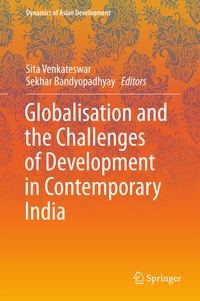
Globalisation and the Challenges of Development in Contemporary India
Description

The editors focus on three major themes, each discussed in a section: The first section, Framing the Macro-Economic Environment, defines the framework for interrogating globalisation and socio-economic changes in India over the last few decades of the 20th century spiraling into India in the 21st century. The next section, Food Security and Natural Resources, highlights critical considerations involved in feeding a burgeoning population. The discussions pose important questions in relation to the resilience of both people and planet confronting increasingly unpredictable climate-induced scenarios. The final section, Development, Activism and Changing Technologies, discusses some of the social challenges of contemporary India through the lens of inequalities and emergent activisms. The section concludes with an elaboration of the potential and promise of changing technologies and new social media to build an informed and active citizenry across existing social divides.
More details
Other editions
Additional editions
Persons
Sekhar Bandyopadhyay is Director, New Zealand India Research Institute, School of History, Philosophy, Political Science & International Relation, New Zealand. Sekhar Bandyopadhyay is Director of the New Zealand India Research Institute and Professor of Asian History at Victoria University of Wellington. His academic specialisation is in social and political history of colonial and postcolonial India. He has also written on the Indian diaspora and India-New Zealand relations in historical times. He has published seven books, eight edited or co-edited books, and more than fifty book chapters and journal articles. In 2009 he was elected a Fellow of the Royal Society of New Zealand. In 2014, for his book Decolonization in South Asia: Meanings of Freedom in Post-independence West Bengal, 1947-52, he was awarded the Rabindra Smriti Puraskar by the Bangla Academy, Government of West Bengal.
