

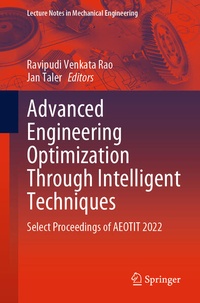
Advanced Engineering Optimization Through Intelligent Techniques
Description

This book comprises peer-reviewed papers presented at the International Conference on Advanced Engineering Optimization Through Intelligent Techniques (AEOTIT) 2022. The book combines contributions from academics and industry professionals and covers advanced optimization techniques across all major engineering disciplines like mechanical, manufacturing, civil, automobile, electrical, chemical, computer, and electronics engineering. The book discusses different optimization techniques and algorithms such as genetic algorithm, non-dominated sorting genetic algorithm-II, and III, differential search, particle swarm optimization, fruit fly algorithm, cuckoo search, teaching-learning-based optimization algorithm, grey wolf optimization, Jaya algorithm, Rao algorithms, and many other latest meta-heuristic techniques and their applications. Various multi-attribute decision-making methods such as AHP, TOPSIS, ELECTRE, PROMETHEE, DEMATEL, R-method, fuzzy logic, and their applications are also discussed. This book serves as a valuable reference for students, researchers, and practitioners and helps them in solving a wide range of optimization problems.
More details
Other editions
Additional editions
Persons
R. Venkata Rao is a Professor (Higher Administrative Grade) at the Department of Mechanical Engineering, S. V. National Institute of Technology, Surat, India. He has more than 31 years of teaching and research experience. He completed his B.Tech. in 1988, M.Tech. in 1991, and Ph.D. in 2002, and obtained his D.Sc. in 2017. His research interests include advanced optimization algorithms and their applications to design, thermal and manufacturing engineering, fuzzy multiple attribute decision-making (MADM) methods, and their industrial applications. He has 8 authored books and over 350 research papers to his credit, published in national and international journals and conference proceedings. He has received national and international awards for his research efforts. He is a reviewer for over 80 national and international journals and serves on the editorial boards of several international journals. He has also been Visiting Professor at the Cracow University of Technology, Poland; BITSPilani Dubai Campus; and Asian Institute of Technology, Bangkok.
Jan Taler is a Senior Professor in the Department of Energy of the Faculty of Environmental and Energy Engineering of Cracow University of Technology, Poland. He has more than 45 years of teaching and research experience, having completed his M.Sc. in 1974, Ph.D. in 1977, and D.Sc. in 1987. He has published more than 380 articles in scientific journals. He has authored 12 books and over 25 chapters in scientific monographs and entries in the Encyclopedia of Thermal Stresses. He researches in the field of heat transfer engineering and thermal power engineering with a special interest in the following areas-inverse heat conduction problems, measurement of heat flux and heat transfer coefficient, ash fouling and slagging in steam boilers, dynamics of large steam boilers, and optimization of thermal systems. He has participated in many research projects funded by industry and the Polish Committee for Scientific Research. Many of his innovative technical solutions have been implemented in power plants.
