

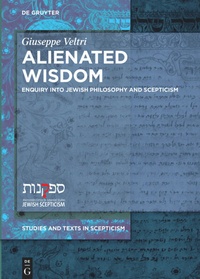
Alienated Wisdom
Description

The present study addresses problems of an epistemological nature which hinge on the question of how to define Jewish thought. It will take its start in an ancient question, that of the relationship between Jewish culture, Greek philosophy, and then Greco-Roman (and Christian) thought in connection with the query into the history and genealogy of wisdom and knowledge.
Our journey into the history of the denomination 'Jewish philosophy' will include a leg that will lead us to certain declarations of political, moral, and scientific principles, and then on to the birth of what is called philosophia perennis or, in Christian circles, prisca theologia . Our subject of inquiry will thus be the birth of the concept of Jewish philosophy, Jewish theology and Jewish philosophy of religion.
A special emphasis will fall on the topic treated in the last part of this study: Jewish scepticism, a theme that involves a philosophical attitude founded on dialectical "enquiry", as the etymology of the Greek word skepsis properly means.
More details
Other editions
Additional editions
Person
Content
- Intro
- Foreword
- Contents
- Preface
- Documentation Style
- Introduction
- PART ONE. ALIENATED WISDOM
- Synopsis: How the Written and Oral Torah Became Alienated Wisdom
- 1. Between Myth and History of Knowledge
- 2. The "Theft" of Written and Oral Wisdom
- 3. Between "Theft" and Genealogy of Knowledge: The Middle Ages
- 4. Primordial Wisdom and Historical Consciousness
- PART TWO. JEWISH PHILOSOPHY: HISTORY OF DEFINITIONS
- Synopsis: How Jewish Tradition Became (Philosophy of) Religion
- 1. From Philosophia Hebraeorum to Jewish Religion
- 2. Philosophy between Jewish Studies and Theology
- 3. Leopold Zunz: The "Scientific" Creation of Jewish Studies
- 4. Abraham Geiger: Jewish Theology as Institution
- 5. Philological Demythologisation as a Premise of New Dogmatisms and Ethics
- PART THREE (JEWISH) SCEPTICISM
- Synopsis: On Jewish Philosophy and Scepticism in the Early Modern Period
- 1. Research on (Jewish) Scepticism
- 2. At The Eve of Modernity: Scepticism in-Between
- 3. Spaces of Dialectic Exchange: The Academies and the Venetian Ghetto
- 4. Socrates, The Jew: The Scepticism of Simone Luzzatto
- 5. Sceptical Judaism: A Protestant Strategy
- Conclusion
- Appendix I. Johannes Frischmuth (1619-1687) Guido Bartolucci
- Appendix II. Johann Frischmuth &
- Johann Leonhard Will
- Bibliography
- Index
