

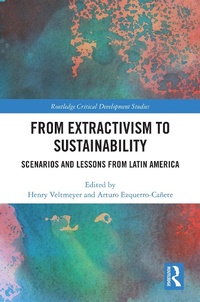
From Extractivism to Sustainability
Scenarios and Lessons from Latin America
1st Edition
Published on 2. March 2023
332 pages
978-1-000-84833-5 (ISBN)
Description

This book investigates how extractive capitalism has developed over the past three decades, what dynamics of resistance have been deployed to combat it, and whether extractivism can ever be transformed into being a part of a progressive development path.
It was not until the 20th century that the extraction of natural resources and raw materials took on a decidedly capitalist form, with the global north extracting primary commodities from the global south as a means of capital accumulation. This book investigates whether extractivism, despite its well-documented negative and destructive socioenvironmental impacts and the powerful forces of resistance that it has generated, could ever be transformed into a sustainable post-development strategy. Drawing on diverse sectoral forms of extractivism (mining, fossil fuels, agriculture), this book analyses the dynamics of both the forces of resistance generated by the advance of extractive capital and alternate scenarios for a more sustainable and liveable future. The book draws particularly on the Latin American experience, where both the propensity of capitalism towards crisis and the development of resistance dynamics to 'extractive' capital have had their greatest impact in the neoliberal era.
This book will be of interest to researchers and students across development studies, economics, political economy, environmental studies, Indigenous studies, and Latin American affairs.
It was not until the 20th century that the extraction of natural resources and raw materials took on a decidedly capitalist form, with the global north extracting primary commodities from the global south as a means of capital accumulation. This book investigates whether extractivism, despite its well-documented negative and destructive socioenvironmental impacts and the powerful forces of resistance that it has generated, could ever be transformed into a sustainable post-development strategy. Drawing on diverse sectoral forms of extractivism (mining, fossil fuels, agriculture), this book analyses the dynamics of both the forces of resistance generated by the advance of extractive capital and alternate scenarios for a more sustainable and liveable future. The book draws particularly on the Latin American experience, where both the propensity of capitalism towards crisis and the development of resistance dynamics to 'extractive' capital have had their greatest impact in the neoliberal era.
This book will be of interest to researchers and students across development studies, economics, political economy, environmental studies, Indigenous studies, and Latin American affairs.
More details
Series
Edition
1. Auflage
Language
English
Place of publication
London
United Kingdom
Publishing group
Taylor & Francis Ltd
Target group
College/higher education
Professional and scholarly
Illustrations
14 Tables, black and white; 17 Line drawings, black and white; 17 Illustrations, black and white
ISBN-13
978-1-000-84833-5 (9781000848335)
Copyright in bibliographic data and cover images is held by Nielsen Book Services Limited or by the publishers or by their respective licensors: all rights reserved.
Schweitzer Classification
Other editions
Additional editions
Henry Veltmeyer | Arturo Ezquerro-Canete
From Extractivism to Sustainability
Scenarios and Lessons from Latin America
Book
08/2024
1st Edition
Routledge
€63.90
Shipment within 10-20 days
Henry Veltmeyer | Arturo Ezquerro-Canete
From Extractivism to Sustainability
Scenarios and Lessons from Latin America
Book
03/2023
1st Edition
Routledge
€186.80
Shipment within 10-20 days
Persons
Henry Veltmeyer is Senior Research Professor at the Universidad Autonoma de Zacatecas, Mexico, and Professor Emeritus of International Development Studies (IDS) at Saint Mary's University, Canada, with a specialized interest in Latin American development.
Arturo Ezquerro-Canete is Research Fellow at the Center for Advanced Latin American Studies in the Humanities and Social Sciences (CALAS) at the University of Guadalajara, Mexico.
Arturo Ezquerro-Canete is Research Fellow at the Center for Advanced Latin American Studies in the Humanities and Social Sciences (CALAS) at the University of Guadalajara, Mexico.
Content
Introduction Part 1: The Contemporary Dynamics of Global Capitalism 1: The contradictions and verities of capitalism 2: The geoeconomics and geopolitics of extractive capital in Latin America Part II: Extractivism in the Mines and the Countryside: Development Dynamics 3: Mexico's mining and petroleum policies under AMLO: A turn to neo-extractivism? 4: The power politics of agro-extractivism for sustainability transformations 5: Water, Land and Gold: Extractivism and the environment in Colombia Part III: Towards a Sustainable Development Pathway: Extractivism or a New Industrial Policy? 6: Is there a role for extractivism in a postdevelopment transition towards sustainability? 7: The green energy transition: Expansion and deepening of extractivism 8: The new geographies of an energy transition: A challenge or a developmental opportunity? Part IV: Resistance on the Extractive Frontier 9: Reloaded neo-extractivism, multi-actor conflicts and alternative horizons: Keys to the socio-ecological crisis 10: Beyond corporate social responsibility: New territorial management strategies for defeating community-based resistance to extractivism 11: Communities in resistance: Forging the communitarian revolutionary subject Part V: Post-Extractivist Alternatives 12: Post-extractivist transitions: Concepts, sequences and examples 13: Sumak Kawsay for Indigenous Women 14: Commune socialism: Self-management, popular power and autonomy in Venezuela 15: Beyond extractivism: Post-extractivist alternatives and pathways
