

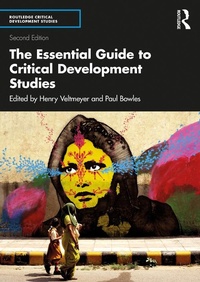
The Essential Guide to Critical Development Studies
2nd Edition
Published on 30. September 2021
442 pages
978-1-000-44225-0 (ISBN)
Description

The Essential Guide to Critical Development Studies provides an up-to-date and authoritative introduction to the field, challenging mainstream development discourse and the assumptions that underlie it.
Critical development studies lays bare the economic, political, social, and environmental crises that characterise the current global capitalist system, proposing instead systemic change and different pathways for moving beyond capitalism into a new world of genuine progress where economic and social justice and ecological integrity prevail. In this book, the authors challenge market-driven, neoliberal development agendas, incorporating analyses of class, gender, race, and the dynamics of uneven capitalist development. This thoroughly revised and expanded second edition includes:
18 new chapters, including on topics such as philanthrocapitalism, race, the energy transition, Indigenous resistance and resilience, and global health
Expanded global coverage, including new chapters on South Africa, North Africa, and the Gulf Arab states
A new section on resistance and alternatives
Additional pedagogical features, including a glossary of key terms, discussion questions, and expanded guides for further reading
This textbook will be essential reading for students of global development, political science, sociology, economics, gender studies, geography, history, anthropology, agrarian studies, international political economy, and area studies. It will also be an important resource for development researchers, practitioners and policymakers.
Critical development studies lays bare the economic, political, social, and environmental crises that characterise the current global capitalist system, proposing instead systemic change and different pathways for moving beyond capitalism into a new world of genuine progress where economic and social justice and ecological integrity prevail. In this book, the authors challenge market-driven, neoliberal development agendas, incorporating analyses of class, gender, race, and the dynamics of uneven capitalist development. This thoroughly revised and expanded second edition includes:
18 new chapters, including on topics such as philanthrocapitalism, race, the energy transition, Indigenous resistance and resilience, and global health
Expanded global coverage, including new chapters on South Africa, North Africa, and the Gulf Arab states
A new section on resistance and alternatives
Additional pedagogical features, including a glossary of key terms, discussion questions, and expanded guides for further reading
This textbook will be essential reading for students of global development, political science, sociology, economics, gender studies, geography, history, anthropology, agrarian studies, international political economy, and area studies. It will also be an important resource for development researchers, practitioners and policymakers.
Reviews / Votes
'In this updated and expanded edition across over forty chapters, this volume is the "go to" source for scholars and students of critical development studies. It provides the highest levels of scholarship and knowledge around the history, content and scope of the field with relevance for challenging and posing contemporary policy and activism.'Ben Fine, Emeritus Professor, School of Oriental and African Studies (SOAS), University of London, UK
'Given the aspirations for social, economic and climate justice, the need for critical, interdisciplinary knowledge that points us toward bold alternatives has never been greater. This Essential Guide offers an invaluable resource in this regard. Its chronicling of the trajectory of development studies will be particularly useful to contemporary scholars to see their ideas in a historical context.'
Ananya Mukherjee Reed, Professor, Department of Economics, Philosophy and Political Science, University of British Columbia Okanagan, Canada; Co-editor, Canadian Journal of Development Studies
'The second edition of The Essential Guide to Critical Development Studies offers a theoretically sophisticated, comprehensive and highly accessible guide to the growing field of international development studies from a critical perspective. It is critical in two senses: critical of mainstream development thought, while at the same time scrutinising popular ideas on alternatives. It will be an indispensable guide for academic researchers (students and senior scholars) as well as activists and development policy practitioners.'
Saturnino M. Borras Jr., Professor of Agrarian Studies, International Institute of Social Studies (ISS), the Netherlands
'We have not reached the end of history but the story of progress, its errors and criticisms, is the most important one in social science. Here critical development scholars have both charted and navigated an extensive archipelago of ideas to produce this guide. This updated and expanded edition covers many crucial debates and is indispensable.'
Barbara Harriss-White, FAcSS, Emeritus Professor and Fellow, Wolfson College, Oxford University, UK
More details
Series
Edition
2nd edition
Language
English
Place of publication
London
United Kingdom
Publishing group
Taylor & Francis Ltd
Target group
College/higher education
Professional and scholarly
Illustrations
7 Tables, black and white; 2 Line drawings, black and white; 2 Illustrations, black and white
ISBN-13
978-1-000-44225-0 (9781000442250)
Copyright in bibliographic data and cover images is held by Nielsen Book Services Limited or by the publishers or by their respective licensors: all rights reserved.
Schweitzer Classification
Other editions
Additional editions
Book
10/2021
Routledge
Unfortunately, price unknown
Available (delivery time upon request)
Book
09/2021
2nd Edition
Routledge
€179.50
Shipment within 15-20 days
Book
09/2021
2nd Edition
Routledge
€66.70
Shipment within 15-20 days
Persons
Henry Veltmeyer is Senior Research Professor at the Universidad Autonoma de Zacatecas, Mexico, and Professor Emeritus of International Development Studies (IDS) at Saint Mary's University, Canada.
Paul Bowles is Professor of Global Studies and Economics at the University of Northern British Columbia, Canada.
Paul Bowles is Professor of Global Studies and Economics at the University of Northern British Columbia, Canada.
Content
Critical Development Studies: An Introduction 1. Introduction to Critical Development Studies: Four Characteristics with Illustrations from Seven Decades Part 1: History as Development 2. Unravelling the Canvas of History Part 2: Thinking Critically about Development 3. Critical Development Theory: Results and Prospects 4. Race in/and Development 5. Development Theory: The Latin American Pivot 6. Postdevelopment and Other Critiques of Development 7. Feminist Contributions to Critical Development Studies Part 3: System Dynamics: Capitalism, Imperialism, Development, and Globalisation 8. Capitalism and Crises 9. Development, Capitalism, Imperialism, Globalisation: A Tale of Four Concepts 10. Globalisation Versus Development: Beyond Dualism 11. Philanthrocapitalism and Development 12. The Migration-Development Nexus in the Neoliberal Era Part 4: Policy Configurations for Development 13. The Post-Washington Consensus 14. International Cooperation for Development 15. The Developmental State, Globalisation, and Structural Transformations 16. Local Economic Development, Microcredit, and Financial Inclusion Part 5: Inside the BRICS 17. Brazil: Development Strategies and Peripheral Conditions 18. India: Critical Issues of a 'Tortuous Transition' 19. Interrogating the China Model of Development 20. South Africa: An Economy of Extremes Part 6: Poverty, Inequalities, and Development Dynamics 21. Development: Class Matters 22. The Dynamics of Poverty Production: A Political Economy Perspective for the SDGs Era 23. Poverty Analysis through a Gender Lens 24. Women, Work, and Gender Inequalities: With Illustrations from Cambodia and China 25. Health Inequalities and Development in a Global Context Part 7: Capitalism, Labour and the State 26. Labour and Development 27. The Triangle of Underdevelopment: Technology, Patents, and Monopoly 28. The Making of the New Chinese Working Class 29. Labour and Development in Latin America 30. Class and State Formation in the Gulf Arab States Part 8: Dynamics of Agrarian Change and Urban Development 31. Contemporary Dynamics of Agrarian Change 32. Food Regimes and Agrarian Questions 33. Urban Development in the Global South 34. Peasant Alternatives to Neoliberalism Part 9: Development, Climate Change, and the Environment 35. Eco-Marxist Lenses for Viewing Human-Nature Relations 36. Climate Change and Development 37. The Energy Transition and the Global South 38. The Political Economy of Extractivism in North Africa Part 10: Resistances and Alternatives 39. Understanding the Rise of the Far Right, and what to do about it 40. Rural Dispossession and Resistance in Asia and Africa 41. Extractive Capitalism and the Resistance in Latin America 42. Colonialism's Miasmas: Indigenous Resistance and Resilience 43. Workers' Control and Self-Management 44. Communitarian Revolutions: Ecological Economics from Below Conclusion 45. Moving towards Another World: Possibilities and Pitfalls
