

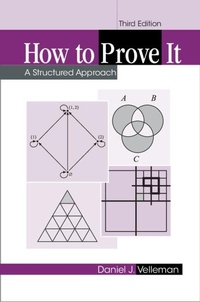
How to Prove It
A Structured Approach
3rd Edition
Published on 24. July 2019
978-1-108-33745-8 (ISBN)
Description

Proofs play a central role in advanced mathematics and theoretical computer science, yet many students struggle the first time they take a course in which proofs play a significant role. This bestselling text's third edition helps students transition from solving problems to proving theorems by teaching them the techniques needed to read and write proofs. Featuring over 150 new exercises and a new chapter on number theory, this new edition introduces students to the world of advanced mathematics through the mastery of proofs. The book begins with the basic concepts of logic and set theory to familiarize students with the language of mathematics and how it is interpreted. These concepts are used as the basis for an analysis of techniques that can be used to build up complex proofs step by step, using detailed 'scratch work' sections to expose the machinery of proofs about numbers, sets, relations, and functions. Assuming no background beyond standard high school mathematics, this book will be useful to anyone interested in logic and proofs: computer scientists, philosophers, linguists, and, of course, mathematicians.
Reviews / Votes
'Not only does this book help students learn how to prove results, it highlights why we care so much. It starts in the introduction with some simple conjectures and gathering data, quickly disproving the first but amassing support for the second. Will that pattern persist? How can these observations lead us to a proof? The book is engagingly written, and covers - in clear and great detail - many proof techniques. There is a wealth of good exercises at various levels. I've taught problem solving before (at The Ohio State University and Williams College), and this book has been a great addition to the resources I recommend to my students.' Steven J. Miller, Williams College, Massachusetts 'This book is my go-to resource for students struggling with how to write mathematical proofs. Beyond its plentiful examples, Velleman clearly lays out the techniques and principles so often glossed over in other texts.' Rafael Frongillo, University of Colorado, Boulder 'I've been using this book religiously for the last eight years. It builds a strong foundation in proof writing and creates the axiomatic framework for future higher-level mathematics courses. Even when teaching more advanced courses, I recommend students to read chapter 3 (Proofs) since it is, in my opinion, the best written exposition of proof writing techniques and strategies. This third edition brings a new chapter (Number Theory), which gives the instructor a few more topics to choose from when teaching a fundamental course in mathematics. I will keep using it and recommending it to everyone, professors and students alike.' Mihai Bailesteanu, Central Connecticut State University 'Professor Velleman sets himself the difficult task of bridging the gap between algorithmic and proof-based mathematics. By focusing on the basic ideas, he succeeded admirably. Many similar books are available, but none are more treasured by beginning students. In the Third Edition, the constant pursuit of excellence is further reinforced.' Taje Ramsamujh, Florida International University 'Proofs are central to mathematical development. They are the tools used by mathematicians to establish and communicate their results. The developing mathematician often learns what constitutes a proof and how to present it by osmosis. How to Prove It aims at changing that. It o?ers a systematic introduction to the development, structuring, and presentation of logical mathematical arguments, i.e. proofs. The approach is based on the language of ?rst-order logic and supported by proof techniques in the style of natural deduction. The art of proving is exercised with naive set theory and elementary number theory throughout the book. As such, it will prove invaluable to ?rst-year undergraduate students in mathematics and computer science.' Marcelo Fiore, University of Cambridge 'Overall, this is an engagingly-written and effective book for illuminating thinking about and building a careful foundation in proof techniques. I could see it working in an introduction to proof course or a course introducing discrete mathematics topics alongside proof techniques. As a self-study guide, I could see it working as it so well engages the reader, depending on how able they are to navigate the cultural context in some examples.' Peter Rowlett, LMS Newsletter 'Altogether this is an ambitious and largely very successful introduction to the writing of good proofs, laced with many good examples and exercises, and with a pleasantly informal style to make the material attractive and less daunting than the length of the book might suggest. I particularly liked the many discussions of fallacious or incomplete proofs, and the associated challenges to readers to untangle the errors in proofs and to decide for themselves whether a result is true.' Peter Giblin, University of Liverpool, The Mathematical GazetteMore details
Edition
3rd Revised edition
Language
English
Place of publication
Cambridge
United Kingdom
Target group
College/higher education
Edition type
Revised edition
Illustrations
Worked examples or Exercises; 47 Line drawings, black and white
File size
4,81 MB
ISBN-13
978-1-108-33745-8 (9781108337458)
Copyright in bibliographic data and cover images is held by Nielsen Book Services Limited or by the publishers or by their respective licensors: all rights reserved.
Schweitzer Classification
Other editions
Additional editions
Book
07/2019
3rd Edition
Cambridge University Press
€135.40
Shipment within 15-20 days
Book
07/2019
3rd Edition
Cambridge University Press
€46.00
Available immediately
Person
Daniel J. Velleman is Julian H. Gibbs '46 Professor of Mathematics, Emeritus at Amherst College, and was a professor at Amherst College from 1983 to 2017. He received his B.A. from Dartmouth College in 1976, and his Ph.D. from the University of Wisconsin, Madison in 1980. His other books include Which Way Did the Bicycle Go? (with Stan Wagon and Joe Konhauser, 1996), Philosophies of Mathematics (with Alexander George, 2002), and Calculus: A Rigorous First Course (2016). Among his awards and distinctions are the Chauvenet Prize, the Paul R. Halmos-Lester R. Ford Award, the Carl B. Allendoerfer Award, and the Chandler Davis Prize for Expository Excellence. He was Editor of Dolciani Mathematical Expositions from 1999 to 2004 and the American Mathematical Monthly from 2007 to 2011.
Content
1. Sentential logic; 2. Quantificational logic; 3. Proofs; 4. Relations; 5. Functions; 6. Mathematical induction; 7. Number theory; 8. Infinite sets.
