

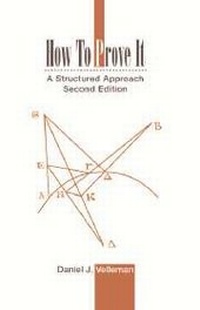
How to Prove It
A Structured Approach
2nd Edition
Published on 20. March 2006
978-0-511-15943-5 (ISBN)
Description

Many students have trouble the first time they take a mathematics course in which proofs play a significant role. This new edition of Velleman's successful text will prepare students to make the transition from solving problems to proving theorems by teaching them the techniques needed to read and write proofs. The book begins with the basic concepts of logic and set theory, to familiarize students with the language of mathematics and how it is interpreted. These concepts are used as the basis for a step-by-step breakdown of the most important techniques used in constructing proofs. The author shows how complex proofs are built up from these smaller steps, using detailed 'scratch work' sections to expose the machinery of proofs about the natural numbers, relations, functions, and infinite sets. To give students the opportunity to construct their own proofs, this new edition contains over 200 new exercises, selected solutions, and an introduction to Proof Designer software. No background beyond standard high school mathematics is assumed. This book will be useful to anyone interested in logic and proofs: computer scientists, philosophers, linguists, and of course mathematicians.
Many students have trouble the first time they take a mathematics course in which proofs play a significant role. This new edition of Velleman's successful text will prepare students to make the transition from solving problems to proving theorems by teaching them the techniques needed to read and write proofs. The book begins with the basic concepts of logic and set theory, to familiarize students with the language of mathematics and how it is interpreted. These concepts are used as the basis for a step-by-step breakdown of the most important techniques used in constructing proofs. The author shows how complex proofs are built up from these smaller steps, using detailed 'scratch work' sections to expose the machinery of proofs about the natural numbers, relations, functions, and infinite sets. To give students the opportunity to construct their own proofs, this new edition contains over 200 new exercises, selected solutions, and an introduction to Proof Designer software. No background beyond standard high school mathematics is assumed. This book will be useful to anyone interested in logic and proofs: computer scientists, philosophers, linguists, and of course mathematicians.
Many students have trouble the first time they take a mathematics course in which proofs play a significant role. This new edition of Velleman's successful text will prepare students to make the transition from solving problems to proving theorems by teaching them the techniques needed to read and write proofs. The book begins with the basic concepts of logic and set theory, to familiarize students with the language of mathematics and how it is interpreted. These concepts are used as the basis for a step-by-step breakdown of the most important techniques used in constructing proofs. The author shows how complex proofs are built up from these smaller steps, using detailed 'scratch work' sections to expose the machinery of proofs about the natural numbers, relations, functions, and infinite sets. To give students the opportunity to construct their own proofs, this new edition contains over 200 new exercises, selected solutions, and an introduction to Proof Designer software. No background beyond standard high school mathematics is assumed. This book will be useful to anyone interested in logic and proofs: computer scientists, philosophers, linguists, and of course mathematicians.
Reviews / Votes
'The book begins with the basic concepts of logic and theory ... These concepts are used as the basis for a step-by-step breakdown of the most important techniques used in constructing proofs. No background standard in high scholl mathematics is assumed.' L'Enseignement Mathematique'The book begins with the basic concepts of logic and theory ... These concepts are used as the basis for a step-by-step breakdown of the most important techniques used in constructing proofs. No background standard in high scholl mathematics is assumed.' L'Enseignement Mathematique
More details
Edition
2nd Revised edition
Language
English
Place of publication
Cambridge
United Kingdom
Publishing group
Cambridge University Press
Target group
College/higher education
Edition type
Revised edition
Illustrations
Worked examples or Exercises; 10 Tables, unspecified
File size
2,24 MB
ISBN-13
978-0-511-15943-5 (9780511159435)
Copyright in bibliographic data and cover images is held by Nielsen Book Services Limited or by the publishers or by their respective licensors: all rights reserved.
Schweitzer Classification
Other editions
Additional editions
Book
01/2006
2nd Edition
Cambridge University Press
€92.84
Article exhausted; check for reprint
Book
01/2006
2nd Edition
Cambridge University Press
€34.65
Article exhausted; check for reprint
Person
Daniel J. Velleman received his BA at Dartmouth College in 1976 summa cum laude, the highest distinction in mathematics. He received his PhD from the University of Wisconsin, Madison, in 1980 and was an instructor at the University of Texas, Austin, from 1980 to 1983. His other books include Which Way Did the Bicycle Go? (with Stan Wagon and Joe Konhauser, 1996) and Philosophies of Mathematics (with Alexander George, 2002). Among his awards and distinctions are the Lester R. Ford Award for the paper 'Versatile Coins' (with Istvan Szalkai, 1994), and the Carl B. Allendoerfer Award for the paper 'Permutations and Combination Locks' (with Greg Call, 1996). He has been a member of the editorial board for American Mathematical Monthly since 1997 and was Editor of Dolciani Mathematical Expositions from 1999 to 2004. He published papers in the Journal of Symbolic Logic, Annals of Pure and Applied Logic, Transactions of the American Mathematical Society, Proceedings of the American Mathematical Society, American Mathematical Monthly, the Mathematics Magazine, the Mathematical Intelligencer, the Philosophical Review, and the American Journal of Physics.
Daniel J. Velleman received his BA at Dartmouth College in 1976 summa cum laude, the highest distinction in mathematics. He received his PhD from the University of Wisconsin, Madison, in 1980 and was an instructor at the University of Texas, Austin, from 1980 to 1983. His other books include Which Way Did the Bicycle Go? (with Stan Wagon and Joe Konhauser, 1996) and Philosophies of Mathematics (with Alexander George, 2002). Among his awards and distinctions are the Lester R. Ford Award for the paper 'Versatile Coins' (with Istvan Szalkai, 1994), and the Carl B. Allendoerfer Award for the paper 'Permutations and Combination Locks' (with Greg Call, 1996). He has been a member of the editorial board for American Mathematical Monthly since 1997 and was Editor of Dolciani Mathematical Expositions from 1999 to 2004. He published papers in the Journal of Symbolic Logic, Annals of Pure and Applied Logic, Transactions of the American Mathematical Society, Proceedings of the American Mathematical Society, American Mathematical Monthly, the Mathematics Magazine, the Mathematical Intelligencer, the Philosophical Review, and the American Journal of Physics.
Daniel J. Velleman received his BA at Dartmouth College in 1976 summa cum laude, the highest distinction in mathematics. He received his PhD from the University of Wisconsin, Madison, in 1980 and was an instructor at the University of Texas, Austin, from 1980 to 1983. His other books include Which Way Did the Bicycle Go? (with Stan Wagon and Joe Konhauser, 1996) and Philosophies of Mathematics (with Alexander George, 2002). Among his awards and distinctions are the Lester R. Ford Award for the paper 'Versatile Coins' (with Istvan Szalkai, 1994), and the Carl B. Allendoerfer Award for the paper 'Permutations and Combination Locks' (with Greg Call, 1996). He has been a member of the editorial board for American Mathematical Monthly since 1997 and was Editor of Dolciani Mathematical Expositions from 1999 to 2004. He published papers in the Journal of Symbolic Logic, Annals of Pure and Applied Logic, Transactions of the American Mathematical Society, Proceedings of the American Mathematical Society, American Mathematical Monthly, the Mathematics Magazine, the Mathematical Intelligencer, the Philosophical Review, and the American Journal of Physics.
Content
1. Sentential logic; 2. Quantificational logic; 3. Proofs; 4. Relations; 5. Functions; 6. Mathematical induction; 7. Infinite sets.
