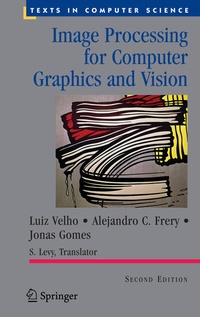
Image Processing for Computer Graphics and Vision
Description

Image processing is concerned with the analysis and manipulation of images by computer. Providing a thorough treatment of image processing with an emphasis on those aspects most used in computer graphics, the authors concentrate on describing and analyzing the underlying concepts rather than on presenting algorithms or pseudocode. As befits a modern introduction to this topic, a good balance is struck between discussing the underlying mathematics and the main topics: signal processing, data discretization, the theory of colour and different colour systems, operations in images, dithering and half-toning, warping and morphing and image processing.
This second edition reflects recent trends in science andtechnology that exploit image processing in computer graphics and vision applications. Stochastic image models and statistical methods for image processing are covered as are: A modern approach and new developments in the area, Probability theory for image processing, Applications in image analysis and computer vision.
Reviews / Votes
From the reviews of the second edition:
"The mathematical aspects of image processing are emphasized in this book . . I found useful information in all of the chapters, for reasons of personal bias, I found some chapters more interesting than others-- especially 'Color Quantization,' 'Digital Halftoning' (dithering), 'Combining Images,' and 'Warping and Morphing.' Chapters can be read independently, and each includes a bibliography. The presentation is well structured and clear." (O. Lecarme, ACM Computing Reviews, June, 2009)
"The book is devoted to image processing techniques with an emphasis on the aspects most used in computer graphics and vision. . The book is presented in an accessible fashion, with many illustrations and examples. . It is suitable both as a textbook and as a professional reference for students, researchers and engineers. It is a great starting point for those who want to use computer graphics and vision in research or are interested in the field." (Agnieszka Lisowska, Mathematical Reviews, Issue 2011 j)
More details
Other editions
Additional editions