

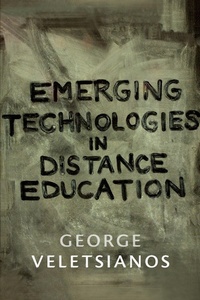
Emerging Technologies in Distance Education
1st Edition
Published on 1. July 2010
350 pages
978-1-897425-77-0 (ISBN)
Description

A showcase of the work of research scholars and innovative practitioners the world over who use emerging interactive technologies for teaching and learning at a distance. This book highlights the pedagogical, organizational, cultural, social, and economic factors that influence the integration of emerging technologies in education.
More details
Other editions
Additional editions
George Veletsianos
Emerging Technologies in Distance Education
Book
06/2010
AU Press
€55.89
Shipment within 3-4 weeks
Person
Veletsianos George:
George Veletsianos is a professor in the School of Education and Technology at Royal Roads University and holds a Canada Research Chair in Innovative Learning and Technology. His research is dedicated to understanding the practices and experiences of learners, educators, and scholars in emerging online settings. His presentations, publications, and most recent thoughts on education can be found at www.veletsianos.com.George Veletsianos is a professor in the School of Education and Technology at Royal Roads University and holds a Canada Research Chair in Innovative Learning and Technology. His research is dedicated to understanding the practices and experiences of learners, educators, and scholars in emerging online settings. His presentations, publications, and most recent thoughts on education can be found at www.veletsianos.com.
George Veletsianos is a professor in the School of Education and Technology at Royal Roads University and holds a Canada Research Chair in Innovative Learning and Technology. His research is dedicated to understanding the practices and experiences of learners, educators, and scholars in emerging online settings. His presentations, publications, and most recent thoughts on education can be found at www.veletsianos.com.George Veletsianos is a professor in the School of Education and Technology at Royal Roads University and holds a Canada Research Chair in Innovative Learning and Technology. His research is dedicated to understanding the practices and experiences of learners, educators, and scholars in emerging online settings. His presentations, publications, and most recent thoughts on education can be found at www.veletsianos.com.
Content
Introduction / George Veletsianos Part I. Foundations of Emerging Technologies in Distance Education
1. A Definition of Emerging Technologies for Education / George Veletsianos
2. Theories for Learning with Emerging Technologies / Terry Anderson
3. Imagining Multi-Roles in Web 2.0 Distance Education / Elizabeth Wellburn and B. J. Eib
4. Beyond Distance and Time Constraints: Applying Social Networking Tools and Web 2.0 Approaches in Distance Education / Mark J. W. Lee and Catherine McLoughlin Part II. Learning Designs for Emerging Technologies
5. "Emerging": A Re-Conceptualization of Contemporary Technology Design and Integration / The Learning Technologies Collaborative
6. Developing Personal Learning Networks for Open and Social Learning / Alec Couros
7. Creating a Culture of Community in the Online Classroom Using Artistic Pedagogical Technologies / Beth Perry and Margaret Edwards
8. Structured Dialogue Embedded within Emerging Technologies / Yiannis Laouris, Gayle Underwood, Romina Laouri, and Aleco Christakis Part III. Social, Organizational, and Contextual Factors in Emerging Technologies Implementations
9. Personal Learning Environments / Trey Martindale & Michael Dowdy
10. Learning, Design, and Emergence: Two Case Studies of Moodle in Distance Education / Andrew Whitworth and Angela Benson
11. Institutional Implementation of Wikis in Higher Education: The Case of the Open University of Israel (OUI) / Hagit Meishar-Tal, Yoav Yair, and Edna Tal-Elhasid
12. The Use of Web Analytics in the Design and Evaluation of Distance Education / P. Clint Rogers, Mary R. McEwen, and SaraJoy Pond
13. New Communications Options: A Renaissance in Videoconference Use / Richard Caladine, Trish Andrews, Belinda Tynan, Robyn Smyth, and Deborah Vale Part IV. Learner-Learner, Learner-Content, and Learner-Instructor Interaction and Communication with Emerging Technologies
14. Using Social Media to Create a Place that Supports Communication / Rita Kop
15. Technical, Pedagogical, and Cultural Considerations for Language Learning in MUVEs / Charles Xiaoxue Wang, Brendan Calandra, and Youngjoo Yi
16. Animated Pedagogical Agents and Immersive Worlds: Two Worlds Colliding / Bob Heller and Mike Procter Conclusion / George Veletsianos Contributors / Index
1. A Definition of Emerging Technologies for Education / George Veletsianos
2. Theories for Learning with Emerging Technologies / Terry Anderson
3. Imagining Multi-Roles in Web 2.0 Distance Education / Elizabeth Wellburn and B. J. Eib
4. Beyond Distance and Time Constraints: Applying Social Networking Tools and Web 2.0 Approaches in Distance Education / Mark J. W. Lee and Catherine McLoughlin Part II. Learning Designs for Emerging Technologies
5. "Emerging": A Re-Conceptualization of Contemporary Technology Design and Integration / The Learning Technologies Collaborative
6. Developing Personal Learning Networks for Open and Social Learning / Alec Couros
7. Creating a Culture of Community in the Online Classroom Using Artistic Pedagogical Technologies / Beth Perry and Margaret Edwards
8. Structured Dialogue Embedded within Emerging Technologies / Yiannis Laouris, Gayle Underwood, Romina Laouri, and Aleco Christakis Part III. Social, Organizational, and Contextual Factors in Emerging Technologies Implementations
9. Personal Learning Environments / Trey Martindale & Michael Dowdy
10. Learning, Design, and Emergence: Two Case Studies of Moodle in Distance Education / Andrew Whitworth and Angela Benson
11. Institutional Implementation of Wikis in Higher Education: The Case of the Open University of Israel (OUI) / Hagit Meishar-Tal, Yoav Yair, and Edna Tal-Elhasid
12. The Use of Web Analytics in the Design and Evaluation of Distance Education / P. Clint Rogers, Mary R. McEwen, and SaraJoy Pond
13. New Communications Options: A Renaissance in Videoconference Use / Richard Caladine, Trish Andrews, Belinda Tynan, Robyn Smyth, and Deborah Vale Part IV. Learner-Learner, Learner-Content, and Learner-Instructor Interaction and Communication with Emerging Technologies
14. Using Social Media to Create a Place that Supports Communication / Rita Kop
15. Technical, Pedagogical, and Cultural Considerations for Language Learning in MUVEs / Charles Xiaoxue Wang, Brendan Calandra, and Youngjoo Yi
16. Animated Pedagogical Agents and Immersive Worlds: Two Worlds Colliding / Bob Heller and Mike Procter Conclusion / George Veletsianos Contributors / Index
