

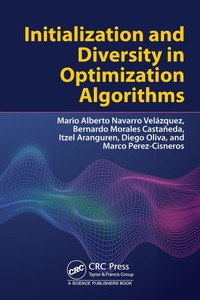
Initialization and Diversity in Optimization Algorithms
Published on 19. February 2026
238 pages
978-1-040-63531-5 (ISBN)
Description

Designing new algorithms in swarm intelligence is a complex undertaking. Two critical factors have been seen to have a direct correlation with positive results. First is initialization, which serves as the initial step for all swarm intelligence techniques. Candidate solutions are generated to form the initial population, which are subsequently modified during the iterative process. A well-initialized population increases the algorithm's chances of avoiding local optima and finding the global optimum in fewer iterations. Although random distributions are commonly used for initialization, there are various ways to initialize the population elements.
Maintaining diversity among the population elements throughout the iterative process is also essential. This diversity facilitates a more thorough and efficient exploration of the search space. In swarm intelligence algorithms, there are multiple methods to measure diversity, each with its own advantages and disadvantages.
This book presents the theory behind the initialization process and the different mechanisms. Additionally, it includes a comparative study of various diversity indicators. It explores different methodologies to compute its value and explains how it can be incorporated as a mechanism for deciding when to apply operators during the optimization process. Multiple examples are provided in the book using two classical algorithms: Differential Evolution and Particle Swarm Optimization. It includes MATLAB (R) code and offers several exercises that readers can use for experimentation and design purposes.
Maintaining diversity among the population elements throughout the iterative process is also essential. This diversity facilitates a more thorough and efficient exploration of the search space. In swarm intelligence algorithms, there are multiple methods to measure diversity, each with its own advantages and disadvantages.
This book presents the theory behind the initialization process and the different mechanisms. Additionally, it includes a comparative study of various diversity indicators. It explores different methodologies to compute its value and explains how it can be incorporated as a mechanism for deciding when to apply operators during the optimization process. Multiple examples are provided in the book using two classical algorithms: Differential Evolution and Particle Swarm Optimization. It includes MATLAB (R) code and offers several exercises that readers can use for experimentation and design purposes.
More details
Language
English
Place of publication
London
United Kingdom
Publishing group
Taylor & Francis Ltd
Target group
College/higher education
Professional and scholarly
Product notice
Reflowable
Illustrations
35 Tables, black and white; 43 Line drawings, black and white; 6 Halftones, black and white; 49 Illustrations, black and white
File size
8,04 MB
ISBN-13
978-1-040-63531-5 (9781040635315)
Copyright in bibliographic data and cover images is held by Nielsen Book Services Limited or by the publishers or by their respective licensors: all rights reserved.
Schweitzer Classification
Other editions
Additional editions

Mario A. Navarro Velazquez | Bernardo Morales-Castaneda | Itzel Aranguren
Initialization and Diversity in Optimization Algorithms
Book
02/2026
1st Edition
CRC Press
€190.60
Shipment within 10-20 days
Persons
Mario Alberto Navarro Velazquez obtained a Master of Science in Electronic Engineering and Computer Science in 2019, focusing his research on the design of metaheuristic algorithms and applications in image segmentation. In 2023, he obtained a PhD in Electronic and Computer Engineering at the University Center for Exact Sciences and Engineering (CUCEI) in Guadalajara, Mexico, concentrating on the coevolution of metaheuristic strategies to solve various optimization problems. His most recent recognitions include becoming a part of the National System of Researchers obtaining the distinction as a national researcher level 1 (SNI 1), and membership in the Mexican Academy of Computing (AmexComp). His research interests include artificial intelligence, specifically the design and hybridization of evolutionary algorithms, the development of operators and hyper heuristics to solve high-dimensional problems, and the integration of evolutionary algorithms and machine learning.
Bernardo Morales Castaneda obtained a Bachelor's in Computer Engineering from the University of Guadalajara (UdeG), Mexico in 2016 and a Master's degree in Electronic and Computer Engineering from University of Guadalajara (UDG) in 2018. He obtained a Doctorate degree in Electronics and Computer Science in 2022. Since 2022, Dr. Morales has been serving as a research professor in the Department of Information and Knowledge-based Innovation at the University Center for Exact Sciences and Engineering (CUCEI) of UDG. His research areas include various branches of AI such as artificial neural networks, computer vision, image segmentation, and the development of metaheuristic algorithms. Since 2023, Dr. Morales has been recognized as a member of the National System of Researchers (SNI) with the distinction of National Researcher Level 1.
Itzel Aranguren obtained a degree in Biomedical Engineering from the Universidad de Guadalajara (UDG), Mexico (2016). In 2018, she obtained a Master's of Science in Electronic Engineering and Computing from UDG and successively, and a Doctor in Electronics and Computer Sciences in 2022. Since 2019, Dr. Aranguren has been a research professor in the Department of Computational Sciences of the University Center for Exact Sciences and Engineering (CUCEI) of the UDG. Dr. Aranguren develops her research in medical image enhancement, metaheuristic algorithms, optimization, and vision. She is recognized as a member of the National System of Researchers (SNI), having the distinction of National Researcher Level 1.
Diego Oliva (Senior Member, IEEE) received a B.Eng. in Electronics and Computer Engineering from the Industrial Technical Education Center (CETI) of Guadalajara, Mexico, in 2007, and a M.Sc. in Electronic Engineering and Computer Sciences from the University of Guadalajara, Mexico, in 2010. He obtained a PhD in Informatics in 2015 from the Universidad Complutense de Madrid. Currently, he is a Professor at the University of Guadalajara in Mexico. He has the National Researcher Rank 2 distinction by the Mexican Council of Science and Technology. In 2022, he obtained the distinction of Highly Cited Researcher by Clarivate (WoS). He has been listed in the world's 2% most cited scientists according to Stanford University and Elsevier since 2022. He also serves as editor for journals such as IEEE Access, Engineering Applications of Artificial Intelligence, Swarm and Evolutionary Computation, and Knowledge-Based Systems, among others. His research interests include evolutionary and swarm algorithms, hybridization of evolutionary and swarm algorithms, and computational intelligence.
Marco Perez-Cisneros (Senior Member, IEEE) has a B.Eng. in communications and electronics engineering from the University of Guadalajara, Mexico, a M. Eng. from ITESO University Mexico, and the PhD from The University of Manchester, UK. He is a Professor with the Electro-Photonics Department and has been appointed as the Chancellor of the University Centre of Exact Sciences and Engineering, University of Guadalajara. He is a member of the National Research System in Mexico. Since 2018, he has been a member of the Mexican National Science Academy. He is a Regular Member of the IET, UK. He also serves as an Associate Editor for IEEE Letters.
Bernardo Morales Castaneda obtained a Bachelor's in Computer Engineering from the University of Guadalajara (UdeG), Mexico in 2016 and a Master's degree in Electronic and Computer Engineering from University of Guadalajara (UDG) in 2018. He obtained a Doctorate degree in Electronics and Computer Science in 2022. Since 2022, Dr. Morales has been serving as a research professor in the Department of Information and Knowledge-based Innovation at the University Center for Exact Sciences and Engineering (CUCEI) of UDG. His research areas include various branches of AI such as artificial neural networks, computer vision, image segmentation, and the development of metaheuristic algorithms. Since 2023, Dr. Morales has been recognized as a member of the National System of Researchers (SNI) with the distinction of National Researcher Level 1.
Itzel Aranguren obtained a degree in Biomedical Engineering from the Universidad de Guadalajara (UDG), Mexico (2016). In 2018, she obtained a Master's of Science in Electronic Engineering and Computing from UDG and successively, and a Doctor in Electronics and Computer Sciences in 2022. Since 2019, Dr. Aranguren has been a research professor in the Department of Computational Sciences of the University Center for Exact Sciences and Engineering (CUCEI) of the UDG. Dr. Aranguren develops her research in medical image enhancement, metaheuristic algorithms, optimization, and vision. She is recognized as a member of the National System of Researchers (SNI), having the distinction of National Researcher Level 1.
Diego Oliva (Senior Member, IEEE) received a B.Eng. in Electronics and Computer Engineering from the Industrial Technical Education Center (CETI) of Guadalajara, Mexico, in 2007, and a M.Sc. in Electronic Engineering and Computer Sciences from the University of Guadalajara, Mexico, in 2010. He obtained a PhD in Informatics in 2015 from the Universidad Complutense de Madrid. Currently, he is a Professor at the University of Guadalajara in Mexico. He has the National Researcher Rank 2 distinction by the Mexican Council of Science and Technology. In 2022, he obtained the distinction of Highly Cited Researcher by Clarivate (WoS). He has been listed in the world's 2% most cited scientists according to Stanford University and Elsevier since 2022. He also serves as editor for journals such as IEEE Access, Engineering Applications of Artificial Intelligence, Swarm and Evolutionary Computation, and Knowledge-Based Systems, among others. His research interests include evolutionary and swarm algorithms, hybridization of evolutionary and swarm algorithms, and computational intelligence.
Marco Perez-Cisneros (Senior Member, IEEE) has a B.Eng. in communications and electronics engineering from the University of Guadalajara, Mexico, a M. Eng. from ITESO University Mexico, and the PhD from The University of Manchester, UK. He is a Professor with the Electro-Photonics Department and has been appointed as the Chancellor of the University Centre of Exact Sciences and Engineering, University of Guadalajara. He is a member of the National Research System in Mexico. Since 2018, he has been a member of the Mexican National Science Academy. He is a Regular Member of the IET, UK. He also serves as an Associate Editor for IEEE Letters.
Content
1. Introduction to Swarm Optimization. 2. Two Classical Metaheuristics: Differential Evolution and Particle Swarm Optimization. 3. The Influence of Initialization in Metaheuristics. 4. Different Methodologies for Initialization. 5. Implementation of Initialization Methods in PSO and DE. 6. The Importance of Diversity in Metaheuristics. 7. Different Indicators for Measuring Diversity. 8. Implementation of Diversity Indicators in DE and PSO. 8. Implementation of Diversity Indicators in DE and PSO. 9. Pros and Cons of the Use of Different Initializations and Diversity Indicators. Appendix A. Test Functions. Appendix B. MATLAB codes for Initialization Methods and 2D Visualization. Appendix C. Solutions.
