

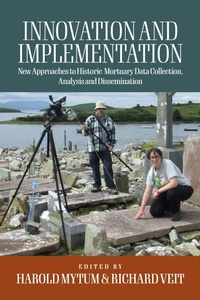
Innovation and Implementation
Critical Reflections on New Approaches to Historic Mortuary Data Collection, Analysis, and Dissemination
1st Edition
Published on 14. July 2023
284 pages
978-1-80539-046-6 (ISBN)
Description

Providing a comprehensive set of guidance to assist researchers wishing to carry out, curate and disseminate field research at a historic burial ground, chapters offer up to date methods for surface and subsurface survey and for the recording and archiving of burial monument data. Divided into three parts considering documentary research and recording of mortuary landscapes, reflections on memorial recording projects, and archiving and wider dissemination of data and interpretations. Also included is the archaeological potential of pet cemeteries and other pet memorials. Discussions therefore include how methodologies may or may not be applicable to both human and animal subjects.
Reviews / Votes
"...the chapters provide a clear description of historic cemetery archaeological practices, giving individuals a better idea of potential archaeological projects and careers and the challenges faced by those in the field." * Heather Garvin, Des Moines University"This is a timely, well-organized volume that focuses on new and updated approaches toward cemetery studies. The 14 chapters outline different but complimentary methodologies in cemetery studies and their application over a cross section of global locations." * Nancy E. Tatarek, Ohio University
More details
Edition
1. Auflage
Language
English
Place of publication
Oxford
United Kingdom
Target group
Professional and scholarly
Illustrations
Bibliography; Index; 67 Illustrations
ISBN-13
978-1-80539-046-6 (9781805390466)
DOI
10.3167/9781805390466
Copyright in bibliographic data and cover images is held by Nielsen Book Services Limited or by the publishers or by their respective licensors: all rights reserved.
Schweitzer Classification
Other editions
Additional editions
Richard Veit | Harold Mytum
Innovation and Implementation
Critical Reflections on New Approaches to Historic Mortuary Data Collection, Analysis, and Dissemination
Book
07/2023
Berghahn Books
€147.30
Shipment within 3-4 weeks
Persons
Richard Veit is a Professor of Anthropology and Associate Dean of the Wayne D. McMurray School of Humanities and Social Sciences at Monmouth University. His research interests include gravestones and burial grounds, early American material culture, vernacular architecture, and conflict archaeology.
Content
List of illustrations
List of tables
Acknowledgements
Introduction
Harold Mytum and Richard Veit
Part I: Exploring Surface, Subsurface and Documentary Evidence
Chapter 1. Applying Reflectance Transformation Imaging (RTI) to Record and Interpret Mortuary Monuments
Harold Mytum
Chapter 2. Reevaluating Empty Sections Within Historic Cemeteries: Discovering Victims of the 1918 Influenza Pandemic
Mark Nonestied
Chapter 3. Is Anyone Out There? Survey and Research Techniques for CRM Projects when Burial Grounds/Cemeteries Border Construction Projects
Mickey Dobbin and Bob Dean
Chapter 4. Who Lies Where? A Land and Air-based Survey Methodology for Documenting Historic Cemeteries
Richard W. Hunter, James S. Lee III, Alexis Alemy and Evan Mydlowski
Part II: Field Recording of Monuments and Burial Ground Management
Chapter 5. Now You See It, Now You Don't: Evaluating Earlier Cemetery Monument Records through Modern Recording
Anne G. Giesecke and Dan Steffen
Chapter 6. An International Mortuary Monument Recording System - From Site Analysis to International Comparative Studies
Harold Mytum
Chapter 7. "As Old as Pompeii or Herculaneum": Kolkata, India's South Park Street Cemetery, An Example of Rapid Recording
Richard Veit
Chapter 8. Standing for Sacred Spaces: NC Division of Cultural Resources and the African American Burial Ground Network Act
Melissa A Timo
Chapter 9. Mourning and Remembering Deceased Companion Species: Mortuary Monuments and Graves for Horses in Finland
Tiina AEikaes, Janne Ikaeheimo, Tuija Kirkinen, Karin Hemmann, and Paeivi Laine
Chapter 10. Preserving the Rainbow Bridge: Recording Pet Cemeteries
Eric Tourigny
Part III: Archiving and Dissemination
Chapter 11. Discovering England's Burial Spaces (DEBS): Using Digital Tools in Graveyard Recording and Archiving
Julian D Richards, Toby Pillatt, Debbie Maxwell, Gareth Beale and Nicole Smith
Chapter 12. The Cemetery Surveyor Application: Non-paper data Collection Methods in Luxembourg Burial Grounds
Christoph K. Streb, Cyrille Medard de Chardon, and Thomas Kolnberger
Chapter 13. Burial Grounds on the Web: Reviewing the Role of Digital Data beyond Genealogy, and how Historical Archaeology can play its part
Anna Fairley Nielsson
Chapter 14. Burial Ground Recording and Analysis: Where Next?
Harold Mytum and Richard Veit
Index
List of tables
Acknowledgements
Introduction
Harold Mytum and Richard Veit
Part I: Exploring Surface, Subsurface and Documentary Evidence
Chapter 1. Applying Reflectance Transformation Imaging (RTI) to Record and Interpret Mortuary Monuments
Harold Mytum
Chapter 2. Reevaluating Empty Sections Within Historic Cemeteries: Discovering Victims of the 1918 Influenza Pandemic
Mark Nonestied
Chapter 3. Is Anyone Out There? Survey and Research Techniques for CRM Projects when Burial Grounds/Cemeteries Border Construction Projects
Mickey Dobbin and Bob Dean
Chapter 4. Who Lies Where? A Land and Air-based Survey Methodology for Documenting Historic Cemeteries
Richard W. Hunter, James S. Lee III, Alexis Alemy and Evan Mydlowski
Part II: Field Recording of Monuments and Burial Ground Management
Chapter 5. Now You See It, Now You Don't: Evaluating Earlier Cemetery Monument Records through Modern Recording
Anne G. Giesecke and Dan Steffen
Chapter 6. An International Mortuary Monument Recording System - From Site Analysis to International Comparative Studies
Harold Mytum
Chapter 7. "As Old as Pompeii or Herculaneum": Kolkata, India's South Park Street Cemetery, An Example of Rapid Recording
Richard Veit
Chapter 8. Standing for Sacred Spaces: NC Division of Cultural Resources and the African American Burial Ground Network Act
Melissa A Timo
Chapter 9. Mourning and Remembering Deceased Companion Species: Mortuary Monuments and Graves for Horses in Finland
Tiina AEikaes, Janne Ikaeheimo, Tuija Kirkinen, Karin Hemmann, and Paeivi Laine
Chapter 10. Preserving the Rainbow Bridge: Recording Pet Cemeteries
Eric Tourigny
Part III: Archiving and Dissemination
Chapter 11. Discovering England's Burial Spaces (DEBS): Using Digital Tools in Graveyard Recording and Archiving
Julian D Richards, Toby Pillatt, Debbie Maxwell, Gareth Beale and Nicole Smith
Chapter 12. The Cemetery Surveyor Application: Non-paper data Collection Methods in Luxembourg Burial Grounds
Christoph K. Streb, Cyrille Medard de Chardon, and Thomas Kolnberger
Chapter 13. Burial Grounds on the Web: Reviewing the Role of Digital Data beyond Genealogy, and how Historical Archaeology can play its part
Anna Fairley Nielsson
Chapter 14. Burial Ground Recording and Analysis: Where Next?
Harold Mytum and Richard Veit
Index
