

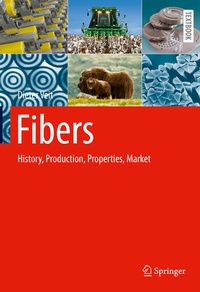
Fibers
Description

This textbook covers the production of all relevant natural and man-made fibers, their inner structure, properties, applications, markets and historic development. More than 1,600 photos, maps and sketches complement the text. The properties of important fibers are compared in a large number of tables and graphics to simplify selecting an appropriate fiber for a given application.
More details
Other editions
Additional editions
Person
Dieter Veit has studied mechanical engineering with a major in textiles at RWTH Aachen University. After completing his Dr.-Ing., he worked in man-made fiber plant engineering and since 2001 he has been giving lectures on natural and man-made fibers at RWTH Aachen University. He authored and edited several books on textile technology and artificial intelligence.
Content
Part 1. Fundamentals.- Chapter 1. Definitions.- Chapter 2. History.- Chapter 3. Market.- Chapter 4. Inner Structure of Fibers.- Part 2. Natural Fibers.- Chapter 5. Cotton.- Chapter 6. Bast Fibers.- Chapter 7. Hard Fibers.- Chapter 8. Fruit Fibers.- Chapter 9. Wool.- Chapter 10. Fine Animal Hair.- Chapter 11. Silk.- Chapter 12. Asbestos.- Chapter 13. Other Natural Fibers.- Part 3. Chemical Fibers - Processes and Machines.- Chapter 14. Synthetic Man-made Fibers - Polymer Formation Processes.- Chapter 15. Aggregates for Polymer Formation.- Chapter 16. Processes for the Production of Man-made Fibers.- Chapter 17. Aggregates for the Production of Synthetic Filaments.- Chapter 18. Aggregates for the Production of Solution Spun Man-made Fibers.- Chapter 19. Processes for the Production of Textile Filament Yarns.- Chapter 20. Processes for the Production of Industrial Yarns.- Chapter 21. Process for the Production of Monofilaments.- Chapter 22. Process for the Production of Carpet Yarns.- Chapter 23. Process for the Production of Film Yarns.- Chapter 24. Processes for the Production of Staple Fibers.- Chapter 25. Processes for the Production of Nonwovens.- Chapter 26. Bicomponent Fibers.- Chapter 27. Fine Fibers.- Chapter 28. Aerogels.- Chapter 29. Texturing.- Part 4. Synthetic Chemical Fibers - Production and Properties.- Chapter 30. Polyester.- Chapter 31. Polyamide.- Chapter 32. Aramid.- Chapter 33. Polyolefins.- Chapter 34. Polyacrylonitrile.- Chapter 35. Polylactic Acid.- Chapter 36. Elastane.- Chapter 37. High Performance Fibers.- Chapter 38. Carbon Fibers.- Chapter 39. Carbon Nanotubes and Graphene.- Chapter 40. Optical Fibers.- Part 5. Cellulosic Chemical Fibers - Production and Properties.- Chapter 41. Cellulosic Man-made Fibers.- Part 6. Biopolymers.- Chapter 42. Biopolymers.- Part 7. Inorganic Fibers.- Chapter 43. Glass Fibers.- Chapter 44. Basalt Fibers.- Chapter 45. Ceramic Fibers.- Part 8. Metal Fibers.- Chapter 46. Metal Fibers.- Part 9. Test Methods.- Chapter 47. Test Methods.- Part 10. Properties of Natural and Chemical Fibers.- Chapter 48. Properties.- Part 11. Producers and Trade Names.- Chapter 49. Producers and Trade Names.- Part 12. Outlook and Trends.- Chapter 50. Outlook and Trends.
