

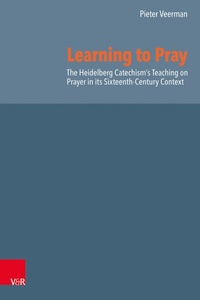
Learning to Pray
The Heidelberg Catechism's Teaching on Prayer in its Sixteenth-Century Context
1st Edition
Published on 16. June 2025
348 pages
978-3-647-50222-9 (ISBN)
Description

Pieter Veerman in his work explains why the Heidelberg Catechism is a unique teacher of thankfulness in its sixteenth-century context. Veerman provides an in-depth theological analysis of Q&A 115-129. The author compares this teaching with Catholic, Lutheran, and Reformed catechetical writings, demonstrating that the Heidelberg Catechism is a synthesis of earlier theological thought. The explanation of the Lord's Prayer is central, as it is within the broader catechetical tradition. The Heidelberg Catechism's uniqueness lies in its thoughtful presentation and integration of various elements. By presenting catechetical answers in the form of prayers themselves, this catechism establishes itself as a valuable manual of piety. It differs from contemporaneous Catholic catechisms by emphasizing that true prayer arises from the heart. Its emphasis on the Holy Spirit is a distinctly Reformed feature.
More details
Other editions
Additional editions
Pieter Veerman
Learning to Pray
The Heidelberg Catechism's Teaching on Prayer in its Sixteenth-Century Context
Book
06/2025
1st Edition
Vandenhoeck & Ruprecht
from
€120.00
Available immediately
Persons
Pieter Veerman is Assistant Professor of Practical Theology at the Theological University of Apeldoorn and Vrije Universiteit Amsterdam, the Netherlands. He received his PhD in 2016 from the Protestant Theological University in Amsterdam with a dissertation on the Heidelberg Catechism's teaching on prayer. His current research is focused on the Heidelberg Catechism (1563) and early and present-day catechetical sermons on the Lord's Prayer. He is a member of Societas Homiletica.
Content
- Cover
- Contents
- Preface
- Title Page
- Copyright
- 1. Prayer in the Heidelberg Catechism
- 1.1 Introduction
- 1.2 The State of Scholarship
- 1.3 The Question
- 1.4 Methodology
- 1.5 Delineation of the Catechisms and Theological Themes in This Study
- 1.5.1 Catechisms
- 1.5.2 Theological Themes
- 1.6 Outline of This Study
- 2. Catechetical Prayer Instruction Prior to the Protestant Reformations
- 2.1 Introduction
- 2.2 Catechesis in the Early Church and Middle Ages
- 2.3 The Lord's Prayer as the Basic Text in Prayer Instruction
- 2.4 Breviary Prayer, Prayer Books, and Other Literature Promoting Piety in the Middle Ages
- 2.5 The Practice of Catechetical Instruction
- 2.6 Praying and Divine Judgment
- 2.7 Summary and Conclusions
- 3. The Doctrine Of Prayer in the Heidelberg Catechism
- 3.1 Introduction
- 3.2 Question and Answer 115
- 3.2.1 Theological Examination of the Text
- 3.2.2 Summary
- 3.3 Question and Answer 116
- 3.3.1 Theological Examination of the Text
- 3.3.2 Summary
- 3.4 Question and Answer 117
- 3.4.1 Theological Examination of the Text
- 3.4.2 Summary
- 3.5 Question and Answer 118
- 3.5.1 Theological Examination of the Text
- 3.5.2 Summary
- 3.6 Question and Answer 119
- 3.6.1 Theological Examination of the Text
- 3.6.2 Summary
- 3.7 Question and Answer 120
- 3.7.1 Theological Examination of the Text
- 3.7.2 Summary
- 3.8 Question and Answer 121
- 3.8.1 Theological Examination of the Text
- 3.8.2 Summary
- 3.9 Question and Answer 122
- 3.9.1 Theological Examination of the Text
- 3.9.2 Summary
- 3.10 Question and Answer 123
- 3.10.1 Theological Examination of the Text
- 3.10.2 Summary
- 3.11 Question and Answer 124
- 3.11.1 Theological Examination of the Text
- 3.11.2 Summary
- 3.12 Question and Answer 125
- 3.12.1 Theological Examination of the Text
- 3.12.2 Summary
- 3.13 Question and Answer 126
- 3.13.1 Theological Examination of the Text
- 3.13.2 Summary
- 3.14 Question and Answer 127
- 3.14.1 Theological Examination of the Text
- 3.14.2 Summary
- 3.15 Question and Answer 128
- 3.15.1 Theological Examination of the Text
- 3.15.2 Summary
- 3.16 Question and Answer 129
- 3.16.1 Theological Examination of the Text
- 3.16.2 Summary
- 3.17 Conclusion and Transition
- 4. The Teaching on Prayer in Lutheran Catechisms
- 4.1 Introduction
- 4.2 The Teaching on Prayer in Luther's Catechisms
- 4.2.1 Introduction
- 4.2.2 Structure and Form of the Small Catechism (1529)
- 4.2.3 Theological Themes in the Small Catechism
- 4.2.4 Structure and Form of the Large Catechism (1529)
- 4.2.5 Theological Themes in the Large Catechism (1529)
- 4.2.6 Summary and Conclusions
- 4.3 The Teaching on Prayer in Ambrosius Moiban's Catechism
- 4.3.1 Introduction
- 4.3.2 Structure and Form
- 4.3.3 Theological Themes
- 4.3.4 Summary and Conclusions
- 4.4 The Teaching on Prayer in Brenz's Fragstück des christlichen Glaubens für die jugendt (1535)
- 4.4.1 Introduction
- 4.4.2 Structure and Form
- 4.4.3 Theological Themes
- 4.4.4 Summary and Conclusions
- 4.5 The Teaching on Prayer in Melanchthon's Die zehn Gebote, der Glaube, das Vaterunser (1549)
- 4.5.1 Introduction
- 4.5.2 Structure and Form
- 4.5.3 Theological Themes
- 4.5.4 Summary and Conclusions
- 4.6 The Teaching on Prayer in a Wide Range of Lutheran Catechisms
- 4.6.1 Introduction
- 4.6.2 Structure and Form
- 4.6.3 Theological Themes
- 4.6.4 Summary of the Teaching on Prayer in the Lutheran Catechisms and Conclusions
- 5. The Teaching on Prayer in Reformed Catechisms
- 5.1 Introduction
- 5.2 Teaching on Prayer in Bucer's Catechisms
- 5.2.1 Introduction
- 5.2.2 Structure and Form of the Kurtze schrifftliche erklärung (1534)
- 5.2.3 Theological Themes in the Kurtze schrifftliche erklärung (1534)
- 5.2.4 Structure and Form of Der kürtzer Catechismus (1537)
- 5.2.5 Theological Themes in Der kürtzer Catechismus (1537)
- 5.2.6 Structure and Form of Der Kürtzer Catechismus (1543)
- 5.2.7 Theological Themes in Der Kürtzer Catechismus (1543)
- 5.2.8 Summary and Conclusions
- 5.3 Teaching on Prayer in Leo Jud's Der Kürtzer Catechismus (1535)
- 5.3.1 Introduction
- 5.3.2 Structure and Form
- 5.3.3 Theological Themes
- 5.3.4 Summary and Conclusions
- 5.4 Teaching on Prayer in Calvin's Catechisms
- 5.4.1 Introduction
- 5.4.2 Structure and Form of the Instruction et confession de foy (1536/1537)
- 5.4.3 Theological Themes in the Instruction et confession de foy
- 5.4.4 Structure and Form of the Catechism of the Church of Geneva (1542)
- 5.4.5 Theological Themes in the Catechism of Geneva
- 5.4.6 Summary and Conclusions
- 5.5 Teaching on Prayer in Johannes à Lasco's De catechismus, oft kinder leere, diemen te London, inde Duytsche ghemeynte is ghebruyckende (1551)
- 5.5.1 Introduction
- 5.5.2 Structure and Form
- 5.5.3 Theological Themes
- 5.5.4 Summary and Conclusions
- 5.6 Summary and Conclusions regarding the Teaching on Prayer in the Reformed Catechisms
- 6. The Teaching on Prayer in Catholic Catechisms
- 6.1 Introduction
- 6.2 Structure and Form
- 6.3 Theological Themes
- 6.4 Summary and Conclusions
- 7. The Teaching on Prayer in Beza and Ursinus
- 7.1 Introduction
- 7.2 Teaching on Prayer in Beza's Confessio christianae fidei (1560)
- 7.2.1 Introduction
- 7.2.2 Structure and Form
- 7.2.3 Theological Themes
- 7.2.4 Summary and Conclusions
- 7.3 Teaching on Prayer in Ursinus's Catechesis minor and Catechesis major
- 7.3.1 Introduction
- 7.3.2 Structure and Form of the Catechesis minor (1561 or 1562)
- 7.3.3 Theological Themes in the Catechesis minor
- 7.3.4 Form and Structure of the Catechesis major (1562)
- 7.3.5 Theological Themes in the Catechesis major
- 7.3.6 Summary and Conclusions
- 8. The Teaching on Prayer in the Heidelberg Catechism in the Context of Contemporaneous Catechisms
- 8.1 Introduction
- 8.2 Structure and Form
- 8.3 Theological Themes
- 8.4 Conclusions
- 8.5 Conclusions with Respect to Earlier Research and Commentaries
- Abbreviations
- Bibliography
- Primary Sources
- Secondary Literature
- Index
