

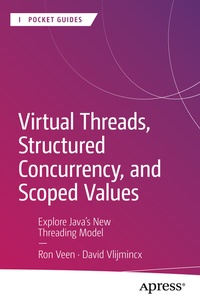
Virtual Threads, Structured Concurrency, and Scoped Values
Description

Discover the exciting new APIs introduced by Java's Project Loom. This quick guide covers all the essential concepts the Java developer needs in order to understand virtual threads, structured concurrency, and scoped values.
Authors Ron Veen and David Vlijmincx clearly explain the superiority of virtual threads, introduced in Java 21, over the traditional Java threads of the past 25 years. Then they dive into how structured concurrency streamlines interactions by treating related threads as a unified unit of work, akin to the impact of structured programming on regular programming. From there, the authors explore the third Project Loom API and scoped values, clarifying their advantages over regular ThreadLocals and providing efficient usage insights. The book concludes with an exploration of common scheduling strategies.
By the end of this book, you will have a solid understanding of the concepts behind Project Loom and will be able to immediately apply this knowledge to your own code.
You Will
- Discover what virtual threads are, why they were created, and how to use them in your code
- Gain insight into how concurrency improves the observability of code
- Write your own StructuredTaskScopes tailored to your needs
- Understand why you should replace ThreadLocals with Scoped Values
- Know the different strategies for multithreaded computer programs
Who This Book is For
Java developers of any level. This knowledge is so fundamental to staying relevant in the Java job market that every developer needs to understand it for their career development.
More details
Other editions
Additional editions
Persons
Ron Veen is an experienced software engineer who has seen it all, from mainframes to microservices. Through all of this, he is guided by his passion for software engineering and software architecture. For more than 15 years he has been working on the JVM and the Java ecosystem and has seen all the frameworks and libraries from Apache to ZK. He is an Oracle Certified Java Programmer (OCP) and Sun Certified Business Component Developer (SCBCD/OCPBCD). He is an international speaker at software conferences and has published several books on Java and Jakarta EE.
David Vlijmincx is a developer with more than eight years of experience, an Oracle Ace, an author, a blogger, and a conference speaker with a passion for Java development. He has been working in the industry since 2016 and has a deep understanding of Java and its capabilities. He is always looking for new and innovative ways to solve complex problems and strives to stay up-to-date with the latest technologies and best practices in the field. Currently, he is working as a software consultant.
Content
Chapter 1: Virtual Threads.- Chapter 2: Structured Concurrency.- Chapter 3: Scoped Values.- Chapter 4: Concurrency Patterns.
