

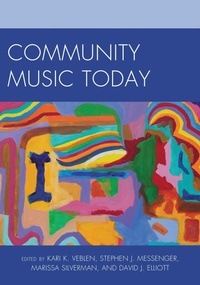
Community Music Today
1st Edition
Published on 16. January 2013
300 pages
979-8-7651-8620-6 (ISBN)
Description

Community Music Today highlights community music workers who constantly improvise and reinvent to lead through music and other expressive media. It answers the perennial question "What is community music?" through a broad, international palette of contextual shades, hues, tones, and colors. With over fifty musician/educators participating, the book explores community music in global contexts, interconnections, and marginalized communities, as well as artistry and social justice in performing ensembles.
This book is both a response to and a testimony of what music is and can do, music's place in people's lives, and the many ways it unites and marks communities. As documented in case studies, community music workers may be musicians, teachers, researchers, and activists, responding to the particular situations in which they find themselves. Their voices are the threads of the multifaceted tapestry of musical practices at play in formal, informal, nonformal, incidental, and accidental happenings of community music.
This book is both a response to and a testimony of what music is and can do, music's place in people's lives, and the many ways it unites and marks communities. As documented in case studies, community music workers may be musicians, teachers, researchers, and activists, responding to the particular situations in which they find themselves. Their voices are the threads of the multifaceted tapestry of musical practices at play in formal, informal, nonformal, incidental, and accidental happenings of community music.
More details
Edition
1. Auflage
Language
English
Place of publication
United States
Publishing group
Bloomsbury Publishing Plc
ISBN-13
979-8-7651-8620-6 (9798765186206)
Copyright in bibliographic data and cover images is held by Nielsen Book Services Limited or by the publishers or by their respective licensors: all rights reserved.
Schweitzer Classification
Other editions
Additional editions
Kari K. Veblen | Stephen J. Messenger | Marissa Silverman
Community Music Today
Book
01/2013
Rowman & Littlefield Publishers
€74.00
Shipment within 3-4 weeks
Persons
Kari K. Veblen (Canada, USA) is Assistant Dean of Research and Associate Professor of Music Education at the Don Wright Faculty of Music at University of Western Ontario, Canada. A musician and educator, Dr. Veblen studies international trends in Community Music and writes on the intersections of music, education, the arts, and society and pursues a twenty-five year fascination with transmission of traditional Irish/Celtic/diasporic musics. An international representative to the NAfME Adult and Community Special Research Interest Group, she has served on many professional boards, including the ISME board. She is associate editor of the International Journal of Community Music.
Stephen James Messenger (USA) is a public school teacher who works with a diverse student body at the secondary level (his training includes special education, the teaching of Reading, and English as a Second Language) and is a visiting instructor in English Composition at St. Mary's College of Maryland, the public honors college of the University of Maryland system, where he teaches English composition focused on the students' musical lives. An active musician, Dr. Messenger plays guitar, mandolin, octave mandolin, and bass guitar and participates in a variety of on-line musical communities. His research interests include popular culture, poetry and imagistic interdisciplinary work, Blues and American roots music, Mexican folk art, and British motorcycles.
Marissa Silverman (USA) is Assistant Professor and Coordinator of Undergraduate Music Education at the John J. Cali School of Music of Montclair State University in Montclair, New Jersey and active professional flutist in New York City. Previously she taught secondary school band, general music, and English literature in New York City. A Fulbright Scholar, her research interests include urban music education, music and social justice, interdisciplinary education, community music, secondary general music, curriculum development, and topics in the philosophy of music and music education. In addition to articles in peer-reviewed journals, Dr. Silverman has published invited book chapters in The Oxford Handbook of Music Education Philosophy, Music, Health and Wellbeing, and The Oxford Handbook of Music Education.
David J. Elliott (Canada, USA) is Professor of Music Education at New York University. Author of Music Matters: A New Philosophy of Music Education (Oxford 1995) and Praxial Music Education: Reflections, and Dialogues (Oxford: 2005), Dr. Elliott lectures and presents worldwide. He is currently Chief Editor of Action, Criticism and Theory for Music Education and serves on several other editorial boards. As an award-winning composer and arranger, Dr. Elliott has published many choral and instrumental works (Boosey and Hawkes, New York). His primary interests are music education philosophy, curriculum, creativity, composition, and community music.
Stephen James Messenger (USA) is a public school teacher who works with a diverse student body at the secondary level (his training includes special education, the teaching of Reading, and English as a Second Language) and is a visiting instructor in English Composition at St. Mary's College of Maryland, the public honors college of the University of Maryland system, where he teaches English composition focused on the students' musical lives. An active musician, Dr. Messenger plays guitar, mandolin, octave mandolin, and bass guitar and participates in a variety of on-line musical communities. His research interests include popular culture, poetry and imagistic interdisciplinary work, Blues and American roots music, Mexican folk art, and British motorcycles.
Marissa Silverman (USA) is Assistant Professor and Coordinator of Undergraduate Music Education at the John J. Cali School of Music of Montclair State University in Montclair, New Jersey and active professional flutist in New York City. Previously she taught secondary school band, general music, and English literature in New York City. A Fulbright Scholar, her research interests include urban music education, music and social justice, interdisciplinary education, community music, secondary general music, curriculum development, and topics in the philosophy of music and music education. In addition to articles in peer-reviewed journals, Dr. Silverman has published invited book chapters in The Oxford Handbook of Music Education Philosophy, Music, Health and Wellbeing, and The Oxford Handbook of Music Education.
David J. Elliott (Canada, USA) is Professor of Music Education at New York University. Author of Music Matters: A New Philosophy of Music Education (Oxford 1995) and Praxial Music Education: Reflections, and Dialogues (Oxford: 2005), Dr. Elliott lectures and presents worldwide. He is currently Chief Editor of Action, Criticism and Theory for Music Education and serves on several other editorial boards. As an award-winning composer and arranger, Dr. Elliott has published many choral and instrumental works (Boosey and Hawkes, New York). His primary interests are music education philosophy, curriculum, creativity, composition, and community music.
Content
ACKNOWLEDGEMENTS
FOREWORD
Lee Higgins
LIST OF FIGURES
Chapter 1. The Tapestry: Introducing Community Music
Kari Veblen
Section I: COMMUNITY MUSIC IN GLOBAL CONTEXT
Chapter2.North America: Historical Foundations
Jeff Bush, Andrew Krikun
Chapter3.Community Music in the United Kingdom
Kathryn Deane, Phil Mullen
Chapter 4.Community Music in the Nordic Countries: Politics,
Research, Programs, and Educational Significance
Sidsel Karlsen, Heidi Westerlund, Heidi Partti, Einar Solbu
Chapter5.Community Music in Africa: Perspectives from South Africa,
Kenya, and Eritrea
Elizabeth Oehrle, David Akombo, Elias Weldegebriel
Chapter6. Community Music in Australia and New Zealand Aotearoa
Brydie Leigh Bartleet, Shelley Brunt, Anja Tait, and Catherine Trelfall
Chapter 7. Community Music in East Asia
Chi Cheung Leung, Mari Siobara, Christine Yau
Section II:INTERCONNECTIONS
Chapter8.Intergenerational Music Learning in Community and Schools
Carol Beynon, Chris Alfano
Chapter9.Music Learning as a Lifespan Endeavor
David Myers, Chelcy Bowles, Will Dabback
Chapter10.Community Music Through Authentic Engagement:
Bridging Community, School, and University Programs
Sylvia Chong, Deborah Rohwer, Donna Emmanuel, Nathan Kruse
Rineke Smilde
Chapter11.Digital Community: Sharing, Teaching, Exploring
Stephen J. Messenger
III: MARGINALIZED MUSICS AND COMMUNITIES
Chapter12. Marginalized Communities: Reaching Those Falling
Outside Socially Accepted Norms
Sheila Woodward, Catherine Pestano
Chapter13.Person Growth through Music: The Oakdale Prison
Community Choir and Community Music for Homeless Populations
In New York City
Mary Cohen, Marissa Silverman
Chapter14.Reaching out to Participants who are Challenged
Donald De Vito, Arthur Gill
Chapter15.Diverse Communities, Inclusive Practice
Magali Kleber,Dochy Lichtenstein, Claudia Gluschankof
IV: PERFORMING ENSEMBLES: ARTISTRY, ADVOCACY AND SOCIAL JUSTICE
Chapter16.Community Choirs: Expressions of Identity through
Vocal Performance
Susan Avery, Casey Hayes, Cindy Bell
Chapter17.Instrumental Ensembles: Community Case
Studies from Brazil and the USA
Don Coffman, Joel Barbosa
Chapter18.Expressing Faith through Vocal Performance
Hussein Janmohamed, Cindy Bell, Mehnaz Thawer
Chapter19.Community Music andSustainability Worldwide:
Ecosystems of Engaged Music Making
Huip Schippers, Richard Letts
Chapter 20.Resources in Community Music
Janice Waldron, Steven Moser, Kari Veblen
About the Authors
FOREWORD
Lee Higgins
LIST OF FIGURES
Chapter 1. The Tapestry: Introducing Community Music
Kari Veblen
Section I: COMMUNITY MUSIC IN GLOBAL CONTEXT
Chapter2.North America: Historical Foundations
Jeff Bush, Andrew Krikun
Chapter3.Community Music in the United Kingdom
Kathryn Deane, Phil Mullen
Chapter 4.Community Music in the Nordic Countries: Politics,
Research, Programs, and Educational Significance
Sidsel Karlsen, Heidi Westerlund, Heidi Partti, Einar Solbu
Chapter5.Community Music in Africa: Perspectives from South Africa,
Kenya, and Eritrea
Elizabeth Oehrle, David Akombo, Elias Weldegebriel
Chapter6. Community Music in Australia and New Zealand Aotearoa
Brydie Leigh Bartleet, Shelley Brunt, Anja Tait, and Catherine Trelfall
Chapter 7. Community Music in East Asia
Chi Cheung Leung, Mari Siobara, Christine Yau
Section II:INTERCONNECTIONS
Chapter8.Intergenerational Music Learning in Community and Schools
Carol Beynon, Chris Alfano
Chapter9.Music Learning as a Lifespan Endeavor
David Myers, Chelcy Bowles, Will Dabback
Chapter10.Community Music Through Authentic Engagement:
Bridging Community, School, and University Programs
Sylvia Chong, Deborah Rohwer, Donna Emmanuel, Nathan Kruse
Rineke Smilde
Chapter11.Digital Community: Sharing, Teaching, Exploring
Stephen J. Messenger
III: MARGINALIZED MUSICS AND COMMUNITIES
Chapter12. Marginalized Communities: Reaching Those Falling
Outside Socially Accepted Norms
Sheila Woodward, Catherine Pestano
Chapter13.Person Growth through Music: The Oakdale Prison
Community Choir and Community Music for Homeless Populations
In New York City
Mary Cohen, Marissa Silverman
Chapter14.Reaching out to Participants who are Challenged
Donald De Vito, Arthur Gill
Chapter15.Diverse Communities, Inclusive Practice
Magali Kleber,Dochy Lichtenstein, Claudia Gluschankof
IV: PERFORMING ENSEMBLES: ARTISTRY, ADVOCACY AND SOCIAL JUSTICE
Chapter16.Community Choirs: Expressions of Identity through
Vocal Performance
Susan Avery, Casey Hayes, Cindy Bell
Chapter17.Instrumental Ensembles: Community Case
Studies from Brazil and the USA
Don Coffman, Joel Barbosa
Chapter18.Expressing Faith through Vocal Performance
Hussein Janmohamed, Cindy Bell, Mehnaz Thawer
Chapter19.Community Music andSustainability Worldwide:
Ecosystems of Engaged Music Making
Huip Schippers, Richard Letts
Chapter 20.Resources in Community Music
Janice Waldron, Steven Moser, Kari Veblen
About the Authors
