

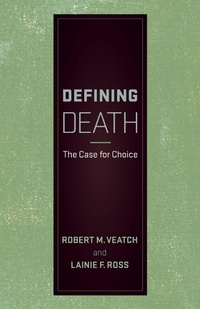
Defining Death
Description

New technologies and medical treatments have complicated questions such as how to determine the moment when someone has died. The result is a failure to establish consensus on the definition of death and the criteria by which the moment of death is determined. This creates confusion and disagreement not only among medical, legal, and insurance professionals but also within families faced with difficult decisions concerning their loved ones.
Distinguished bioethicists Robert M. Veatch and Lainie F. Ross argue that the definition of death is not a scientific question but a social one rooted in religious, philosophical, and social beliefs. Drawing on history and recent court cases, the authors detail three potential definitions of death - the whole-brain concept; the circulatory, or somatic, concept; and the higher-brain concept. Because no one definition of death commands majority support, it creates a major public policy problem. The authors cede that society needs a default definition to proceed in certain cases, like those involving organ transplantation. But they also argue the decision-making process must give individuals the space to choose among plausible definitions of death according to personal beliefs.
Taken in part from the authors' latest edition of their groundbreaking work on transplantation ethics, Defining Death is an indispensable guide for professionals in medicine, law, insurance, public policy, theology, and philosophy as well as lay people trying to decide when they want to be treated as dead.
More details
Other editions
Additional editions
Persons
Robert M. Veatch, PhD, is professor of medical ethics emeritus at the Kennedy Institute of Ethics, Georgetown University. He has received the Lifetime Achievement Award from the American Society of Bioethics and the Humanities. The author of fifty books, he is coauthor of Transplantation Ethics, Second Edition, with Lainie F. Ross. He serves on the United Network for Organ Sharing Ethics Committee and the Board of Directors of the Washington Regional Transplant Community.
Lainie F. Ross, MD, is the Carolyn and Matthew Bucksbaum Professor of Clinical Medical Ethics at the University of Chicago. She is the author of Children, Families and Health Care Decision-Making, Children in Medical Research: Access versus Protection, and coauthor of Transplantation Ethics, Second Edition, with Robert M. Veatch. She has served on the United Network for Organ Sharing Ethics Committee.
Content
1. Defining Death: An Introduction
The Emergence of the Controversy
Three Groups of Definitions
The Emergence of a Uniform Brain-Oriented Definition
Irreversible vs. Permanent Loss of Function
Defining Death and Transplanting Organs
The Structure of the Book
2. The Dead Donor Rule and the Concept of Death
The Dead Donor Rule
Candidates for a Concept of ?Death?
The Public Policy Question
3. The Whole-Brain Concept of Death
The Case for the Whole-Brain Concept
Criteria for the Destruction of All Brain Functions
Problems with the Whole-Brain Definition
Alternatives to the Whole-Brain Definition
4. The Circulatory, or Somatic, Concept of Death
Two Measurements of Death
Circulatory Death and Organ Procurement
The DCD Protocols
Shewmon's Somatic Concept
The Two Definitions of the US President's Council on Bioethics
5. The Higher-Brain Concept of Death
Which Brain Functions Are Critical?
Altered States of Consciousness: A Continuum
Measuring the Loss of Higher-Brain Function
Ancillary Tests
The Legal Status of Death
6. The Conscience Clause: How Much Individual Choice Can Our Society Tolerate in Defining Death?
The Present State of the Law
Concepts, Criteria, and the Role of Value Pluralism
Explicit Patient Choice, Substituted Judgment, and Best Interest
Limits on the Range of Discretion
The Problem of Order: Objections to a Conscience Clause
Implementation of a Conscience Clause
Conclusion
7. Crafting a New Definition-of-Death Law
Incorporating the Higher-Brain-Function Notion
The Conscience Clause
Clarification of the Concept of ?Irreversibility?
A Proposed New Definition of Death for Public Policy Purposes
Conclusion
